In Cork this week, the former Ireland rugby forward Donncha O’Callaghan found a few words to send Kevin Sinfield’s MND challenge team off into a cold dark morning. He said: “Stand up and fight, as they say in this neck of the woods.”
Through rugby union and Gaelic football and on to hurling, Sinfield’s sixth ultra-marathon challenge broke more fresh ground after visits in previous winters to Dublin and Belfast. At each stop the message was to fight. “The thing is with MND – it’s underfunded,” Sinfield said. All across sport, intrepid fundraisers have embarked on body-breaking missions to narrow the gap between what’s needed and what’s available.
The journeys are painful and intense, but inspiring, as you pass through club after club, and see how sport not only comes together to confront tragedy but holds communities together, every day, when there are no cameras around, and no games for people to lose themselves in. In society, they are bastions against isolation and division.
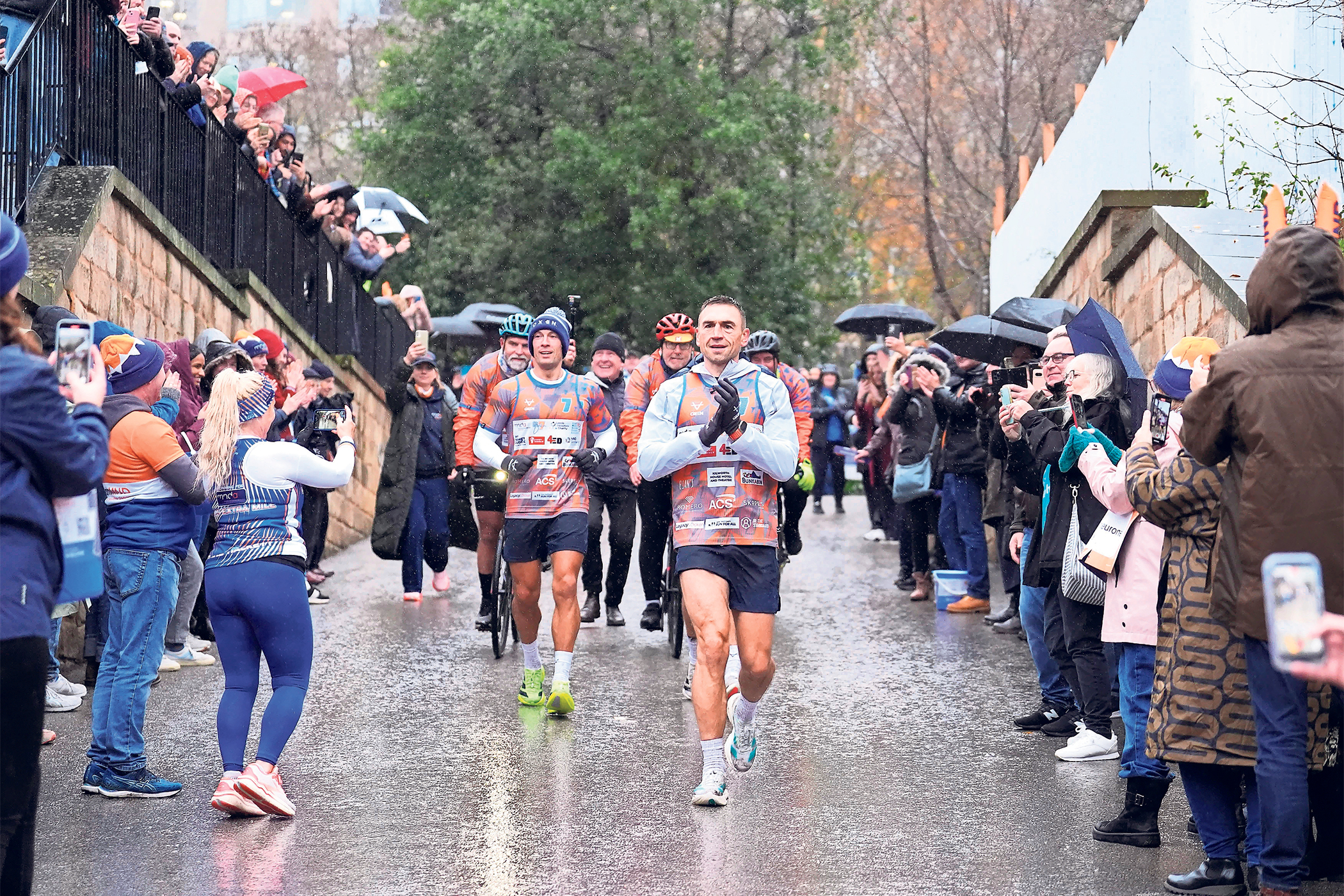
It started as Sinfield’s December ultra-runs usually do, in gusts and slicing rain, from the Suffolk market town of Bury St Edmunds to Ipswich Town’s Portman Road 42km (26 miles) away. From there over seven days it shifted over the Irish sea, then to Swansea, up to Sheffield, across to Workington and Whitehaven, over the Scottish border to Carnoustie and Dundee, then back south towards Headingley, where Sinfield played rugby league with the late Rob Burrow, who died last year with MND.
More than £10m was raised by these trials of mind and body in the previous five expeditions. The growing total, monitored on smartphone screens, through a fog of sleep deprivation, keeps the team running.
The pain
An ultra-marathon is anything more than 42km and can be broken up with stops. Sinfield runs with two non ex-sportsmen, Chris Stephenson and David Spencer, and is supported on the roads by three cyclists and close mates: Darrel Rogers, Martin Wolstencroft and Phil Allingan.
The first thing to start hurting, Spencer and Stephenson say, is “the quads, then the calves, then the toes”. This year, Stephenson had to have a toenail taped back on on the first day. The mind can be an enemy. The brain’s self-sabotage is to say “stop” when the body is still capable of pressing down on “go”.
Families shouldn’t have to go through this. It can’t happen. It has to stop
Families shouldn’t have to go through this. It can’t happen. It has to stop
Kevin Sinfield
In self-protective mode, joints and muscles respond to pain in individual areas by transferring the burden to other parts, which can cause secondary problems – for example in the heels.
Last year Sinfield ran all seven ultras with a leg injury. His physio Dave O’Sullivan says of him: “I’ve always said the strongest muscle in Kev’s body is his brain.”
Newsletters
Choose the newsletters you want to receive
View more
For information about how The Observer protects your data, read our Privacy Policy
The gain
A benefit of the MND community pouring on to the streets to support charity challenges is that many with the disease no longer feel the urge to go home and close the doors. Some even spoke of “shame” at having such a debilitating illness.
But as ever it’s money that makes the biggest difference. The Doddie Weir Foundation has raised and funnelled £19.5m into research and Sinfield will have generated £11m-plus after his sixth challenge.
At the research centre SITraN at Sheffield University, Professor Dame Pamela Shaw updated guests on the UK MND Research Institute, biomarkers and genetic tracing. There is progress, but there is still no cure. Anger about the underfunding is mounting.
The MND Community
Every encounter along the roads with someone with MND, or a bereaved family member, is intensely emotional. Sometimes Sinfield and his fellow runners run on from them in tears. There’s a world of personal stories within the world of fatal neurological disease.
On Wednesday at a rugby club near Swansea they met the family of Kyle Sieniawski, who died aged 14, less than a week ago, a year after he was diagnosed with MND. In childhood MND is extremely rare. His mother Melanie told BBC Breakfast she had spent the days since his death watching videos of her late son. Kyle’s brother Liam explained how he had suspended his college attendance to stay by his brother’s side in hospital.
The following day at the start outside Sheffield United’s Bramall Lane ground, Sinfield welled up during a live BBC Breakfast broadcast and couldn’t talk for 10 seconds. He recalled his meeting with Sieniawski’s family and said, falteringly: “The family shouldn’t have to go through that. It can’t happen. It has to stop.”
At every halt someone with MND, or somebody associated with it, bangs a drum seven times – seven being Rob Burrow’s shirt number.
At Bury St Edmunds Rugby Club, we met James Shephard-Trott, who has the disease, and has climbed Snowdon three times since being diagnosed, raising £25,000.
Everybody’s important, everybody’s loved, everybody’s cared for
Everybody’s important, everybody’s loved, everybody’s cared for
Kevin Sinfield
Waiting at the Shepherd and Dog in Onehouse was Nick Apperley, who needs sticks to walk, but gets around on an adapted trike with a Doddie Weir tartan flag on an aerial. Apperley has raised £50,000 for MND, mainly by pedalling from Suffolk to Sennen in Cornwall. An hour or so later he’s there again with his trike at Ipswich School after riding the 26 miles from Onehouse.
At another village, Ed Yeldham goes to bang the drum for his late wife, who died of MND, then guides his young daughter’s hand to the drumstick so they can strike it together.
At St Mary’s Church, Rougham, a community choir gathers to serenade the runners through the gates. A conversation starts up about the growth in the UK of choirs as cures for loneliness, and as a source of joy. “You turn up grumpy, but go home beaming,” says one singer.
A corollary of following extreme running challenges is that you pass through places you wouldn’t ever visit. Many that you will never have heard of: villages, towns and urban landscapes, where you see kindness, and the need for human connection, flow out of homes, on to pavements and into gathering places, bestowing hope and togetherness on those who come to encourage, and donate to, the campaign passing through their streets.
The names
The eyes of Marcus Stewart glistened with tears as Ipswich fans who had come to greet Sinfield also roared their support for a Portman Road legend. Stewart’s spirit is intact, but MND has caused a weakening of his arms and hands. He scored 27 times in 75 appearances for Ipswich. To step before the crowd in diminished physical condition is daunting but also sustaining. His wife Louise is always at his side.
In Sheffield, the campaigners were joined on a run to Sheffield Rugby Club, high in the hills, by Jess Ennis-Hill, the 2012 London Olympic heptathlon champion. Before they left Bramall Lane, Tony Currie, the former Sheffield United and England star, remembered Don Revie, the England manager who died with MND. Currie said: “We’ve got to get rid of it.”
In sport alone, rugby players Lewis Moody, Burrow, Weir and Ed Slater have all been afflicted. In football, Stephen Darby and Stewart are among the most high-profile cases. This year the former England fast bowler, David “Syd” Lawrence, died with MND.
In a recent interview with The Observer, Sinfield said his mission was to make sure “everybody’s important, everybody’s loved, everybody’s cared for”. He repeated that message on every stop of his latest challenge.
In York on a previous run, someone shouted “Kev for PM” from the crowd. He shows no inclination to go into politics but politicians could learn from how concise and authentic he is in front of audiences. His messaging taps into universal themes about people “looking after each other” and sticking together.
The extreme challenges culture
On the fifth run, from Workington to Whitehaven in Cumbria, Sinfield was joined by Gary McKee, who in 2022 ran a marathon every day for 365 days. McKee, who works at the Sellafield nuclear plant, has planned 100 marathons in 100 days in 2026 to reach £1m in funds for Macmillan Cancer Support and Hospice at Home in Cumbria.
Recently the DJ Sara Cox ran 135 miles over five days and raised £10.2m for BBC Children in Need. In 2023, Kenny Logan walked and cycled 700 miles from Murrayfield to Paris. It’s not only the famous who are taking on extreme challenges. Across society, people have increasingly searched for meaning and release by pushing themselves to the limit for charitable causes. At the English Institute for Sport in Sheffield, visitors may have noticed a plaque quoting Ennis-Hill, who ran a brutally uphill leg with Sinfield: “The only one who can tell you that ‘you can’t win’ is you – and you don’t have to listen.”
The why...
Public spending doesn’t cover all the urgent needs of care and cure, for reasons of policy, preference or plain neglect. Which leaves fundraising as the only alternative to paralysis. To those who run, walk, cycle and swim in extreme challenges, the end-result takes precedence over the politics: getting money to doctors, nurses, and researchers, and into laboratories and drug programmes. When the cure starts, the running can stop.
Photograph by Danny Lawson/PA