

This article is part of the Rory Smith on Football newsletter – a guide to help understand what is happening on the pitch, off the pitch, and why all of it matters.
Throughout the tournament, Rory will be travelling across America, delivering daily commentary on the biggest World Cup ever direct to subscribers. Never miss a newsletter, subscribe now here.
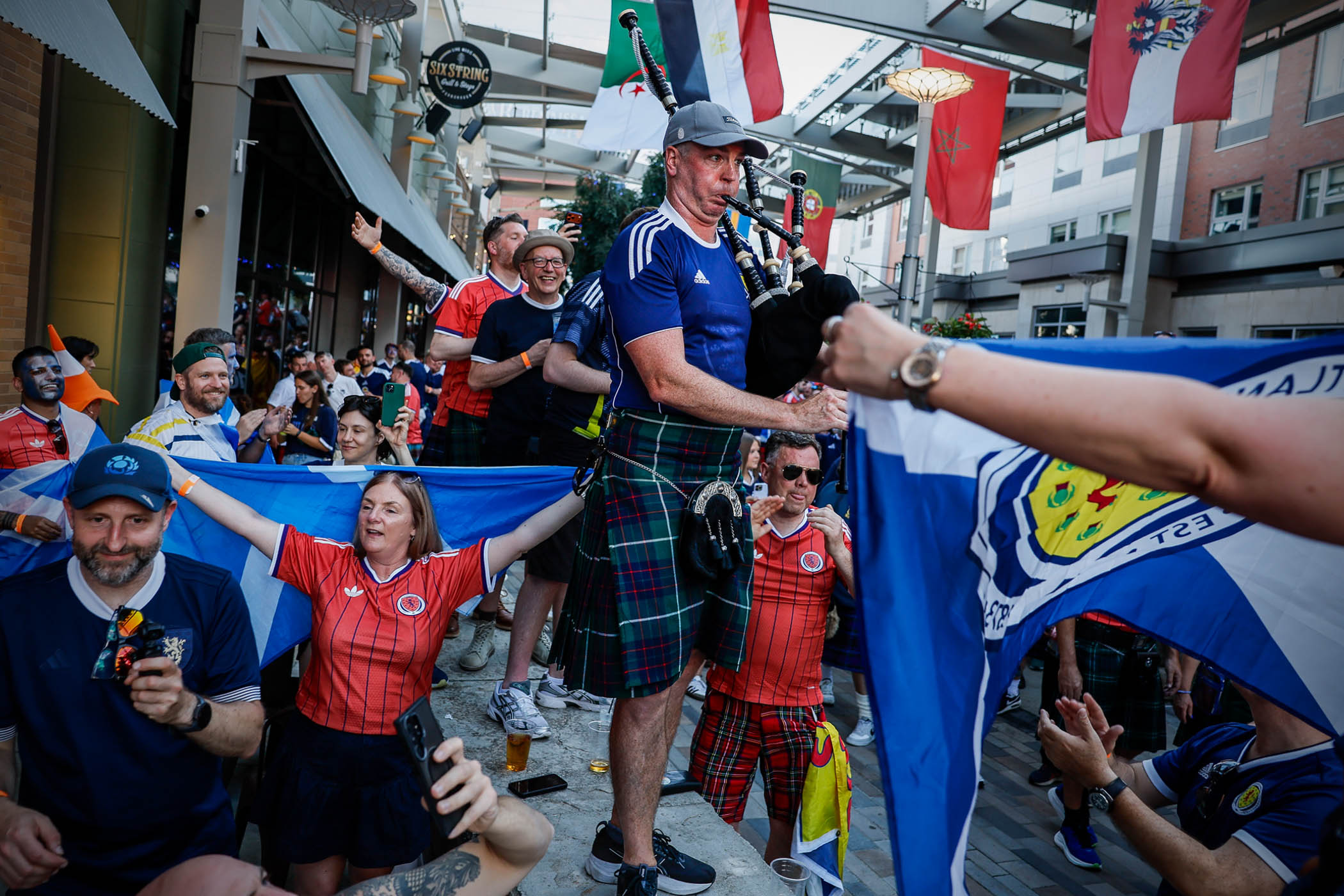
Presumably, at some point, the residents of Boston will grow tired of the sound of bagpipes. Perhaps, in time, they will come to regard them as the rest of us do the vuvuzelas that droned throughout the 2010 World Cup. But as things stand, a week into the Scottish invasion of New England, there is no reason to believe it will happen any time soon.
By now, anyone with even the slightest digital footprint will be well aware of the blossoming romance between the Tartan Army and the flummoxed, delighted residents of Beantown. They are singing about John McGinn at Fenway Park. Roving bands of pipers are walking through Back Bay. Saltires and Lions Rampant have been draped over every available surface. Paul Revere has a traffic cone on his head.
They are by no means the only set of fans to have won hearts and minds across North America in the first week (almost) of this World Cup. The Oranjebus – the old-school double-decker which leads Dutch supporters on their way to games – was shipped to Galveston, Texas, at no small expense, so they could do Links, Rechts – their unmistakable pre-match dance – in Dallas.
Times Square has been filled by Brazilians and Argentinians and Moroccans at various times in the last few days; Mexico and South Korea being drawn in the same group seems to have triggered a lasting friendship. Philadelphia was awash with Ecuadorians. Cape Verde and Curaçao and Australia have all had their moments.
There is a very good chance, then, that it is simply the self-learning effect of the Instagram algorithm that makes it seem that nobody has made quite the impression that the Scots have on Boston. (“Yes please, Meta, I would like to watch Flower of Scotland echoing around the Gillette Stadium again, but this time from an ever-so-slightly different angle.)
Or perhaps there is something deeper here. This World Cup was advertised as a couple of things, correctly or not. It was a chance for the planet to discover North America in general, and the United States in particular. And it was a chance for the United States – or that part of it rich enough to afford tickets, which is all Fifa seemed to care about – to discover football.
The most uplifting aspect so far, though, has been something else. It has provided an opportunity for the US to witness the very best aspects of football’s fan culture: the spirit, the passion, the humour, the inventiveness, the esprit de corps, the joy, the willingness of very large, very drunken men to sing a range of disco hits in public.
This is not, in my experience, what watching professional sports in the United States tends to be like. There is atmosphere, of course, but it is neither quite as raucous or as rhythmic. American chants are, if we’re being diplomatic, quite simple. They are also disappointingly PG. The tradition of repurposing the hooks of pop songs is not so widespread, nor as deep-rooted.
Newsletters
Choose the newsletters you want to receive
View more
For information about how The Observer protects your data, read our Privacy Policy
And, if we are being honest, this is not what watching quite a lot of professional football is like in Europe, either. There is a carnival element to the World Cup. Some fans presumably travel in the hope, or even the expectation, of watching the game’s ultimate victory. But the vast majority do so for the much more realistic purpose of having a nice time, of performing their national identity for the world to see.
This is in contrast to club football, which increasingly does not appear to make people happy. Even victory only brings with it only fleeting relief from the fury and the dread which seems to occupy most fans’ thoughts. In the early stages of the World Cup, on the other hand, as naive as it sounds, there is a genuine pleasure in taking part.
Scotland’s fans have expressed that as well as anyone; so well, in fact, that Boston now appears to be dreading the prospect that they might leave. There have been posts asking that the city be twinned with Glasgow, or that Massachusetts be renamed West Scotland, or that Boston’s transit system be expanded eastward so that it terminates at Waverley.
It would be nice to think that there will be some sort of lasting legacy to this brief encounter, even if it is a little less ambitious; in years to come, perhaps Red Sox fans will be letting off pyro during the seventh-inning stretch, or using the chorus to Achy Breaky Heart to pay homage to a particularly beloved relief pitcher.
All of these encounters, though, have a much more immediate impact. The cravenness of Fifa and the aggressive posturing of the Trump administration meant that this World Cup started under a cloud, as it so often does. There is a bubbling sense that a beloved event is in some way being corrupted, undermined, diluted. What Scotland have done is prove, once again, that it will be saved by those parts that Gianni Infantino cannot touch.
Photograph by Erin Clark/The Boston Globe via Getty Images