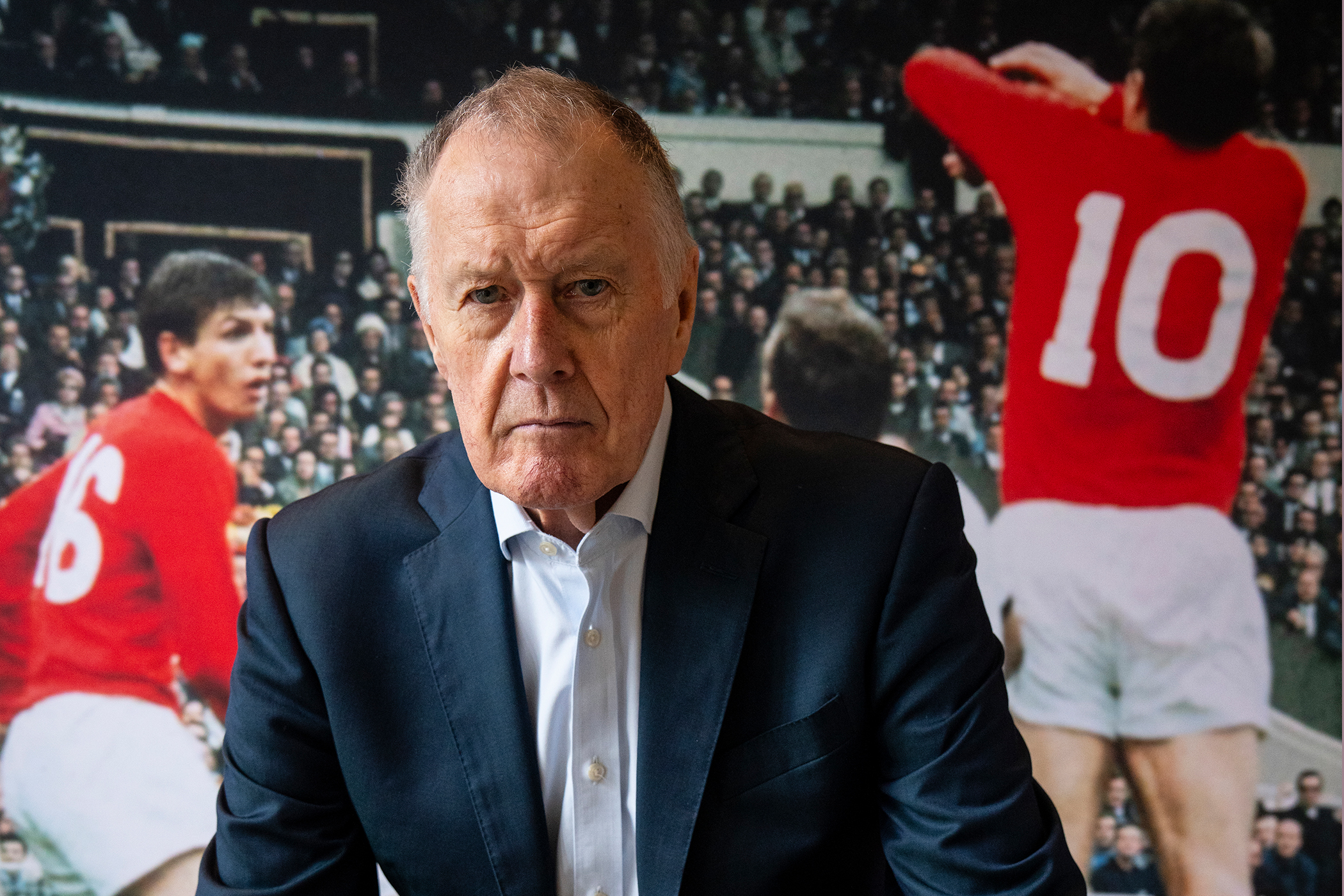
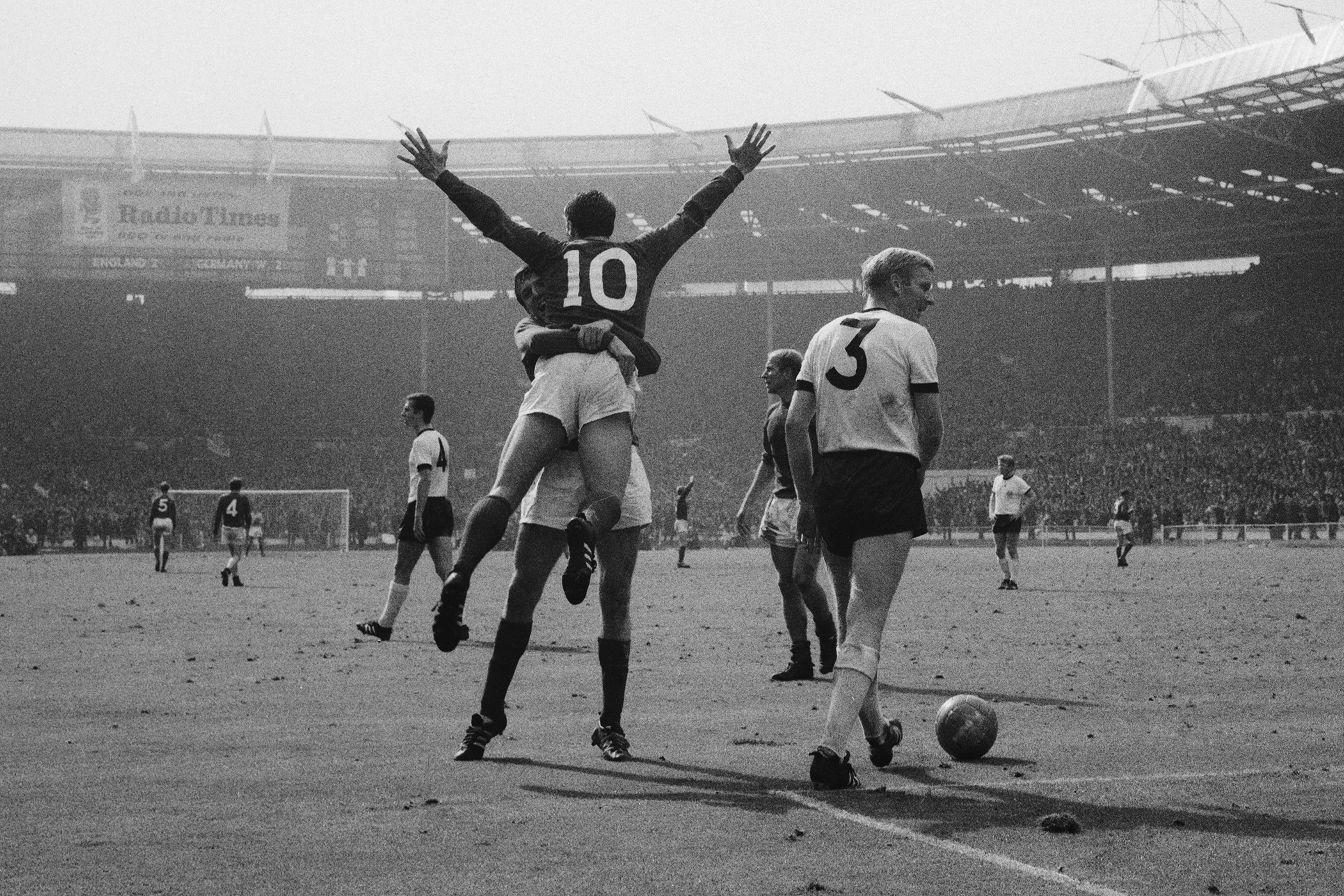
Perhaps the greatest living English sportsperson sits alone in yet another anonymous function room and stares into the middle distance, fleetingly switched off but suited as always. He turned 84 in December, but steadies himself ahead of three hours of the same questions and same anecdotes, of being Sir Geoff Hurst, England’s last living 1966 World Cup winner, grinning shrine to its greatest success and ceaseless failure since.
We meet in Kensington’s Royal Garden Hotel, where just under 60 years ago he ate breakfast with his wife, reading newspapers that wrote his legend. A picture from that morning hangs in their living room, as the press photographed them skipping through Hyde Park.
He’s here helping drum up interest in an auction selling, among other things, Pelé and Gordon Banks’s World Cup winners’ medals and Alan Ball’s shirt from the final. He doesn’t quite understand why people are willing to pay so much for what are, to him, mementoes of lost friends, of a lost world.
Martin Peters’s spare shirt from the ’66 final is worthless without his best mate wearing it. “It brings me great sadness when I look, as I do every day, at things like this,” he explains, sketching the odd melancholy of his everyday existence.
He’s flogging his personalised numberplate – 66 GH, of course – and a painting of his second goal “by a famous artist”, but most of it is long gone. In 2001 he asked his three daughters which of his possessions they would want to inherit, to which his eldest replied: “I like the settee in the living room.” Within months, his shirt fetched £91,750 at auction and his medal sold to West Ham’s museum for £150,000. You could conservatively triple those numbers if he still owned them, but he would rather have helped his children and grandchildren earlier in life.
There’s an odd incongruity between an achievement so all-consuming it is eternal, and the fact that nothing has changed about it since LBJ was president. Yet Hurst is the last guardian of those memories, a privilege he refuses to disregard having watched five England teammates die with dementia, including Peters, his closest friend. He has spent decades as a living monument to his greatest day, a pioneer of the professional ex-footballer movement, and yet there is still seemingly ravenous demand to hear about it.
His Last Man Standing Farewell Tour has been frequenting regional theatres for two years and shows no sign of actually saying goodbye. He has done 15 shows in the first half of 2026 with four more to come.
“It’s important you talk about it, but you’re also in the hands of other people’s memories,” he says. “One of the best parts of it is that you meet people that were either at the game or remember where they were and what they were doing.” He seems shockingly balanced for someone who talks about himself every day.
Yet coaxing him into saying something he’s never said before is almost impossible, stories so smooth and well-told they have almost ossified into cliché, pauses and punchlines perfectly timed.
Most people barely seem to bother – you hear “Geoff, how did it feel to score in a World Cup final?” (“Well it wasn’t just one…”) “How do you rate England’s chances this summer, Geoff?” (A pre-semi-final exit would be “bitterly disappointing”.) “Geoff, how do you feel about sparkling water?” (Pro, apparently.)
Newsletters
Choose the newsletters you want to receive
View more
For information about how The Observer protects your data, read our Privacy Policy
He starts one I think I haven’t heard before, but find retold almost verbatim in 2011 and 2021. There’s mowing the lawn the day after winning the World Cup; running the Sheet Anchor pub near Stoke-on-Trent; selling insurance for Abbey Life. There’s the two years managing Chelsea, another two at Kuwait SC; working as a pundit for £60 a match; working the day his younger brother, Robert, died by suicide.
To be an elite footballer in 2026 is to exist in a fantastical unreality, knowing that playing for five years effectively secures your financial future. Hurst spent 30 years post-retirement living an ostensibly average life, trapped between fame and misfortune, all the recognition with none of the benefit. So he talks a lot about discipline and modesty, about not feeling like a celebrity.
Before the 2006 World Cup, Gary Neville wrote that “even coming into this tournament the players from ’66 are being wheeled out, doing commercial deals. And they’ll still be doing those adverts in 40 years’ time unless we do something about it.” Having blessed Budweiser’s produce before Euro 2024, Hurst has just collaborated with Greene King to brew “60 Years of Hurst”. He’s had a school and a racehorse named for him, and was GQ’s Legend of the Year 2017. On Friday he helped launch the Sir Geoff Hurst Cuvée 66.
The Arsenal Premier League winners’ parade made him think about the lack of fanfare to his own achievement, having to organise his own celebrations with Ball and Nobby Stiles at Danny La Rue’s nightclub. “The celebration for the three West Ham players was at the first game of next season, when we played Chelsea at home,” he says. “Martin, Bobby [Moore] and I went round the pitch and then lost 2-1.”
He calls suspicions that Gordon Banks was poisoned by the CIA in 1970 “rubbish”, but has concerns: the goalkeeper’s stomach problem was “unusual when you consider that discipline was so strict and no drinking, nothing for five or six weeks, that only one player had a health issue, one of our key members”.
As our time ends, I mention that I’m a year older than he was when he lifted the World Cup and Sir Geoff softens, becomes Geoff, grandfather of five and husband of 61 years. He offers some advice: “Be very disciplined, work hard, be sensible in your leisure activities, no drugs, don’t get boozed too much. Good behaviour with your family. Your family, your relations are the most important aspect of your life.”
And then he turns on again, ready to answer the same questions, tell the same anecdotes, to be Sir Geoff Hurst once more.
Portrait by Antonio Olmos / The Observer