
The one thing everyone knows about tiki taka, or at least the thing that everyone knew, for a while, back when it felt like nothing we had ever seen before, a vision of a bold and unstoppable future, was that it was the insult that conquered the world.
Javier Clemente, the Spanish translation for the English term “Neil Warnock,” had coined the phrase with a curled lip and a withering sneer in response to an essay in the newspaper El País. An unrepentant man of the long ball, he warned that no good would come of all this fussiness, all this flummery, all this tiki taka. It was too sterile, too delicate, too bloodless.
He was, of course, quite wrong. Between 2008 and 2012, Spain produced what may well have been the greatest international side of all time: an offshoot of Pep Guardiola’s Barcelona that won, in the space of four years, two European Championships and the country’s maiden World Cup.
More than that, though, Andrés Iniesta and Xavi Hernández and all the rest seemed to redefine football’s concept of beauty as they did so. Though Guardiola, aware of its origins, always rejected the description, tiki taka morphed into a compliment, uttered admiringly and breathlessly as Spain entranced another team with what Sir Alex Ferguson called their “passing carousel.”
Technically perfect, philosophically pure, tiki taka came to be the game’s idea of its own highest form. The fact that Clemente, as old-school a figure as might be imagined, had initially deployed it so dismissively was not just a curious back story, a world-class hmm actually, but something more; it served to underline how comprehensively the new had defeated the old.
History, as has been pointed out, is an unending dialogue between the past and the present. And, a decade and a half on from its zenith, the present would appear to feel that maybe everyone was a touch too quick to denigrate Clemente. Watching Spain at this World Cup, certainly, it is hard not to feel that he might at least have had a bit of a point.
It is not, to be clear, that Spain are a poor team. They are not. Until Charles De Ketelaere scored for Belgium in their quarter-final in Los Angeles on Friday, the European champions had not conceded a goal all tournament; Unai Simón, the goalkeeper, now holds the record for the longest unbeaten streak in a World Cup finals.
More than that, they had barely conceded a shot. After a staccato, impotent display against Cape Verde in their opening group game, perhaps partly explained by ring rust, they breezed past Saudi Arabia and Uruguay, hardly breaking a sweat. They swatted aside Austria with ease, before picking their way past the rather sturdier challenges of Portugal and Belgium.
Throughout, Spain have looked more coherent than any other side at this World Cup, with the possible exception of their semi-final opponents, France. Luis de la Fuente’s team have a distinct vision of how they want to play, of what they want to do, of how they intend to win. Their late victories against Portugal and Belgium is testament not just to their patience, but to their belief.
It is an article of faith in Spanish football that this game model, this way of playing, rooted in the same principles that marked its great tiki taka forebear, is superior to all of the others. Spain do not play this way out of some moral duty. It is not a pose. It is because they feel it is the best way to win, a dogma that has been drilled into these players since they were children.
Newsletters
Choose the newsletters you want to receive
View more
For information about how The Observer protects your data, read our Privacy Policy
The problem is that it is, increasingly, difficult to watch. That Spain have avoided the wild emotional swings experienced by Argentina and England en route to the semifinals is a good thing; that they have failed to provide anything at all that might quicken the pulse or draw the breath is very much not. This is the tiki taka that Clemente warned us about: rote, robotic, neither thrilling nor, crucially, desperately effective.
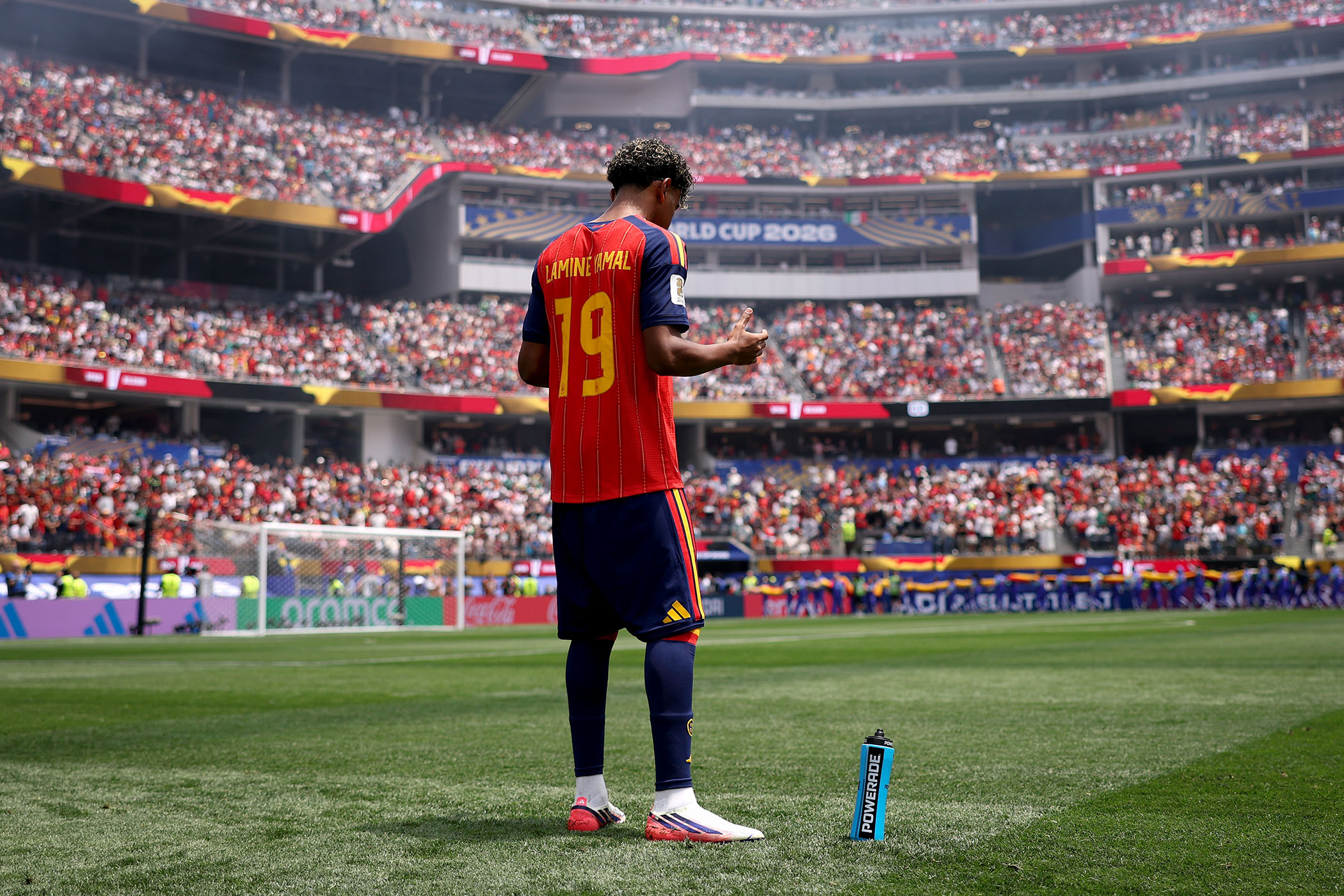
De la Fuente would, doubtless, point to his mitigating circumstances. Two years ago, as he guided Spain to the European Championship, his team was garlanded with the virtuosity of Lamine Yamal on one wing and the thrust of Nico Williams on the other. Their presence elevated Spain; they offered an incision that infused all of the passing with purpose.
Neither has yet had much of an impact on the World Cup. Williams missed huge swaths of last season with pubalgia, before his campaign was curtailed by a hamstring issue. He was still working his way back to fitness when the tournament started; he then missed another two games after being caught recklessly by the Uruguay winger Nicolás De La Cruz late in their group game. It was, the 24-year-old said, one of “the worst days” of his life.
Yamal has played far more, but his performances have done little to suggest he is fully clear of the hamstring tear that prematurely ended his season with Barcelona. It has hardly helped that he has been so tightly marked every time he has taken to the field. That is the kinder interpretation; the more worrying is that Yamal – who turned 19 today – has effectively been run into the ground over the last three years by both club and country, and the bill is now due.
Perhaps that is all it is. Perhaps if Yamal and Williams were at their best then Spain would be no less compelling than France. But then the promise of tiki taka was always that it was repeatable, scalable, that it ran sufficiently deep and worked sufficiently well that it did not rest on one or two outstandingly talented individuals.
Instead, maybe this is what happens with all revolutions: ideas that are designed to liberate slowly curdled by an obsession with control, by how things should be done, poisoned by their certainty in their own superiority. Maybe tiki taka, in this and possibly only sense, is not too different from certain other collectivist philosophies, their idealistic principles lost, somewhere along the way, in the blind fog of zealotry.
Photograph by Alex Pantling/Fifa via Getty Images