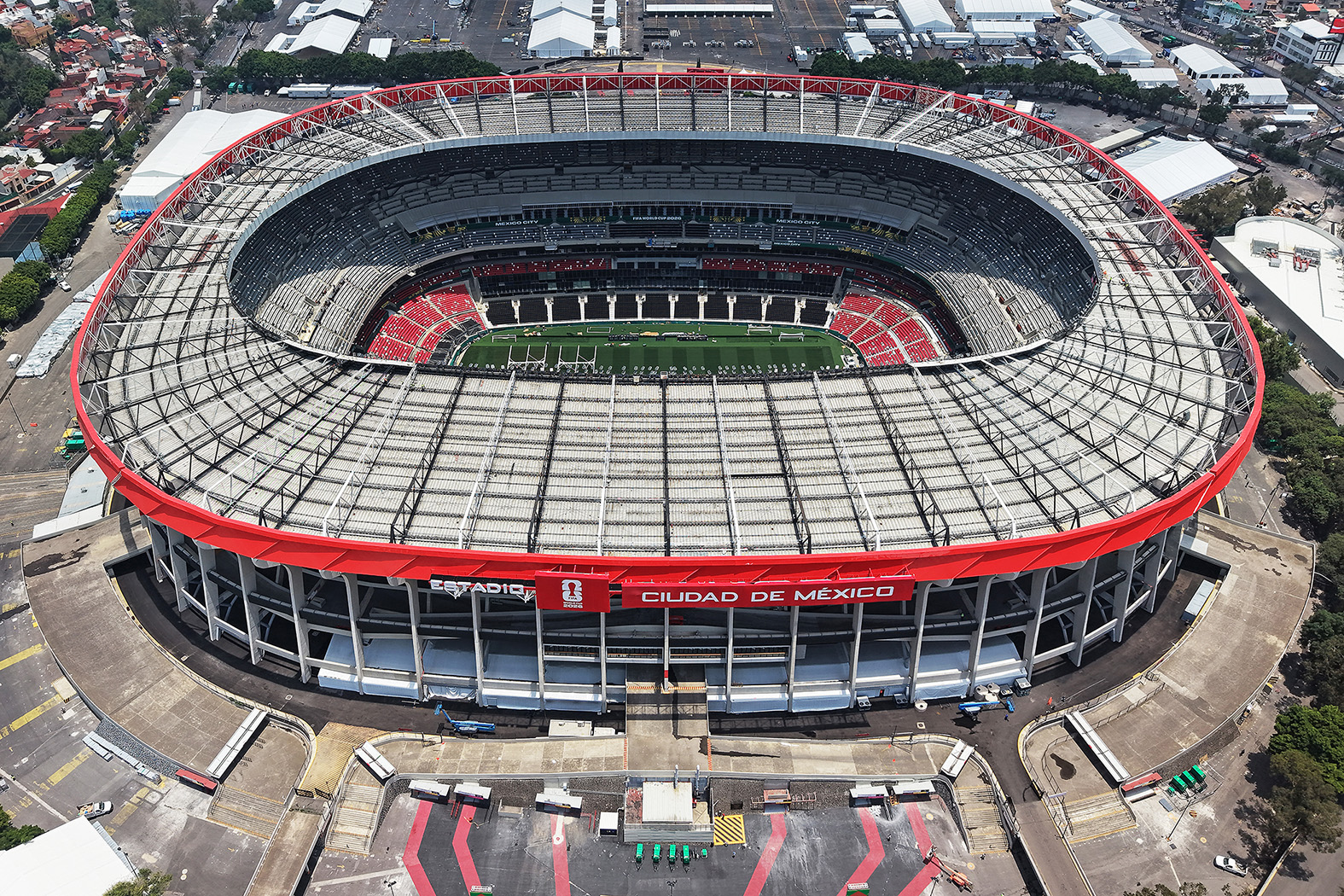



Fifa did not waste any time. On 14 May, the game’s governing body took official control of the stadium that will host the opening game of the 2026 World Cup. The following day, a towering pair of cranes were already hard at work, draping a vast red banner over the lip of its roof. From that moment on, it was no longer Estadio Banorte. It is now Estadio Ciudad de México.
Rendered into English as Mexico City Stadium, that is the name included in all of Fifa’s literature around the World Cup. It is how it will be referred to on television. It might be bland, but the World Cup’s broadcasters are under strict instructions that their legions of commentators covering the five games in the Mexican capital should use the preferred nomenclature. Others will follow suit.
But it is not, of course, what everyone else will call it. As far as the general public is concerned, Mexico will kick off the tournament against South Africa today at what is probably the most iconic of all World Cup venues: the Azteca.
The story behind that discrepancy is largely administrative, but it is also instructive: a potent example of how little understanding Fifa has for the combination of memory, history and shared myth that makes the tournament that serves as its crown jewel so special.
In 2020, the stadium’s owners – Ollamani, formerly a part of the Televisa media empire – accepted a $105 million loan from Banorte, one of Mexico’s largest banks, to help pay for the remodelling work necessary to make the stadium ready for its third World Cup. “We will modernise this emblematic stadium while respecting its essence,” Ollamani’s owner, Emilio Azcárraga Jean, said at the time.
The renovations, only completed in March, have been extensive: the façade has been restored and high-resolution screens installed; the changing rooms have been modernised and a tunnel leading to the pitch created. Populous, the architects behind the Tottenham Hotspur Stadium, designed a new dugout area, shaded by a canopy “inspired by the original tessellation on the Telstar and Azteca balls used during the 1970 and 1986 finals in Mexico.”
In exchange for funding no small portion of that work, Banorte were granted naming rights. The two Mexican sides who call the stadium home, Club Ámerica and Cruz Azul, no longer play at the Azteca but Estadio Banorte. (More florid local commentators might be inclined to use its longstanding nickname: El Coliseo de Santa Úrsula, which probably does not need translating.)
Banorte, presumably, understood that would change for the World Cup. Fifa’s regulations dictate that all of its stadiums are “clean zones,” meaning they are free of any and all branding that does not represent the organisation’s own sponsors.
That applies to naming rights deals as much as advertising hoardings: all but one of the 16 stadiums hosting games over the next two months has undergone a sudden, and temporary, name change.
As in Mexico City, where Banorte’s logo now sits beneath a swatch of fabric bearing the phrase “Ciudad de México,” that has often involved concealing the iconography of the primary sponsor. The only exception is in Atlanta, where a giant Mercedes-Benz badge has remained in place after it was determined that removing it might cause structural damage.
Newsletters
Choose the newsletters you want to receive
View more
For information about how The Observer protects your data, read our Privacy Policy
The stadiums’ new identities are not exactly a triumph of imagination. MetLife, which will host the final, is now the New York/New Jersey Stadium, SoFi has become the Los Angeles Stadium, Lumen Field is Seattle Stadium, and so on. Again, there is an exception: games will still be played at BC Place in Vancouver.
This generic approach might give the whole thing the vague air of an unofficial computer game – featuring such teams as Central America Green and Scandinavia Yellow – but, according to Fifa’s executives, it has the benefit of “consistency.” It is also, to most fans outside North America, largely harmless; none of the stadiums in the United States or Canada have previously featured at a men’s World Cup.
The iconic name has been replaced with something so plain, so corporate, so flat as to be almost meaningless
The iconic name has been replaced with something so plain, so corporate, so flat as to be almost meaningless
That is not true, of course, in Mexico City. The stadium there occupies a unique place in World Cup lore: it is the only ground to have hosted two opening games and technically the only one to have hosted two finals. (The Maracanã held the decisive game in 1950 and 2014, but because of the format of the tournament in the earlier edition, there was not actually a final.)
The Azteca also provided the backdrop for what may well be the three most famous goals the tournament has produced – Carlos Alberto’s crowning glory for Brazil in 1970, Diego Maradona’s semi-literal one-two punch against England in 1986 – as well as staging one of several games now referred to as the Match of the Century: the 1970 semi-final between Italy and West Germany.
In many ways, the fact that Fifa seems to have deemed Azteca a brand in its own right, convincing it to bulldoze that rich, evocative history in favour of a name as vapid and soulless as “Mexico City Stadium” is the least of the organisation’s troubles.
The build-up to the tournament has, after all, been dominated by much more serious scandals, from the degrading security search of Senegal’s players when they arrived in the United States to a host of players, staff, officials, fans and even a referee being refused visas for reasons that are, at best, oblique.
Even in Mexico, Fifa has more pressing concerns. There has been a long-running dispute with the owners of the luxury boxes in Mexico City Stadium – see, its very usage is ugly – over whether their leases applied during the World Cup. Roberto Ruano, a lawyer acting on the box-holders’ behalf, said that at one point Fifa had threatened to remove refrigerators and blenders from the boxes.
There are also plans for at least one protest march to the stadium before the opening game, intended to highlight the issue of victims of the country’s ongoing battle against its drug cartels being “disappeared,” as well as warnings of a general strike timed to coincide with the start of the tournament.
But still, the saga over the name of the stadium in the Mexican capital feels instructive. When asked, Fifa said it “does not comment on specific arrangements relating to individual stadiums,” but insisted it would implement its “clean zone” requirements “in a manner consistent with previous editions of the tournament.”
It is hard to see how it has done anything of the sort in Mexico City. It has, instead, taken a place synonymous with what the World Cup was – the Azteca – and replaced it with something so plain, so corporate, so flat as to be almost meaningless. And in that, perhaps, it has found the perfect name for what Fifa, increasingly, seems to want the World Cup to be.
Photograph by Carl de Souza/AFP via Getty Images