
This article is part of the Rory Smith on Football newsletter – a guide to help understand what is happening on the pitch, off the pitch, and why all of it matters.
Throughout the tournament, Rory will be travelling across America, delivering daily commentary on the biggest World Cup ever direct to subscribers. Never miss a newsletter, subscribe now here.
The World Cup does not descend all at once. Those of us who secretly, ashamedly measure our lives by the rhythm of these tournaments often fall into the trap of imagining that it does: that a switch is flipped and all of a sudden ordinary, daily life is suspended so the whole planet can instantaneously indulge some sort of sacred, month-long, collective ritual.
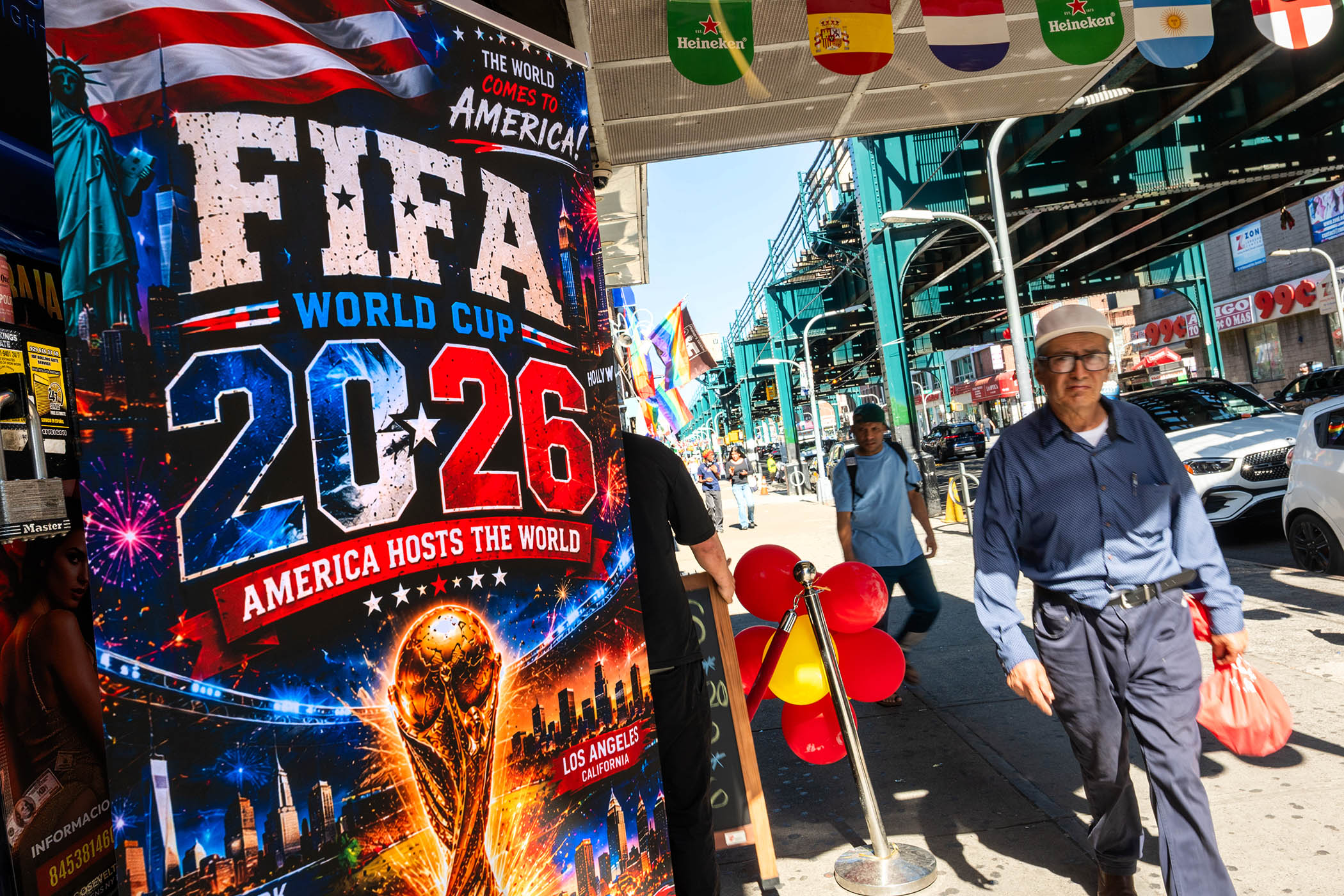
Instead, it comes in glimpses. A contingent of German fans, clad in 1990 replica shirts, wandering aimlessly through Atlanta airport, designed to be a maze from which it is entirely possible there is no escape; videos of bars in New York and Boston, busy in the middle of a weekday afternoon, starting to populate social media feeds.
Huge posters bearing the distinctive trophy affixed to buildings along Los Angeles’ many freeways.
One group wearing Mexico jerseys strolling down to the beach at Santa Monica, and then another, and then another, as the sun starts to rise and the opening game – starting at midday, local time – draws closer.
There are two ways to present this. The easier one, maybe the more common one, is to use it as evidence that football remains an inherently niche pastime in the United States, that the country has hardly come to a standstill, that the influx of tourists that was supposed to fill the host cities’ hotels and flood their restaurants has not materialised.
The opening day of the World Cup, certainly, did not appear to grip the US in quite the same way as it did Mexico City, a great metropolis ground to a halt in the hours leading up to the other host’s red card-addled victory against South Africa in the opening game. (The refereeing discourse that will, inevitably, dominate this tournament hangs heavy and threatening on the horizon.)
The other, more positive, is to remember that while the World Cup is very much a collective experience – the last totem of our shattered monoculture – it is also inherently personal, diffuse, and local. How it manifests depends entirely on context. There’s an old line that watching football on television is like looking at a room through a keyhole. Being privileged enough to be at a World Cup is, mostly, a little like that.
The unprecedented scale of this World Cup will make that still more pronounced. Not just because the tournament that happens in Mexico will look and feel and sound different to the one that plays out in the US and Canada, but because so many of the host cities themselves are so vast and diverse. There will be parts of Los Angeles or New York or Toronto that cannot tear themselves away. And there will be parts of those cities where the whole thing barely seems to register.
Newsletters
Choose the newsletters you want to receive
View more
For information about how The Observer protects your data, read our Privacy Policy
As a child of the 1990s who became probably too invested in the forlorn attempts of Britpop to “conquer” America, it’s always seemed to me that we – where “we” applies to both Britain and football – have a contradictory approach to the United States. On one level it remains our final cultural boss; we crave its approval. On another, we resent its intrusion.
That dichotomy is worth bearing in mind. It is easy to set the very highest bar for what counts as success for this World Cup in the United States, to declare that anything short of instant, absolute hegemony should be regarded as failure, to forget that even in Britain – proudly self-identifying as a football nation – only a half of the population regards itself as interested in (any) sport.
But to do so is both unrealistic and unfair, to imply that some people not being captivated by it is a damning indictment of the entire event. The World Cup descends in fragments, at least at first; and even when it has landed, all of the pieces locking neatly together, it is almost impossible for any of us to see the full picture.
Thank you for reading. Tell us what you think by writing to letters@observer.co.uk
Photograph by Spencer Platt/Getty Images