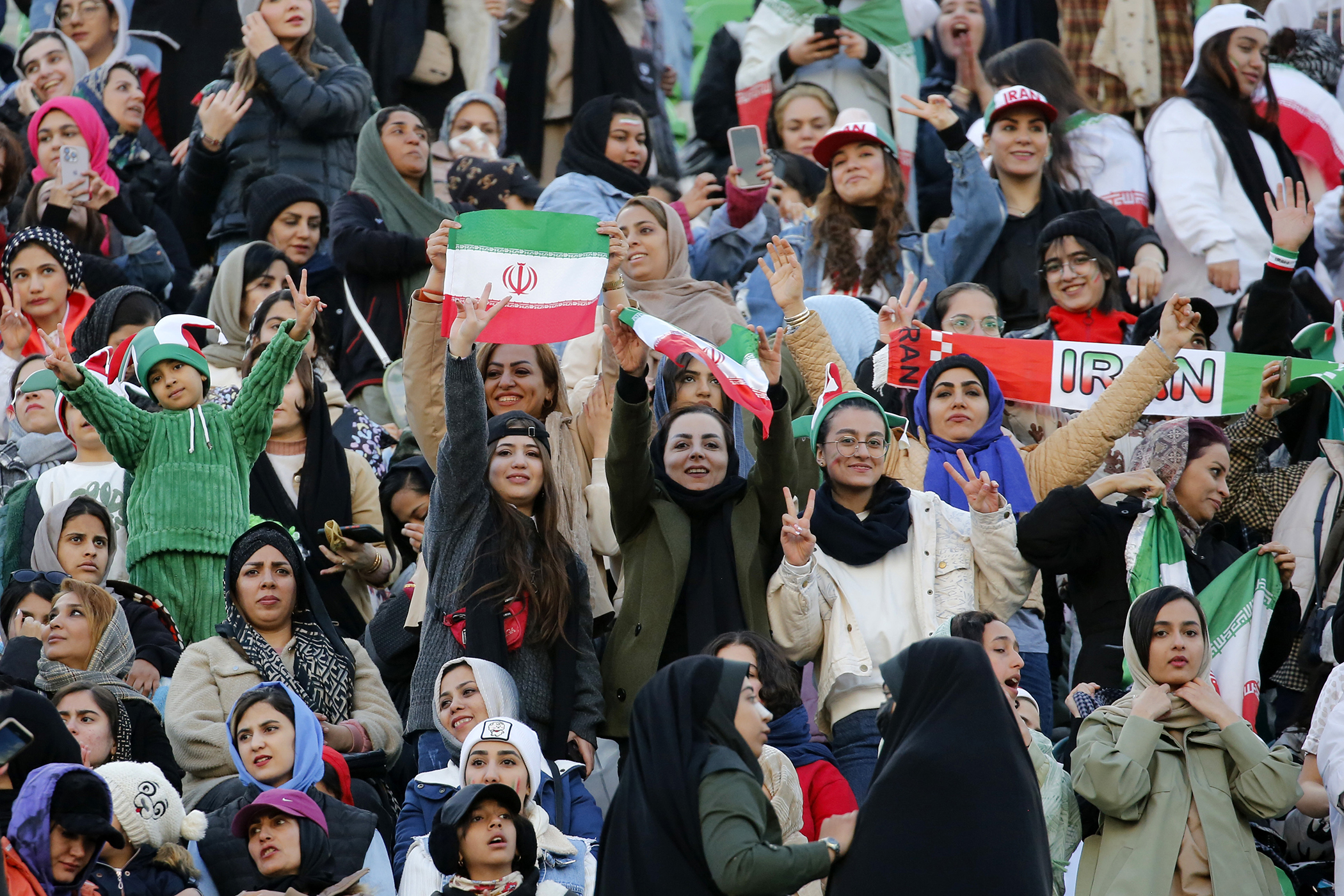
Sara, a feminist activist from Iran, has attended the past four men’s and women’s World Cups in Russia, France, Qatar and Australia, taking her campaign to persuade the Iranian government to allow women into stadiums directly to the most important gatherings in world football.
She had planned to do the same in California next week. But when she went to a US embassy in Europe to apply for a visa, it was denied.
“The guy didn’t look at any of the documents I brought. He just looked at my passport and said: ‘Do you have another passport?’ I said, ‘No.’ And then he said, ‘We don’t give visas to Iranians’,” she said.
At every previous World Cup she had attended, her ticket had been enough to enter the host countries without the need for a separate visa.
Sara, who uses a pseudonym to protect her identity, has been running the Open Stadiums campaign for more than a decade, putting pressure on both Fifa and her government to overturn an unwritten rule in Iran that barred women from attending football matches from 1979 to 2019, and has heavily restricted their attendance since.
That was, until this year. In 2026, the domestic league was played behind closed doors after mass protests at the beginning of the year were brutally suppressed by the government. It has now been suspended due to the US-Israel war. Today, parts of the stadium complex Sara picketed for years lie in bombed-out ruins.
Now, as the World Cup kicks off, Sara finds herself locked out of football once again – not because she is a woman, but because she is Iranian.
On Tuesday, Iran’s football federation said their entire supporter allocation of tickets had been pulled, stranding even those fans who had managed to secure a way into the tournament.
The team have moved their camp from Arizona to Mexico, a World Cup co-host, and will be required to enter and exit the US on the same day as their scheduled matches, while visas for backroom staff have also been denied. It is the first time a country has participated in a World Cup when it is officially at war with a host nation.
Iranians are not the only ones to fall foul of the Trump administration’s harsh border policies. On Monday, referee Omar Abdulkadir Artan, due to be the first Somali to officiate at a World Cup, was denied entry to the US.
Newsletters
Choose the newsletters you want to receive
View more
For information about how The Observer protects your data, read our Privacy Policy
“If Fifa wants to have 48 countries coming to a World Cup, then it means lots of those countries are from the global majority. You cannot have the benefits from them, their fans and the copyright of the football matches, but at the same time you don’t let them go and watch the football,” Sara said.
Sara’s fellow activist Maryam Shojaei will be at a game in Los Angeles. As a citizen of Canada, she did not have trouble getting a visa for the US.
Since 2014, Shojaei has run the #NoBan4Women campaign, displaying banners at international matches around the world arguing for Iranian women’s right to attend games back home.
Shojaei has long had a powerful ally in her brother, former national-team captain Masoud Shojaei, who often raised the issue of women attending games and other human rights issues, despite the personal risks of doing so. In April, the Iranian government froze Masoud Shojaei’s assets for alleged “collaboration with the enemy”.
“I’m going to be there more as an observer than to watch the game,” Maryam Shojaei said. “I’m going there to watch Iranians. It’s a polarised time.”
Though previous teams have been adored by fans in and outside Iran, the 2026 men’s side are more divisive. Among the Iranian diaspora, the team are seen as being close to the government, inspiring less fidelity and more scepticism. LA is home to one of the largest Iranian communities outside Iran. Fifa recently banned the showing of the country’s pre-revolution Lion and Sun flag in stadiums, deeming it too “political”.
Shojaei, too, has found herself on the wrong side of the rules about political neutrality at Fifa-affiliated competitions when she has displayed banners calling for women’s attendance at games. She was surprised, then, to see Fifa president Gianni Infantino present a peace trophy to US president Donald Trump last year.
“They are not allowed to be political, and the way they gave Trump the peace award was very political,” she said. The US would begin its war with Iran two months later.
Shojaei is in North America to promote a book for young adults about her campaign, Azadi Means Freedom: Fighting for Gender Equity Through the World’s Most Popular Game. The recurring internet blackouts since the beginning of the year have made communication with the outside world extremely difficult from within the country.
But she says the war has put a stop to much of the women’s rights activism that had swept the country, including her own. “When you’re thinking about survival, you don’t think about women’s rights and civil rights any more, because it’s a matter of life and death.”
After the World Cup, both women will return to Iran. Sara worries the progress made on women’s rights in recent years will be lost. “We need to start from zero, and in this situation it’s going to be really difficult … mobilising women to demand something more is extremely hard now.
“I’m really proud of the stadium campaign,” she said. “We were trying to change our society in a non-violent way and it was successful, and then this war happens that makes everything even worse.”
Photograph by Fatemeh Bahrami/Anadolu via Getty Images