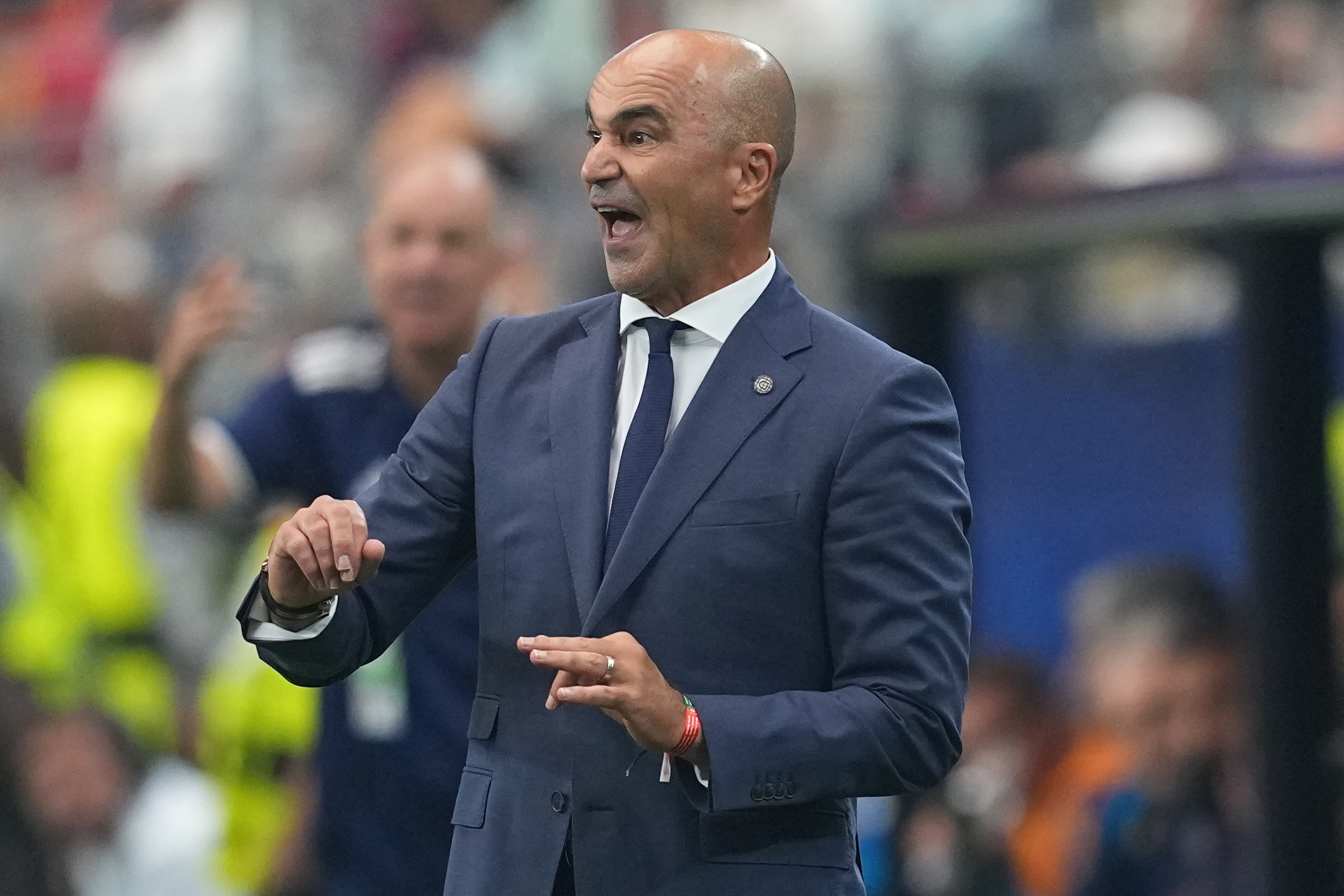
“Roberto Martinez is widely regarded as one of the top coaches at the 2026 World Cup,” begins Fifa’s official profile of the man who has just masterminded perhaps the tournament’s greatest and most predictable humiliation. Hmm, about that. For all the headlines and content machine suggest otherwise, Portugal’s World Cup is not the story of Cristiano Ronaldo, but of Martinez’s obsequiousness and stubbornness, his inability to fashion something vaguely functional from a squad including Paris Saint-Germain’s two-time Champions League-winning midfield, half of Manchester City’s defence, the Premier League player of the year and the world’s best left-back.
Of course, losing 1-0 to Spain in the last 16 is an understandable result, but Portugal should never have been in that position, finishing second in an eminently winnable group having drawn with DR Congo. But had they earned Colombia’s eventual path, would you really have backed them to beat Switzerland, or even necessarily Ghana? Apart from against Uzbekistan (11 goals conceded, two scored), did they ever really do anything to suggest they were the contenders they were purported to be?
At which point we have to ask the obvious question: is Martinez good at this? Last year Radja Nainggolan, the mohicaned former Belgium midfielder, called Martinez “not a football expert” and “a very poor coach”, also saying “there was no tactics or strategy.” Perhaps the most perceptive observation ever made about him still comes from Paul Merson, after one of many dire Everton defeats. “You watch a game, they get beat, you sit there and you think ‘that was a joke, that was shocking’,” Merson said incredulously. “And then he talks, and then he must press a button, and when he finishes talking we all go ‘it weren’t that bad’.”
His career is deeply confusing, the art of first failing upwards and then failing totally. He has not reached the semi-finals of either the Euros or the World Cup with feasibly the world’s fourth-most talented squad, but they did win the Nations League last year. His Belgium side finished third at the 2018 World Cup, although they largely won games they were supposed to win, but didn’t escape the groups in 2022. He won the FA Cup with Wigan three days before they were relegated. He finished fifth in his first season with Everton and left them 12th less than a year later. This is like trying to discern a secret message in a bowl of alphabetti spaghetti.
But in a job which appears to depend as much on both luck and an ability to control a narrative, is Martinez not just playing the game as it should be played? Only 10% of managers make a significant positive impact on their clubs, so the art is really selling mediocrity as something more, writing your own narratives, convincing executives not to believe their eyes, to hope that you might be different.
This was supposed to be a World Cup dominated by the elite club coach set: Thomas Tuchel, Carlo Ancelotti, Mauricio Pochettino, Marcelo Bielsa. Ronald Koeman, Julian Nagelsmann, Rudi Garcia and Martinez are all somewhere on the periphery of that, while Julen Lopetegui managed Qatar, Graham Potter Sweden and Ralf Rangnick Austria. And yet two of the eight World Cup quarter-finalist coaches – Lionel Scaloni and Mohamed Ouahbi – are in their first senior management position at club or international level. Scaloni has won the last three major tournaments with Argentina – two Copa Americas and the 2022 World Cup. Ouahbi is undefeated as Morocco boss, winning six and drawing four since Walid Regragui’s resignation in March, when he said “the team needs a fresh face, a different energy and a new perspective with a new coach.”
While his supposed altruism was admirable, was it necessary? Three more of the eight coaches have been in post since at least 2021, when Switzerland hired Murat Yakin – veteran of six different Swiss Super League clubs and 49 caps as a suave centre-back. Norway’s Ståle Solbakken spent seven years at Copenhagen, winning three league titles after six months at Wolves (remember that spell?). Didier Deschamps has been in charge of France so long – 14 years and counting – that his prior CV is basically irrelevant.
For all the PR and positive vibes and public buy-in, Pochettino’s USA beat Paraguay (41st in Fifa’s pre-tournament rankings), Australia (a generous 27th) and Bosnia and Herzegovina (64th) before being humiliated by the twitching corpse of Belgium’s golden generation. Ancelotti Neymar-ed a nation which has lost quarter-finals at four of the past five World Cups to a last 16 exit. The exceptions are Tuchel – aided by an extraordinary squad – and Garcia. One reason to question the capability of various international managers is the repeated deployment of centre-backs in penalty shootouts – of the 10 spot-kicks taken by central defenders at this World Cup, six have missed, five of those either hitting or soaring over the bar.
In his resignation speech, Martinez said “it doesn’t make sense to continue”. He will be replaced by Jorge Jesus, allegedly managing Portugal for the first time, another managerial itinerant who has sometimes succeeded and sometimes failed. At club level, Ruben Amorim has just reappeared at AC Milan admitting he “made some mistakes”. Germany have watched the past month’s football assiduously and decided Jürgen Klopp is the answer. After Ange Postecoglou was hired as Ronaldo’s new ego-minder at Al-Nassr, Martinez is reportedly a serious contender for the Scotland job. And so the wheel keeps turning, and we keep guessing, and hoping, and failing.
Photograph by AP Photo/Julio Cortez
Newsletters
Choose the newsletters you want to receive
View more
For information about how The Observer protects your data, read our Privacy Policy