


This article originally appeared in the Rory Smith on Football newsletter – a guide to help understand what is happening on the pitch, off the pitch, and why all of it matters.
Throughout the tournament, Rory will be travelling across America, delivering daily commentary on the biggest World Cup ever direct to subscribers. Never miss a newsletter, subscribe now here.
One day the world will stop spinning, but not yet, not now. Watching this England team has become a sort of anti-therapy, designed to hurt and psychologically scar you, to trigger migraines and childhood memories and mental breakdowns. Attempting to reconcile their extreme poles, to pathologise and analyse the mayhem, will leave you chattering on a street corner, screaming Hey Jude at strangers through gulping sobs.
As searing Miami day became searing Miami night, fans stared vacantly into the darkness, enthralled and haunted by what they had just seen, by the places they had been dragged to and from. This is a team and experience to be felt, not understood. “This is pure mentality,” Thomas Tuchel said post-match, as both English and Norwegian players staggered around the Hard Rock turf, legs leaden and minds melted. “You can bottle it up and sell it.”
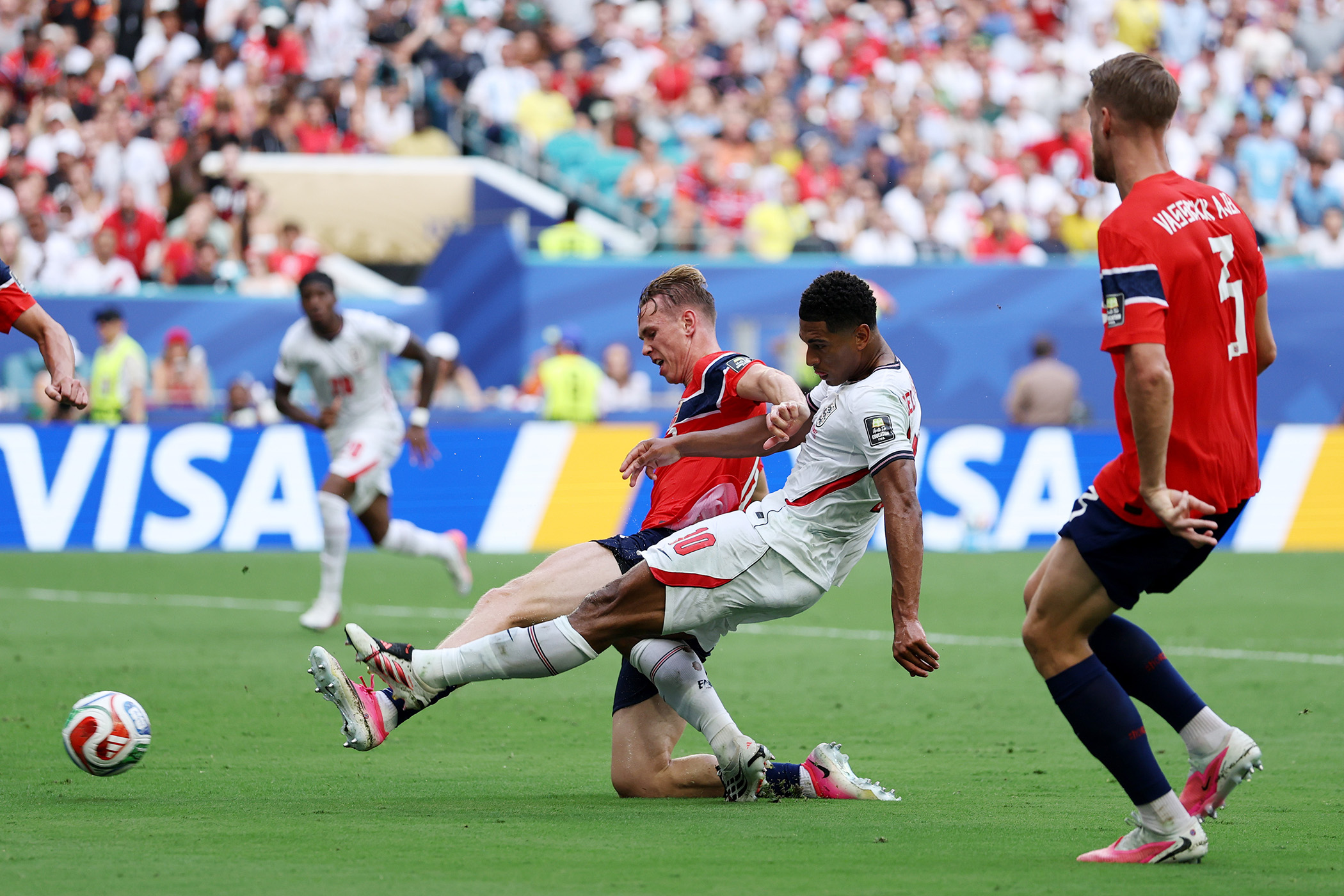
What’s simultaneously very good and very bad? How can almost everything a team does seem both accidental and the product of overwhelming force of will? How can you be World Cup semi-finalists without ever seeming to play well for more than 20 minutes once every three games? How can Jude Bellingham do everything, be everything, and produce arguably the greatest major tournament run from an English player ever?
Bellingham’s six non-penalty goals are the joint-most by an Englishman at any World Cup, level with Gary Lineker in 1986, nine of his 12 England goals coming at major tournaments. This is the second tournament in which England have reached at least the semi-finals in large part due to his ability to flourish in the harshest conditions, to fill space left as others shrink. Only Kylian Mbappé has scored more World Cup goals aged 23 or younger, Bellingham’s seven matching Pelé. Even if he reasonably disagreed with the public’s judgment after the anaesthetic Ghana draw, he has been named man of the match in five of England’s six games over the past month. It doesn’t matter if you’re a team player when you are the team.
England still hasn’t quite worked out how to make sense of Bellingham, how to process and treat an athlete and person this elite. The lazy tendency is to call him American, in the tradition of Michael Jordan and Tom Brady, but there is something fundamentally British about his tenacity and humour. As with all our superstars, the natural response is to search out his weak spots and press them until he breaks, until he proves he’s just as weak and human as the rest of us, and we can temporarily convince ourselves we’re adequate again. But what do you target with Bellingham? That he is too charming and good-looking and eloquent? That he appears just as comfortable in basically any position on the pitch? That he is both preternaturally gifted and endlessly hard-working, selfless and selfish in perfect balance? He is not dull or impulsive. He glows.
It would be impossible for Bellingham to be arrogant, impossible to overestimate his significance or ability, but he is single-minded and self-confident to an extent that inevitably threatens and disrupts the power dynamics around him, that makes him both de facto captain and coach and statesman. Here is someone you naturally want to follow and emulate, but also secretly want to hate. Post-match, Thomas Tuchel made the reasonable point that his team might not need to be quite so extraordinarily resilient if they simply played better in the first place, but Bellingham rejected this idea entirely, seemingly questioning Tuchel’s experience by saying “maybe he doesn’t know what it’s like to play in those kind of conditions against Erling Haaland, [Martin] Ødegaard, [Antonio] Nusa, [Alexander] Sørloth.”
Tuchel has dedicated much of the past 18 months to managing the Bellingham dynamic, to attempting to prove that he holds the power, but this was never going to last. Bellingham’s unimpeachable talent makes it nonsensical not to rely on him and build around him, to give him the keys, but no coach is ever going to be wholly comfortable with that relationship. Tuchel did what he could to not publicly praise Bellingham until recently, to even suggest that Morgan Rogers was genuinely competing for his spot, but both those tactics have become untenable. “I still feel we’ve got another level to go,” he said on Saturday night. “Again, we didn’t quite reach it. But we’ve got match winners. We’ve got Jude.”
England have now reached as many major tournament semi-finals in the past eight years (four) than in the 68 years prior. This is the nation’s footballing golden era, one that increasingly feels as though it will inevitably end with silverware, perhaps in New Jersey in a week’s time, but just as feasibly at Wembley in 2028. The depth and variety of English football is extraordinary and constantly developing, one of only three nations structurally sound and sustainably constructed enough to ensure this continues.
Newsletters
Choose the newsletters you want to receive
View more
For information about how The Observer protects your data, read our Privacy Policy
For now, it is Argentina in Atlanta on Wednesday, stoppable force meeting movable object, two teams with roughshod foundations and three of the world’s ten best players between them, as liable to collapse as surge at any moment. These are the tournament’s premier chaosmongers. Lionel Messi has never played England in a senior international, and yet they now meet for a place in the World Cup final. Don’t try to understand any of this. Just feel it.
Photograph by Buda Mendes/Getty Images