
This article is part of the Rory Smith on Football newsletter – a guide to help understand what is happening on the pitch, off the pitch, and why all of it matters.
Throughout the tournament, Rory will be travelling across America, delivering daily commentary on the biggest World Cup ever direct to subscribers. Never miss a newsletter, subscribe now here.
Donald Trump is already showing the early signs. The American President had been a curious, merciful absence from the first three weeks – or maybe four, it’s hard to tell at this stage – of this World Cup. He had made sure to dominate the build-up to it, to draw Gianni Infantino into his circle, to harness the power of the planet’s last true mega-event.
But once it had arrived, he had melted away. There was a cognitive dissonance here: no matter where you stand on Trump’s politics, nobody would really claim that he makes a habit of vacating the stage. Especially not one as prominent as that provided by the World Cup.
Various theories circulated for why that might be. Perhaps he did not want to travel west, where the United States were playing all their games. Maybe he had been spooked by being booed at Madison Square Garden when he watched the New York Knicks in the NBA Finals. Or was he just busy arranging UFC fights on the White House’s South Lawn? He’s President. He has a lot on.
Now we know that something much more troubling was happening. Silently, in the background, Trump was becoming a soccer guy.
He was asked, at a press conference in the Oval Office yesterday, to clear up the extent to which he was involved in the decision of Fifa’s disciplinary committee to suspend Folarin Balogun’s red card.
A surprisingly good way of understanding Trump’s political career is as a crossover television show: what if the man from The Apprentice was on the news? This should be regarded along those lines, too, but entirely lacking in coherence: not so much Mulder and Scully making a guest appearance on The Simpsons as Kirsty and Phil suddenly showing up to value a house on Buffy the Vampire Slayer.
Trump’s response started out as a fairly standard answer: he said he had called Gianni Infantino, but didn’t tell him what to do, before setting out pretty clearly that he had sort of told him what to do. But then it veered off in unexpected directions: Trump namedropping Lionel Messi and Cristiano Ronaldo and Harry Kane; Trump offering a view on Belgium’s squad depth; Trump questioning the impartiality of a referee.
We know where this leads. Give it a few weeks and he will be on Truth Social, debating whether the lines on semi-automatic offside can really be trusted, developing surprisingly strong opinions on the relative merits of Noah Sadiki, lambasting sundry TalkSport presenters for not sufficiently appreciating the beauty of Arsenal’s set-pieces. Actually: maybe this fits perfectly.
Newsletters
Choose the newsletters you want to receive
View more
For information about how The Observer protects your data, read our Privacy Policy
The 36 hours or so since Trump’s first real intrusion on this World Cup have, without question, been a mess. Rescinding the red card Balogun was awarded against Bosnia smacked of homerism, a weighting of the scales in the favour of the United States. It infuriated not just Belgium, but plenty of others besides; it makes a schism with Uefa just a little more likely.
The best gauge of the scale of that mess was the desperate attempts to clear it up yesterday. First, Infantino released a statement acknowledging the call from Trump, but also boasting that the Fifa president gets calls from loads of world leaders, thanks very much, because they just really love talking to him. All he did, he said, was explain to Trump that “there was an ongoing legal process involving Fifa’s independent judicial bodies.”
In case that did not make the point, the chair of said body released an unattributed statement soon after; quite who it was from was not made clear, but we should presume it contained the words of Mohammed Al Kamali, the current occupant of that title. Again: he stressed that the committee is independent. He also explained, in legalese, that his body has the “discretion” to make these sorts of calls. See? All clear and above board.
Except that at no point did he explain why that decision had been made. He did not lay out the criteria that led the committee to decide that this punishment should be suspended. He said that there were precedents in qualifying for this tournament – they have not been explained either – and alluded to doubts over the validity of the red card. But it has not been rescinded. Balogun has still been fined.
What Fifa in general and Infantino in particular do not seem to grasp is that, even if all of this was completely normal, even if Trump is taken at his word, Infantino’s relationship with the president makes it very difficult to believe that. This is the problem with cosying up to Trump, to any politician: it makes it impossible to assume impartiality.
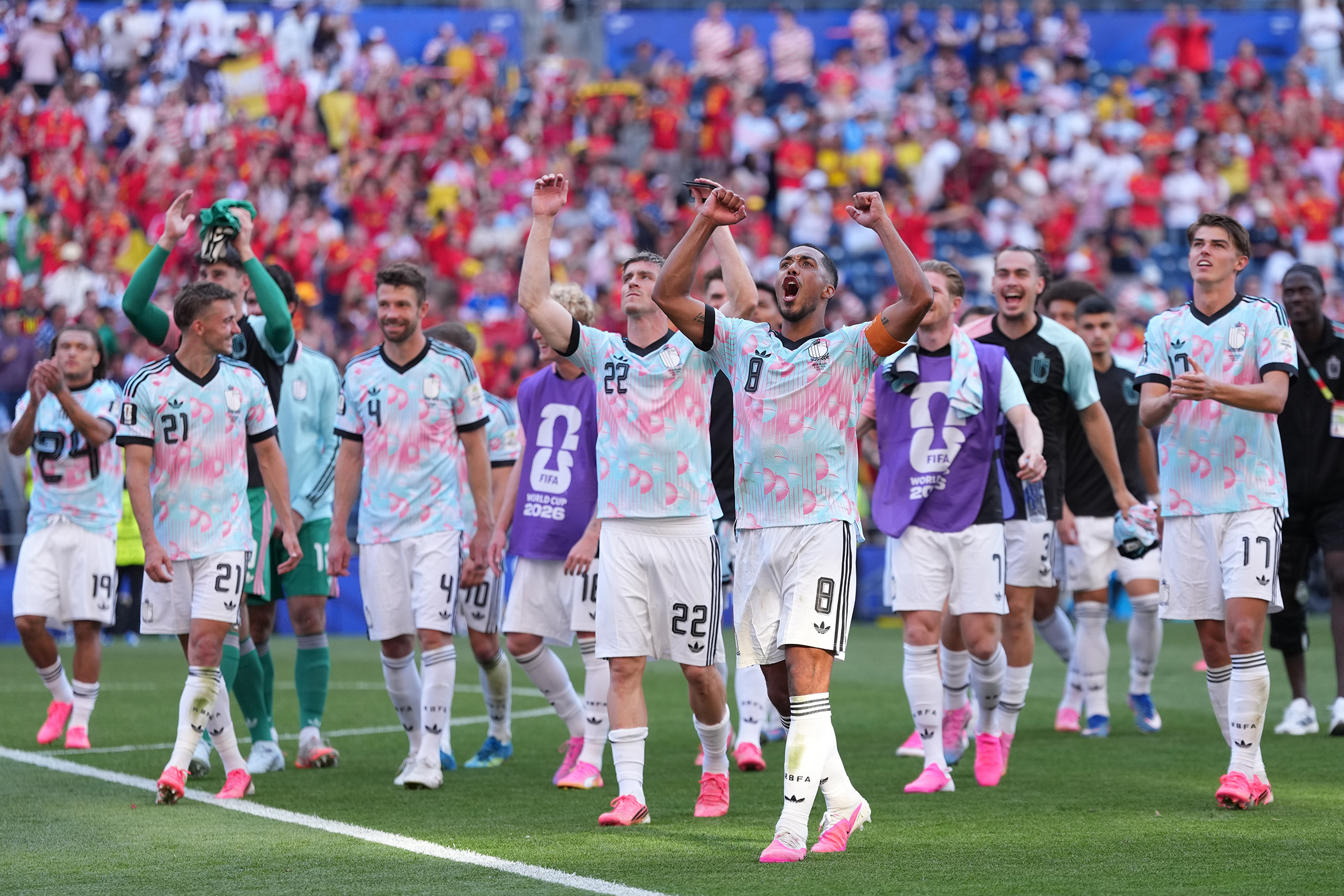
Perhaps, in that sense, it is for the best that the United States were eliminated yesterday, limping to defeat against Belgium. Their conquerors celebrated by doing Trump’s signature dance in the centre circle. They, clearly, wanted to make the point that what they saw as an attempt to thumb the scales against them had not worked. The hosts’ exit nips the scandal in the bud.
But it is also a tremendous shame. Whatever the truth, the controversy will stain how this US team – maybe this US World Cup – is remembered, just a little. They did not just fall; they fell despite what looks like institutional support. Mauricio Pochettino and his players did not need to be put in that position.
And more importantly, it has drawn to a close the period of this tournament that stood as a genuine and organic carnival, a thing of beauty that had emerged from the ashes of the controversies that had marred the weeks, months and years that led to it. Trump is a soccer guy now. More sadly, the World Cup feels political again.
Photograph by Abbie Parr/AP