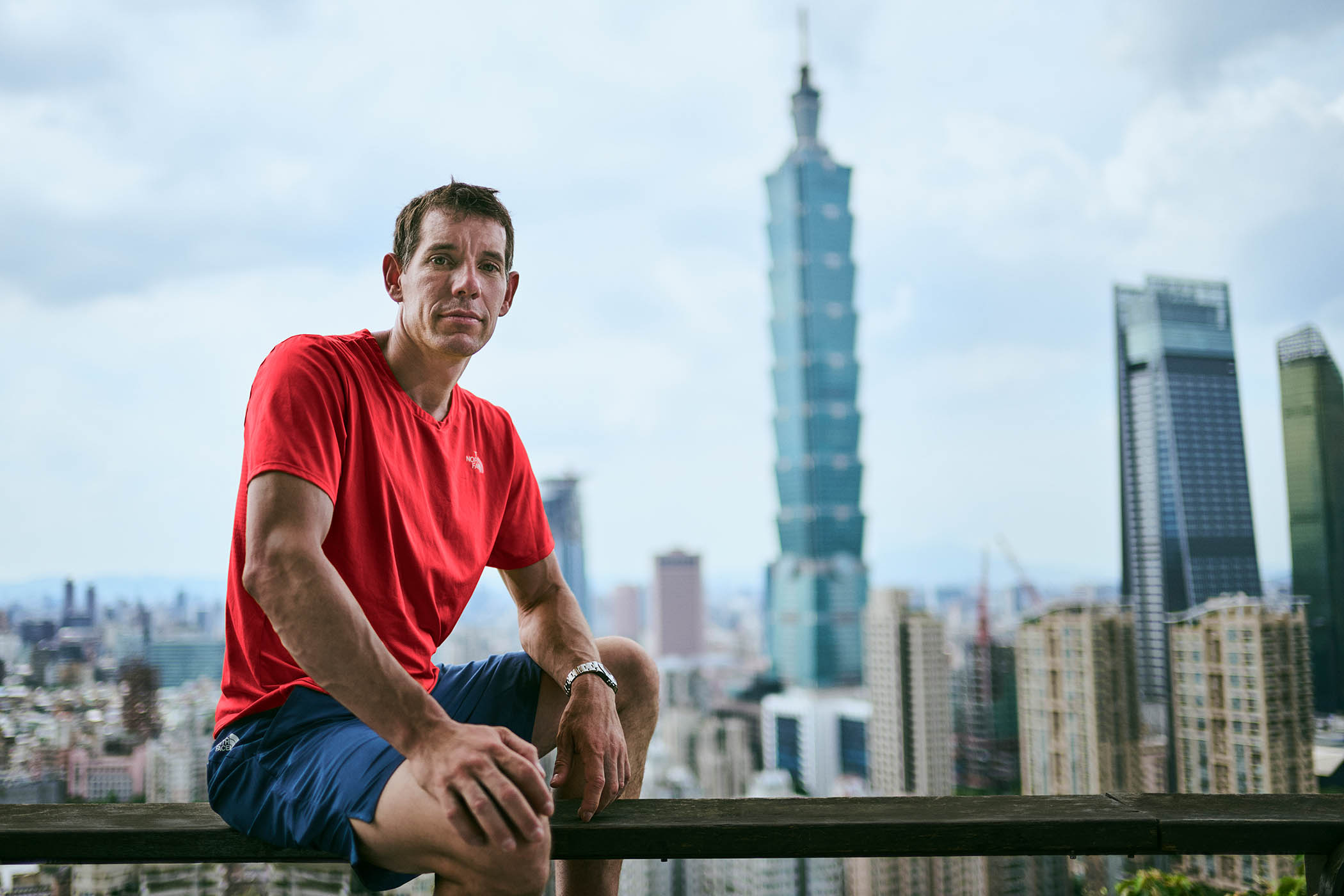
The Taipei 101 skyscraper is 508 metres tall. It’s made up of eight box-like sections, each one sitting squarely on top of the other, like upside down buckets.
On Friday, climber Alex Honnold will attempt to scale the outside of the building, which is 200m taller than The Shard, without any ropes or other safety equipment. And the whole endeavour will be streamed live on Netflix in a two-hour special programme.
It’s a stunt comparable to Philippe Petit’s 1974 tightrope walk between the Twin Towers in New York, but with the added pressure of potentially millions of viewers across the world watching a catastrophic accident, in real time.
The only other person on the planet who has come close to what Honnold will experience is the French climber Alain Robert, famed for his daring, and often illegal, ropeless urban ascents.
“The building was kind of cursed,” Robert told The Observer from his home in Bali.
During the construction of Taipei 101 in 2002, a major earthquake caused the deaths of a number of construction workers, and caused a crane to fall from the 56th floor of the partially built skyscraper.
Robert was asked to climb it – albeit fully roped up – knowing he was there to bring the building some positive PR. But 12 days before the stunt, he fell off a traffic light during a photoshoot and broke his elbow.
“I had 15 stitches. My elbow was nearly one and a half [times] bigger than its normal size. And on the day [of the climb], it was raining cats and dogs.”
As well as the poor weather, and inability to fully use one arm, he added that the climb was hampered further due to the fact that the building wasn’t finished with some of the window frames still covered in slippery vinyl wrapping.
Honnold is attempting this without any assistance. He is the most famous climber in the world, though given climbing’s relatively low profile, that doesn’t make him a household name.
Newsletters
Choose the newsletters you want to receive
View more
For information about how The Observer protects your data, read our Privacy Policy
In 2018, he went from a cult-figure in the climbing world, to the Oscar-winning star of the documentary Free Solo, which followed his lifelong goal of climbing El Capitan, in Yosemite National Park, without a rope.
The film presented him as a calculated machine, immune to fear, and relentless in his pursuit of perfection.
But in the nine years since he completed the era-defining climb, he appears to have settled down. He’s married with two young daughters, hosts a podcast, and occasionally livens up the commentary box of World Climbing competitions.
It begs the question: why would a married father-of-two take this kind of risk?
Perhaps because he doesn’t think it is one.
The terrain, according to Robert at least, is not that strenuous. Robert has invented his own scale of difficulty for climbing buildings, and it’s much simpler than the series of letters and numbers that denote the difficulty of climbing rocks: a scale of one to ten, with one being the easiest and ten the hardest.
Taipei 101, in his scale, gets “a five point five, maximum a six”, which seems promising for Honnold.
Sometimes you get up there and you think ‘Oh my God, what am I doing?’
Sometimes you get up there and you think ‘Oh my God, what am I doing?’
Alex Honnold
In videos circulating on social media ahead of the stunt, Honnold can be seen practicing the moves, fully roped up and giving a cheery wave to people inside the building. He’s also rehearsing in trainers, rather than grippy, rubber-soled climbing shoes.
But regardless of the difficulty of the climb, any mistake would be fatal.
“I’m sure viewers will probably be on edge watching this… but I hope that viewers get a little bit of my joy from the experience,” Honnold said last year.
There’s a certain lightness with which free soloists talk about climbing without ropes. In a recent interview with CNN, Honnold is keen to stress how mentally prepared he is, but also laughed as he said: “Sometimes you get up there and you think ‘Oh my God, what am I doing?’”.
Underneath that veneer, though, there’s also an acceptance of mortality. “I was not really expecting to live very long,” Robert said. At one point in our interview, he reeled off a list of his soloist friends. All of them have died.
The Observer understands that there will be a 10-second delay on the television feed, presumably to allow production staff to cut the feed should an accident occur.
There are concerns that live events like Skyscraper Live might inspire naive copycats to put themselves in dangerous situations – but the numbers tell a different story.
The success of blockbuster climbing films, plus the inclusion of climbing in the Olympics, has contributed to a spectacular rise in the number of casual climbers. In the UK there was a 58% increase in the number of visitors to climbing walls between 2019 and 2023.
But many of these new recruits never leave the confines of an indoor gym. And there’s less data on the number of people who take up free soloing, which remains a fringe part of climbing culture.
Looking at the data for accidents is also an indicator of just how fringe climbing without ropes remains. According to the American Alpine Club, in 2024 only nine people had accidents while free soloing in the USA.
If Robert says his climb of Taipei 101 was cursed, does that make him superstitious?
“No, not at all.”
Photograph by Corey Rich for Netflix