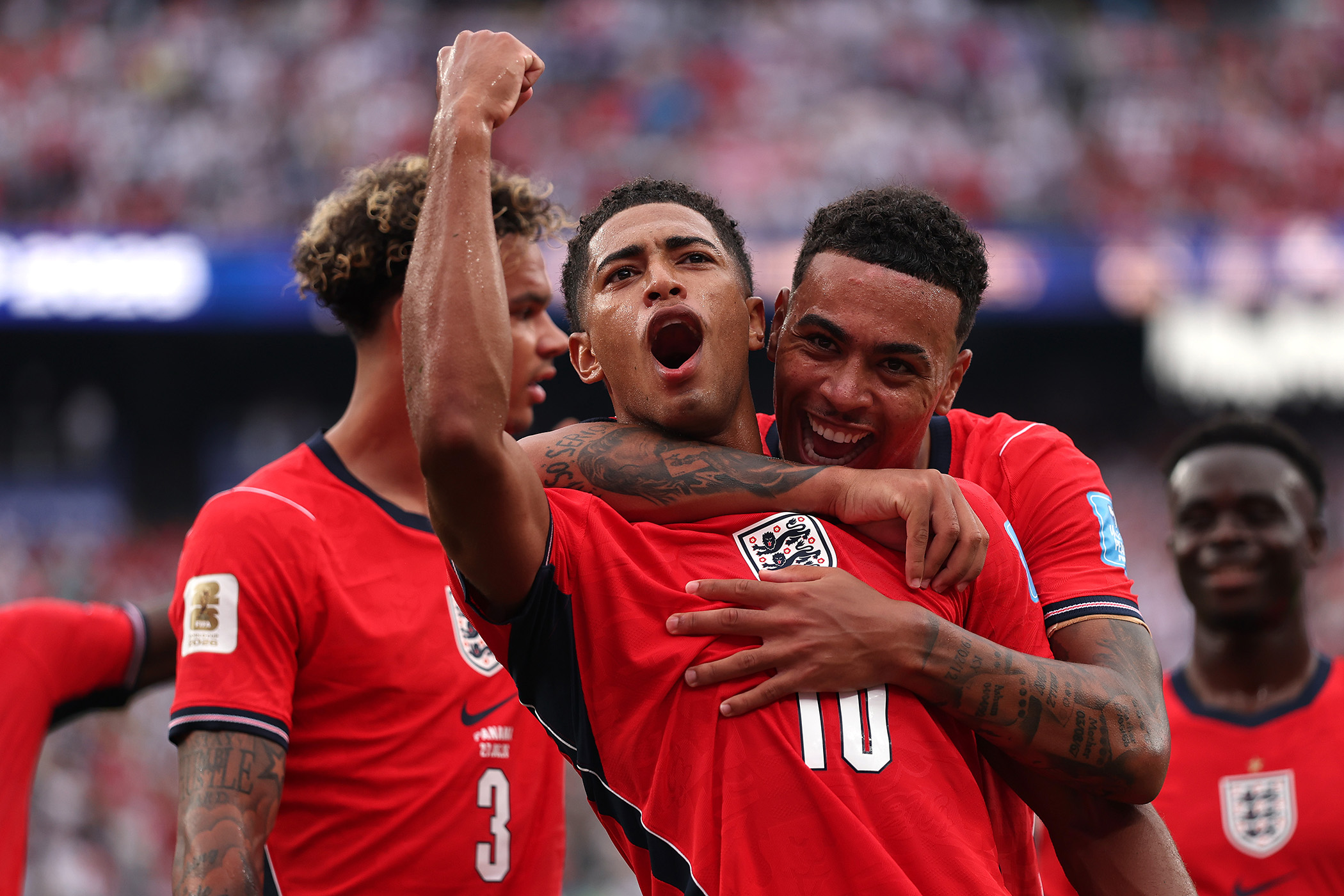


It turns out that maybe Jude Bellingham is worth the stress and, on reflection, corners are alright. England’s ultimate moments players pierced a frantic, disjointed game with a swipe of his left boot, proving that dropping into central midfield cannot stop him always being the centre of gravity. His opener, rapidly followed by Harry Kane’s second from a Bellingham cross, was a reminder of exactly why Thomas Tuchel has put so much time and thought into managing this world-bending talent.
The MetLife is a merciless coliseum, sheer and uninviting, oddly complemented by a sky peppered with 50 shades of grey. It sporadically rained without intent, which meant the sea of red and white was blurred by thousands of ponchos, hydration breaks unnecessary but arriving anyway. An overwhelming sense of drabness and depression attempted to envelope everything around it, and did a good job of it. Shortly before his goal Bellingham had booted an advertising hoarding in frustration and the loudest noise of the first hour was a wild shriek when David Beckham appeared on the big screen. Anthony Barry emerged for his now appointment-viewing half-time dispatch and said “talent isn’t enough, we need synchronicity and rhythm and routines.”
As at every match of the tournament so far in the US, the Star-Spangled Banner blared across a largely empty stadium 55 minutes before kick-off, a bizarre ritual which feels like the product of Gianni Infantino promising Donald Trump the anthem would always be played, but not mentioning when. England wore red in a major tournament for the first time since their third-place play-off of the 2018 World Cup.
Already eliminated by consecutive dull, tentative 1-0 defeats to Ghana and Croatia, Panama pressed relentlessly and chaotically, operating with an extraordinarily high line which verged on self-sabotage, intent on providing their fans one moment, one memory, having entered this match as the only team still yet to score. They began as they meant to go on, Tomás Rodríguez launching a shot at Jordan Pickford after 11 seconds.
Thomas Tuchel made five changes from the Ghana draw, a reminder of England’s remarkable depth and variety. Before the tournament he referenced “14 or 15 starters”, but few would have imagined Jarell Quansah was among those. Tuchel has said he considered Quansah an option at right-back, but it was assumed he was third-choice behind Reece James and Djed Spence, having played less than 300 minutes at right-back across his senior career and not doing it at all for Bayer Leverkusen last season.
Quansah replaced James, unavailable until the last 16 – optimistically – because of a hamstring problem. Pre-match Tuchel said “no one could see [James being injured] coming,” which felt like either a ridiculous oversight or a bit, the most tragically predictable outcome. James has missed more than a year and a half of football across his senior career with hamstring strains, tears or surgeries, most recently six weeks between March and May. This is the Reece James package, perhaps the world’s best right back seemingly condemned to never stay fit long enough to prove it. In December 2023 he underwent surgery in Finland in search of a permanent fix, but this is his fourth hamstring injury since then, clear indication it failed. Enzo Maresca moved him into central midfield at Chelsea in part to limit the stress on his muscles from repeated sprints, but he fills a need for England at right-back.
Tuchel went on to say James’s absence was “no problem”, the inevitable party line but simply untrue. Quansah was defensively sound against Panama, but James is a ridiculously high-end footballer, all power and precision, even if he felt short on match fitness in the first two matches. But you lose something irreplaceable without him, not least a creative variety which can feel like this team’s most obvious flaw. On the left, Nico O’Reilly returned to the starting XI, blessedly confirming that the Spence experiment is over for now. Starting Spence against Ghana was one of Tuchel’s first obvious errors of the tournament, contributing to the general stodginess and unoriginality of England’s attacking play while having little need for his defensive capabilities or little space to use his speed.
Full-back is England’s obvious problem position of this World Cup, its new psychodrama, especially without James, an otherwise meticulously-formed squad based on similar tactical profiles seeming to split at the edges. There are few full-backs like James, but Quansah and Spence are fundamentally opposing players, serving completely different purposes. On the left, for all O’Reilly is exciting and an underrated attacking threat in Tuchel’s system, Spence and Dan Burn are uninspiring and inadequate replacements. Quansah limped off after an hour, replaced by Spence, which might leave him as the only option for the last 32.
Tuchel is obsessed with the psychological side of these tournaments, how to keep morale high across six weeks, how to thread the needle of confidence and arrogance, how to keep everyone involved level and avoid falling into the reactionary boom-or-bust cycle. Starting Morgan Rogers and Marcus Rashford was also a motivational tool, showing them that his compliments and promises mean something, that there really is something for them to keep working for.
England has become an oasis in the chaos and confusion of Rashford’s club career, and this was a Rashford game, Anthony Gordon’s pressing unnecessary given how loosely Panama set up. His directness created most of England’s best chances of the first 45 minutes, slapping a low shot that Orlando Mosquera saved well after eight minutes and whipping a free-kick round the wall and inches round the post in first-half added-time.
Newsletters
Choose the newsletters you want to receive
View more
For information about how The Observer protects your data, read our Privacy Policy
Tuchel has maintained that Morgan Rogers and Jude Bellingham can play together and they did here, Bellingham dropping back alongside Elliot Anderson in central midfield. Anderson started despite experiencing muscle tightness against Ghana.
Over the coming days he will become the most expensive English footballer ever by joining Manchester City for £116m, instantly elevating him to the superstar status his talent deserves. He is a brutally brilliant footballer, guaranteed to run harder and further than you, go over and under and through you. It is still only nine months since his England debut and yet he has become one of this team’s foundational pillars, one of the few lingering debates of the Southgate era Tuchel has been able to end unequivocally.
This was always going to be the tournament that beamed Anderson’s name in fizzing neon lights around the world, that forced people to realise what he is, but joining City will turbocharge that.
Bukayo Saka started his first match of this World Cup as Tuchel manages his long-term achilles injury, relieving everyone involved of another 60 minutes of Noni Madueke dancing past three players and shooting into the side-netting. This was Saka’s 52nd England cap at 24, already a modern great, England’s second highest goalscorer this decade, and like James he provides an irreplicable creativity and force, raises the level. An under-explored storyline is how he and Declan Rice have been impacted by finally summiting the mountaintop with Arsenal, whether they have anything left to give. Can they keep the good vibes going, or is the physical and psychological stress of the past season – perhaps the past four years – going to stop them from crossing the same threshold with England? Rice was rested and Saka was substituted after an hour having provided the corner for Bellingham, but neither look fully fit or comfortable.
Victory means England know their path to the final: first a last 32 match in Atlanta’s mercifully air-conditioned Mercedes-Benz Stadium, then either Mexico or Ecuador in Mexico City, two flawed teams with a high ceiling and low floor, as capable of hurting themselves as any potential opposition. A quarter-final in Miami would follow against one of Brazil, Japan, Norway or Ivory Coast, a semi-final in Atlanta and then back into the MetLife’s vast dullness for the final.
There will be talk of a favourable path, of Spain and France and Germany all falling on the other side of the draw, that Argentina are too old and frail and Brazil too little of anything at all. This is all true, but we still don’t really know what this England team are, what they could become, only producing 20 minutes of unimpeachably good football over their first three games.
Was that an exception, an adrenaline rush, an alignment of the stars, or was it the first sign of where this team is going?
Photograph by Mattia Ozbot/Getty Images