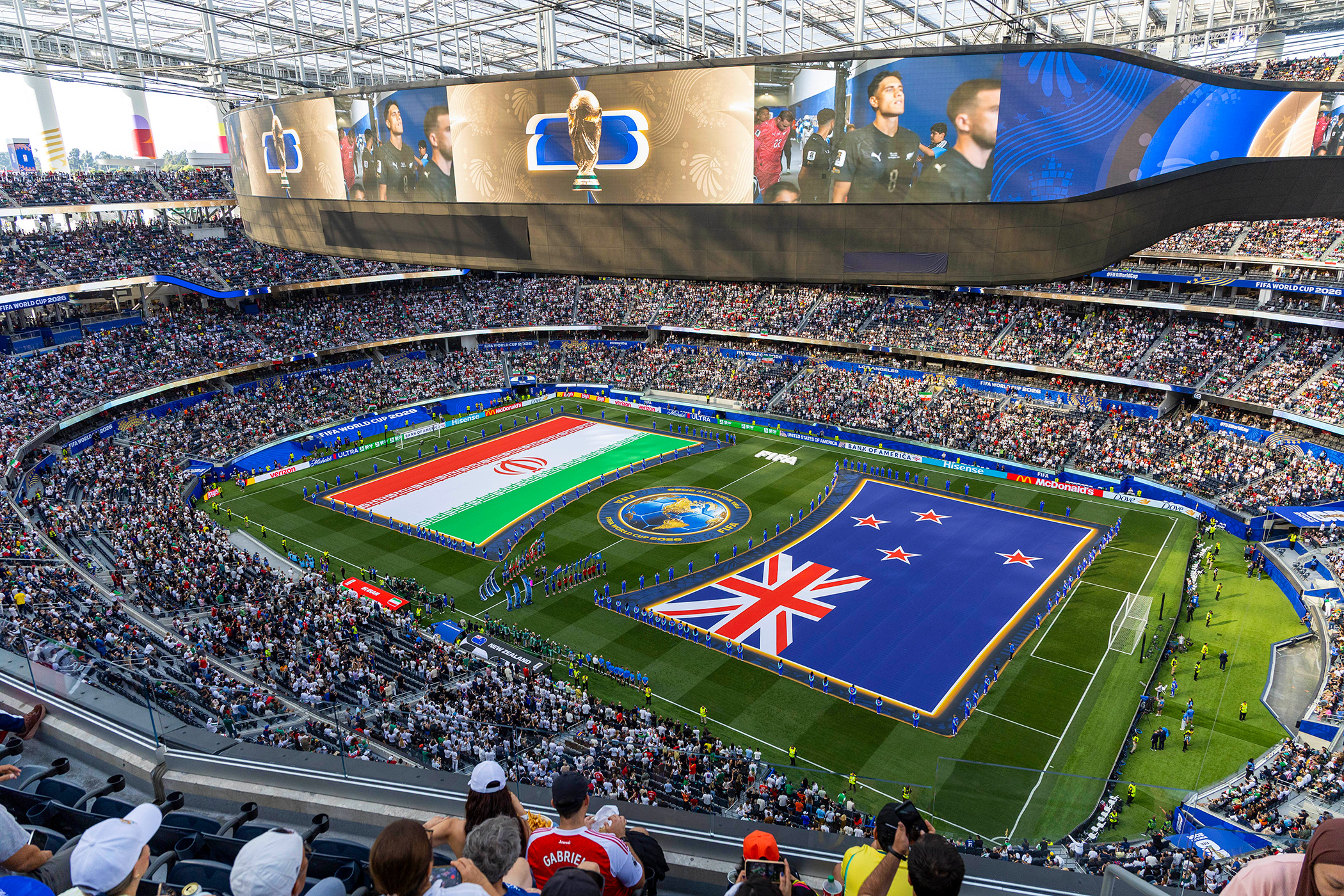



The problem in trying to describe the sensory experience of walking into SoFi for the first time is that the best metaphor is also the absolute worst. It is wrong in every possible way. First: it is a dreadful cliché. Second: it does not stand up even to the slightest scrutiny, a parallel that collapses after just a moment’s thought.
But the biggest issue is that it has been used both so often and so inappropriately for a quarter of a century or so that it no longer contains even a whisper of meaning. There is a good chance, for example, that it has been applied both to the Tottenham Hotspur Stadium (acceptable) and to what is now the University of Bolton Stadium, but will forever be the Reebok (no).
Still, here we are. On Sunday, a considerable proportion of the fans who see Canada face South Africa in the World Cup’s first ever round-of-32 game at SoFi – currently identifying as the Los Angeles Stadium so as not to offend the real stars of the World Cup, Fifa’s commercial partners – will find themselves unable to resist the temptation to compare it to a spaceship.
The cliché does, admittedly, hold better in Inglewood than Greater Manchester. The colossal, 360-degree screen suspended over the pitch has a touch of Independence Day about it; from a distance, the soaring roof dominates its surroundings like District 9, albeit without the malevolence. Trees and vines garland the internal walkways, an Interstellar botanical garden.
But the parallel is not designed to be taken literally. When SoFi opened, in 2020, as the new home of Los Angeles’s two NFL franchises – the Rams and the Chargers – it did so in a blizzard of statistics: the largest arena in the league; the first-ever ‘inside-outside’ stadium; a capacity that can reach 100,000; 13,000 premium seats; an “Infinity” screen containing 70,000 square feet of LED and boasting 80 million pixels.
It was, in other words, a stadium of a different order to anything that had gone before. That is why the spaceship parallel, hackneyed as it might be, remains irresistible. SoFi looks and feels like something from tomorrow. That is by design, said Lance Evans, the Venues Design Director at HKS and the lead architect on the project. His “north star”, he said, was “to craft the future”.
That future will not just manifest in the major leagues of North America; it will cross the Atlantic, too. European football has been borrowing ideas from the United States for the better part of two generations, now, ever since fact-finding missions in the 1980s and 1990s opened executives’ eyes to the glories of luxury suites and corporate boxes and overpriced concession stands. SoFi may not seem alien for long.
Indeed, to some extent it represents some of the ideas that are already reshaping Europe’s stadiums, just with the volume turned up to 11. “The key to modern stadiums is flexibility,” said Alex Thomas, HKS’s Regional Design Director for Sports and Entertainment in Europe.
This is familiar: a billion-dollar venue cannot, realistically, be used a couple of dozen times a year; more if you have a good cup run. “They have to be able to host Taylor Swift or wrestling or corporations holding private events” as well as whichever sport their anchor tenant plays, as Evans put it.
Likewise, SoFi’s unabashed emphasis on premium experiences echoes the logic of many of Europe’s more recent – or more recently refurbished – grounds. This is the era of the Tunnel Club, after all. We are used to thinking of the modern stadium, in part, as an extraction machine, built to keep fans on site for as long as they have money to spend.
Newsletters
Choose the newsletters you want to receive
View more
For information about how The Observer protects your data, read our Privacy Policy
At the same time, there are some aspects that Evans and Thomas feel may depend a little more on context. Real Madrid might have installed a wraparound screen in the revamped Santiago Bernabéu, but Evans is quick to point out that fans are conditioned to expect different things in different places.
Sports in the United States, he said, traditionally use digital inputs to generate atmosphere – flashing messages on screens to orchestrate how fans respond, effectively – in a way that a European crowd would neither expect or appreciate. “You have to listen to the local environment,” he said. “It’s a case of celebrating and amplifying the way we consume sports.”
The real significance of SoFi, though, the part that may well prove to have a more impactful influence, is the design. Until relatively recently, stadiums have essentially been functional structures, not much more than holding pens for fans while they watch a game. Evans and his team’s ambition for SoFi was to make the stadium the spectacle: what he calls “designing for awe”.
That encompassed removing – statistic incoming – seven million cubic yards of soil from the site so that the stadium bowl could sit below ground level; the effect is that “the architecture unveils itself” as spectators file in, Evans said. He hoped to design something that would make fans “want to call someone they loved to tell them about it”.
Just as importantly, it involved giving SoFi a “distinct visual identity”. Even some of Europe’s newer stadiums seem to have come out of a packet: the Emirates and the actual Stadium of Light, in Lisbon, are indistinguishable at first glance. SoFi, by contrast, has texture: blocks of seating that are set apart from the smooth bowl. That is, Evans said, in part an attempt to “create unique moments”, but it serves, too, to make the stadium immediately identifiable.
Those principles, both he and Thomas believe, apply as much in Europe as North America; more complex is the fact that SoFi, like most American stadiums, is designed to be entirely open. It has not been constructed with the aim of segregating fans. In Europe, as Thomas said, “The pattern of design has been enforced by safety concerns for 30 years.”
There is a school of thought that design can help there, too. One of their colleagues, Upali Nanda, has spent decades researching how the built environment can improve outcomes in hospitals and performance in schools; there is no reason, Evans said, that the same ideas cannot apply to stadiums. It may be, in other words, that stadiums constructed specifically to prevent violence create an atmosphere in which violence is more likely.
It should be stressed that this is not a one-way street; there are, Thomas said, several aspects of European grounds that are now being incorporated into American stadiums. “The way they engage with their communities as part of integrated urban environments is really interesting,” he said.
So, too, is the idea of atmosphere: HKS have designed a stand modelled on Borussia Dortmund’s Südtribune – the Yellow Wall – for the forthcoming home of the Cleveland Browns, complete with a steep, 34 degree pitch. (It will, a touch unfortunately, be called the “Dawg Pound”.) The hope is that it will create the sort of noise that has always been a feature of traditional European stadiums. It is, they said, a “conversation” about what the stadium of the future will look like; it is one that starts, though, with that first speechless glance at SoFi.
Thank you for reading. Tell us what you think by writing to letters@observer.co.uk
Photograph by Zuma Press/Avalon