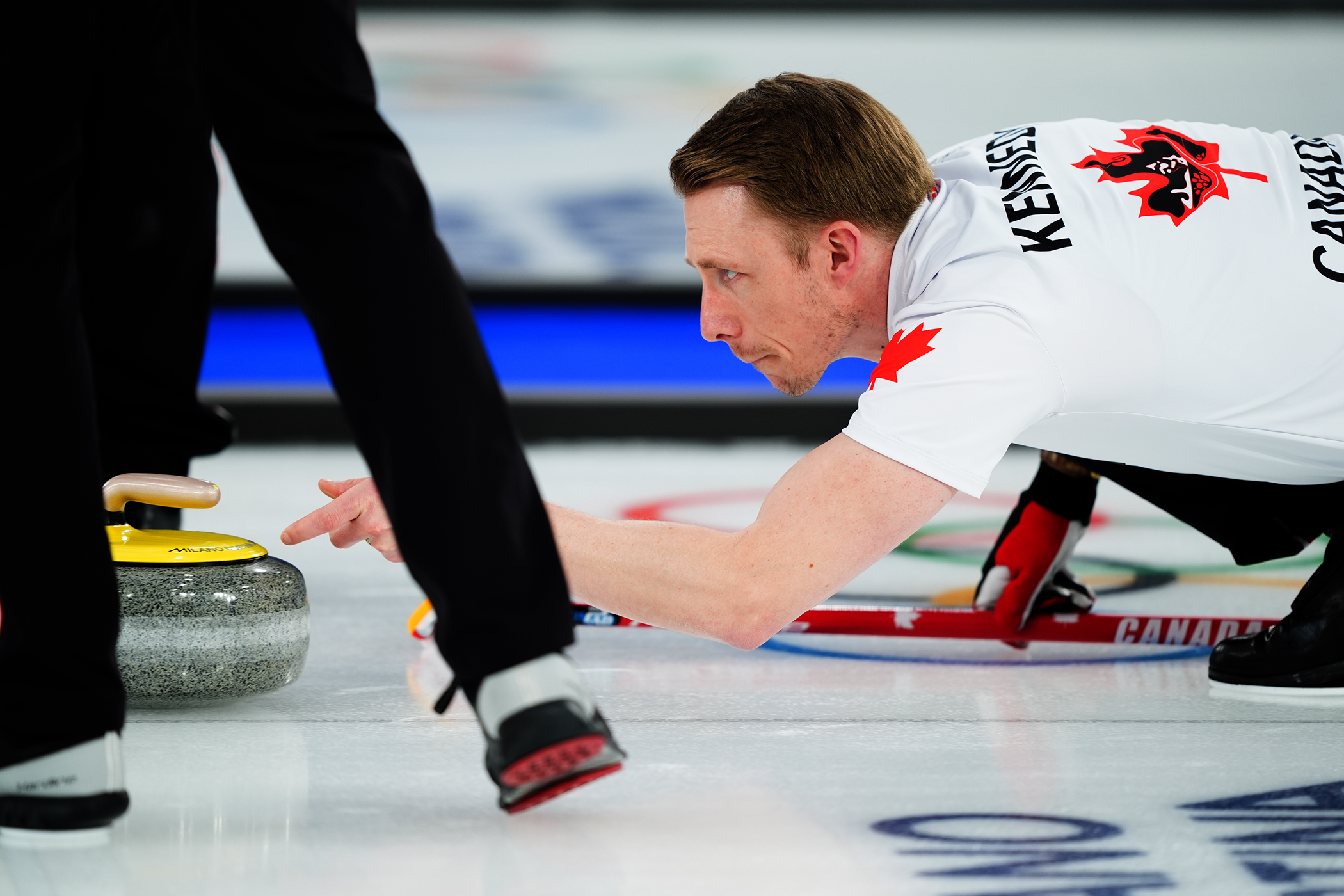


Personally, I don’t mind a bit of double-tapping. Or I didn’t until last week. That lingering touch with which the players send the stone down the ice, like someone reluctantly releasing their lover’s hand on a railway platform, seemed to me to be all bound up with the romance of curling, and part of the magic that brings us flocking to the rinks for, ooh, at least a handful of otherwise slightly under-occupied evenings every four years.
But I get it. Touching the granite during forward motion is strictly forbidden – correcting the stone’s course after release an absolute no-no. And once we concede that there’s a grey area here – as these fresh controversies out of the Winter Olympics oblige us to – we’re suddenly up to our ears in the rule book and having intractable arguments with each other about our “hog lines” and our “points of release”. And there’s nothing romantic about that.
So, as Ankara Leonard from the Royal Montreal Curling Club said to the BBC somewhere in the middle of this week’s squabbles: “Do I think the finger affects the rock? No, I do not. Do I think we have to play within the rules? Yes.”
Just a finger – that’s all it was. But Sweden thought Canada’s Marc Kennedy was cheating with that finger, and Kennedy, appalled at the very suggestion, was then caught on camera delivering what fine journalistic traditions require me to refer to as “an expletive-filled outburst”. (“We’re human out there and there’s a lot of emotions,” he said afterwards. No explanation necessary, Marc. We understand.)
All of which might have blown over soon enough. But then match officials accused the Canadian women’s team of another double-tap, in a narrow defeat by the Swiss, and conspiracy theorists were putting two Canadian double-taps together and making … well, is that four? Two? Five? One of those.
And then, while all that was still bubbling, Great Britain’s men, belatedly joining the party, had a stone chalked off for the same offence.
Suddenly, this double-tapping thing was getting out of hand, as it were. Naturally the sport felt obliged to react, and an update to the “stone monitoring protocol” was swiftly announced. Yet this amendment – essentially repositioning the existing umpires – is arguably only a sticking plaster, and respected voices in curling are now seriously suggesting that there is only one way to get around the double-tap problem and be in a position to adjudicate definitively on points of release in the longer term: the video assistant referee.
To which one can only say: no. Absolutely not. The beauty of curling, surely, is that it’s the same wherever it’s played – from the parks up and down the country on a Sunday morning to the sport’s uppermost echelons. But introduce VAR and straight away you’re hiving off the game’s top end and sending it away to be shadow-monitored from a weird bunker by qualified officials refashioned as full-kit data-analysts who turn out to be no less error-prone than anyone else.
Worse, the in-game officials will quickly become hopelessly dependent on VAR’s support, such that, when suddenly required to identify a stick-on offence without electronic assistance from 16 different angles, they can no longer do so and are left gurgling in the wind.
Meanwhile, in the stands, the unparalleled explosion of emotion that now accompanies a good stone will be neutered because everyone is going to have in their minds the possibility that VAR will discover a reason to discount it. And supporters will increasingly find themselves looking on vacantly during interminable pauses in which they don’t know what’s being reviewed or why, and while it’s slowly dawning on them that they are now basically paying to be extras in a television show that they can’t see.
Newsletters
Choose the newsletters you want to receive
View more
For information about how The Observer protects your data, read our Privacy Policy
And before you know it, you’ll have enraged crowds chanting, “It’s not curling any more” to the tune of “Bread of Heaven”, and diehard fans shaking their heads miserably.
Heads up, curlers. VAR is not the answer here, and never could be. Unless the question was: “How can we most efficiently drive this sport into a permanent state of contentiousness and accidentally ruin it?” Which it certainly wasn’t.
Photograph by Andrew Milligan/PA Wire