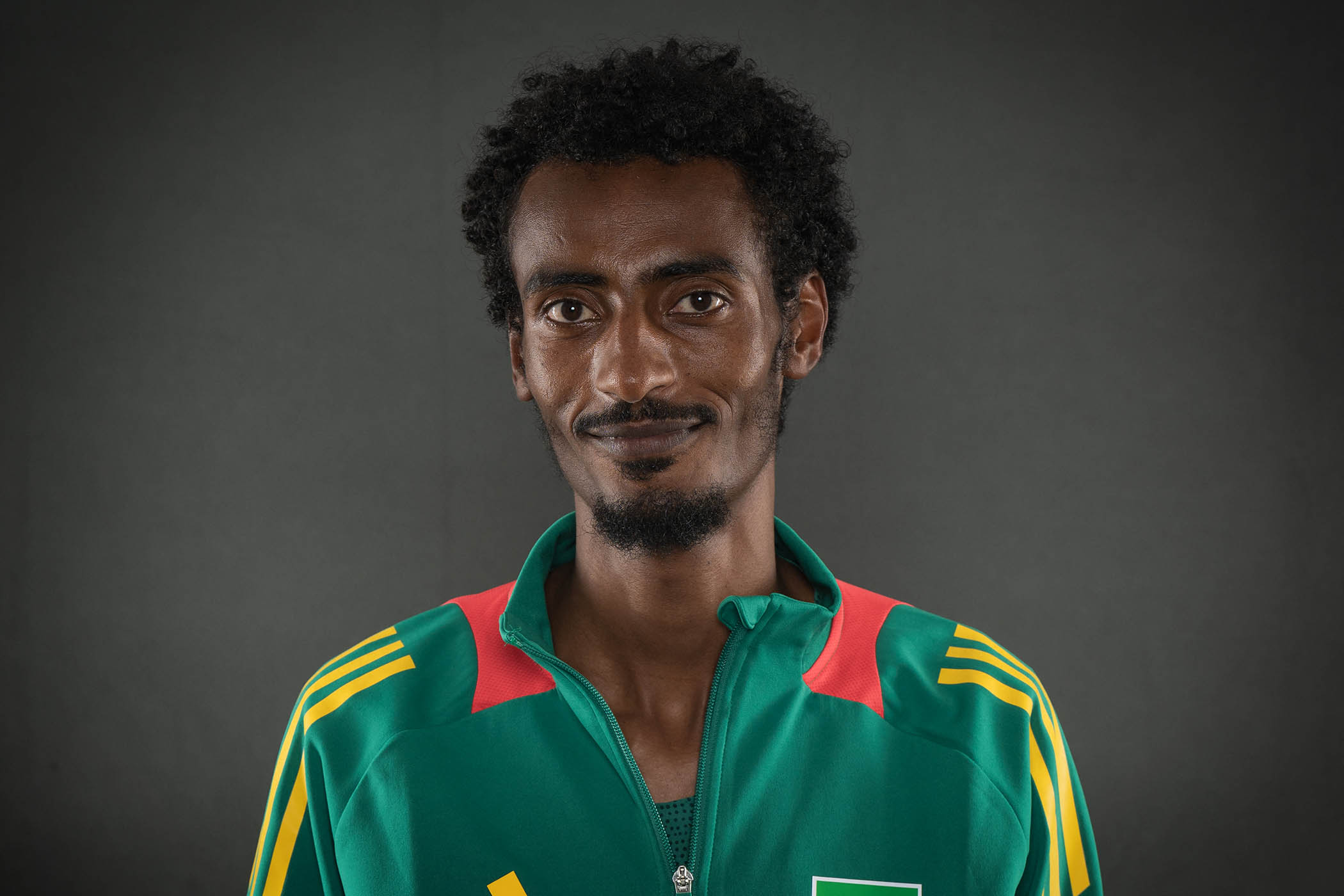

Last Monday afternoon, barely 24 hours after he had shattered the long-established boundaries of human possibility, Yomif Kejelcha found himself leaving London by private jet, heading for Adidas’s corporate headquarters in the small town of Herzogenaurach in Germany, roughly a half-marathon north of Nuremberg.
The 28-year-old Ethiopian was not alone. Sabastian Sawe, the Kenyan who had become the first man to run a marathon in less than two hours in London, was on board. So was Tigst Assefa, Kejelcha’s compatriot who had broken the women’s-only world record on the same day. Adidas, primary sponsors of all three, wanted to celebrate all of their achievements.
Inside the company’s sprawling campus, the trio were introduced to the designers and engineers behind the Adizero Adios Pro Evo 3 supershoes – the ones that weigh less than a deck of cards – they had all worn during the race. There was a meet-and-greet with employees. There was an on-stage question-and-answer session.
Adidas made a point of feting them equally. The building had been festooned with images of all three. There was Assefa kissing her shoe in victory. There was Sawe, perched on top of a timer bearing his unthinkable time. And there, accompanied by the slogan “two sub-two,” was Kejelcha, positioned ever so slightly behind Sawe as they ran into history.
“I am celebrating myself,” Kejelcha told The Observer. “I am so happy, so proud, and I am happy for Sabastian.”
It feels cold and heartless, and maybe just a little cruel, but that is, ultimately, how elite sport works. The idea that anyone could ever complete a 26.2-mile run in less than two hours had, for a long time, been regarded as a pipe dream. Paul Tergat, the great Kenyan runner, declared in 2009 that the feat was “impossible”. Although he did add the caveat that perhaps, one day, “time would chide me”.
That day, as it turned out, was last Sunday. With a little assistance from his lightweight shoes, as well as advances made in fuelling gels, Sawe finished in 1hr 59min 30sec, a time that the London Marathon’s race director, Hugh Brasher, immediately compared in significance to Sir Roger Bannister’s first sub-four-minute mile.
In breaking athletics’ last and greatest barrier, the 31-year-old shot to instant global fame. When he returned to Kenya, late last Wednesday, his plane was given a water-cannon salute. He was greeted on the tarmac by musicians and dancers. Later, the country’s president, William Ruto, presented him with 8 million Kenyan shillings (£45,000), and a car. “You have expanded the horizon of human potential,” he said.
When Kejelcha left Adidas’s headquarters, on the other hand, he flew to Madrid, where he will spend a few days continuing his recovery, before beginning to discuss with his management and his coaches where and when he might race next. He has not been profiled by GQ, or heralded by any presidents.
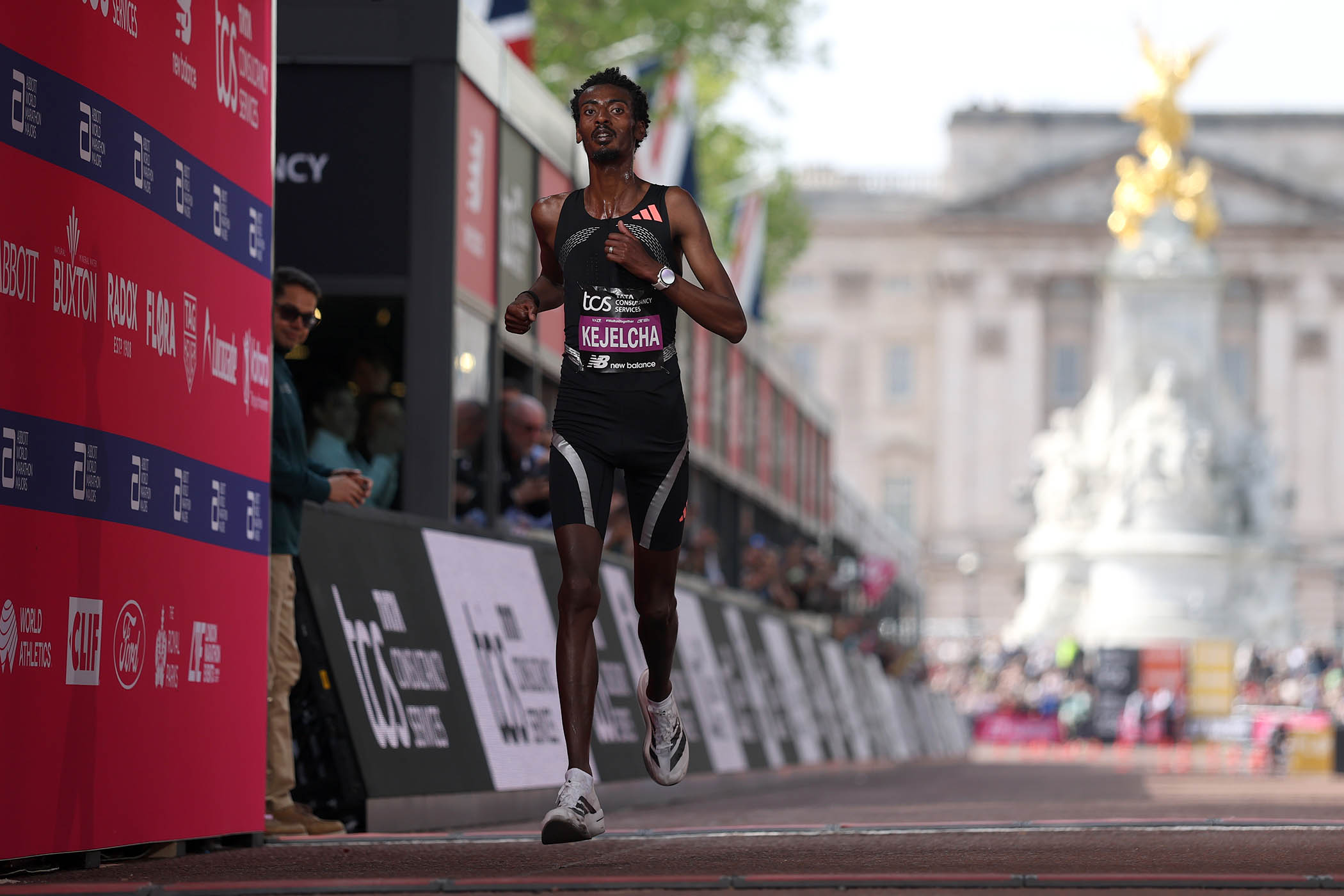
And yet he, too, broke the two-hour barrier. He, too, did something deemed to be impossible. He did it, in fact, in his first ever full marathon. He just did it 11 seconds slower.
Newsletters
Choose the newsletters you want to receive
View more
For information about how The Observer protects your data, read our Privacy Policy
On the phone to Kejelcha last week, it was hard to know how – or when – to ask the obvious question. The position he finds himself in is rare to the point of unique. It is certainly hard to think of a sporting parallel. Occasionally, someone might break a world record and still have to console themselves with a silver medal.
‘Kejelcha did not start with the intention of rewriting the tenets of athletic achievement. He was thinking about finishing in 2hr 2min’
‘Kejelcha did not start with the intention of rewriting the tenets of athletic achievement. He was thinking about finishing in 2hr 2min’
But that is not what Kejelcha has done; or rather it is not just what he has done. He managed to do something nobody else had done in human history, until precisely 11 seconds beforehand. In The Observer’s special London Marathon supplement today, the author Ed Caesar has compared him to Buzz Aldrin, always slightly chagrined at constantly being introduced as the “second man on the moon”. Maybe that is the closest it is possible to get. Maybe only Aldrin would be able to understand how he feels.
And yet, as Kejelcha casts his mind back over not just the race but his journey to it, it becomes clear that the question itself is wrong. Disrespectful, even. He has, over the course of his career, run a rich variety of distances – 3,000m, 5,000m, 10,000m, half-marathons – but he had been trying to persuade his coaches to let him loose on a marathon for a while; London, he said, was his “dream”.
Even so, he did not start with the intention of rewriting the tenets of athletic achievement. He was thinking about finishing in 2hr 2min.
His coaches were a little more confident. “My training had been amazing,” Kejelcha said. “I had changed everything. Nutrition, sleep patterns, everything. And it had been a really long preparation. They said to me that they knew that if I ran well, then I could finish definitely in the top three.”
He remembers feeling “nervous” as he stood on the start line – this was, remember, the furthest he had ever run in competition – but settled into the rhythm of it surprisingly quickly. “The half-marathon is much harder,” he said. “You start much more quickly.” At the risk of alienating literally everyone else who has ever run a marathon, he found the pace of it at 2min 50sec per kilometre “very comfortable”. The shoes, he said, were so featherlight that he didn’t “feel as though I was even touching the ground”.
‘I could not have run like that without him. But I think maybe he could not have run like that without me. We pushed each other’
‘I could not have run like that without him. But I think maybe he could not have run like that without me. We pushed each other’
That remained true to the halfway point; it remained true even as Sawe, “around the 26th or 27th kilometre”, started lifting the pace, turning the screw. “He is very strong,” Kejelcha said. “I was suffering more and more.” He stayed with him for as long as he could, until the 40th kilometre. “He passed me, and I knew he was going to increase,” Kejelcha said. Only then did he know Sawe had beaten him.
By that stage, though, Kejelcha had another target in mind. He had seen, a couple of miles beforehand, that he was on track to beat the world record. He was still feeling good. His legs seemed strong. “I thought I would challenge [myself] to see what time I could do,” he said.
When he saw, entering the final hundred metres, that he had only been running for 1hr 59min, he thought he might as well see if he could get under two hours. He finished the race 41 seconds later. It took a while for what he had done to sink in. “I had to keep asking my coach what time I had done,” he said. “I didn’t believe it.”
This is the juncture, the moment when the question has to come, but it feels inappropriate, awkward. Has he thought, at any point, about what might have been if only he had gone marginally, fractionally, infinitesimally quicker, about the universes that are contained in that 11 seconds?
That is how athletes’ minds work, after all, obsessed with victory and primacy, ruminating on how they might do better next time, where they might claim the next edge. Not Kejelcha, though. “I think I could not have run like that without him. But I think maybe he could not have run like that without me. We pushed each other.”
Maybe the rules are different, at these altitudes; maybe things change when you are not really racing your opponent, or yourself, or even history, but possibility. Maybe, then, first and second does not matter quite so much.
All that matters to Kejelcha, now, is what he might yet be able to do, quite how far he can push this. “I can absolutely go quicker,” he said. “It is not much harder for me to break the next barrier.”
In case you missed our London Marathon supplement featuring every finisher, we have a limited number of additional copies and we’re setting up a way for you to purchase one online and have it posted to you. If you’d like us to contact you about that, please fill in this form and we’ll be in touch:
Photographs by Andrej Isaković AFP, Alex Davidson/Getty Images