
This article first appeared as part of the Daily Sensemaker newsletter – one story a day to make sense of the world. To receive it in your inbox, featuring content exclusive to the newsletter, sign up for free here.
More than 250,000 miles from the ravages of the Earth, the Artemis II crew have travelled further into space than any other humans and are now on their way home.
So what? None of this guarantees a future Artemis mission will actually put people on the moon. Delays to SpaceX’s lunar lander indicate that there are plenty of challenges on this front. But the seven-hour flyby is a remarkable moment, which
•
has tested how the 355,056 individual parts of the Orion spacecraft handle extreme conditions;
•
represents a first step in solving several unsolved mysteries about the nature of the moon; and
•
will remind other countries seeking space dominance that the spirit of American collaboration is not yet dead.
This is America. The four-person crew includes the first woman and the first non-US citizen to head to the moon, as well as the first Black American to travel beyond Earth’s orbit.
This is the mission. Taking off on Wednesday from the Kennedy Space Center in Florida, Orion and its crew were in space within eight minutes and sent out of Earth’s orbit within 24 hours. In between they had to deal with a malfunctioning toilet.
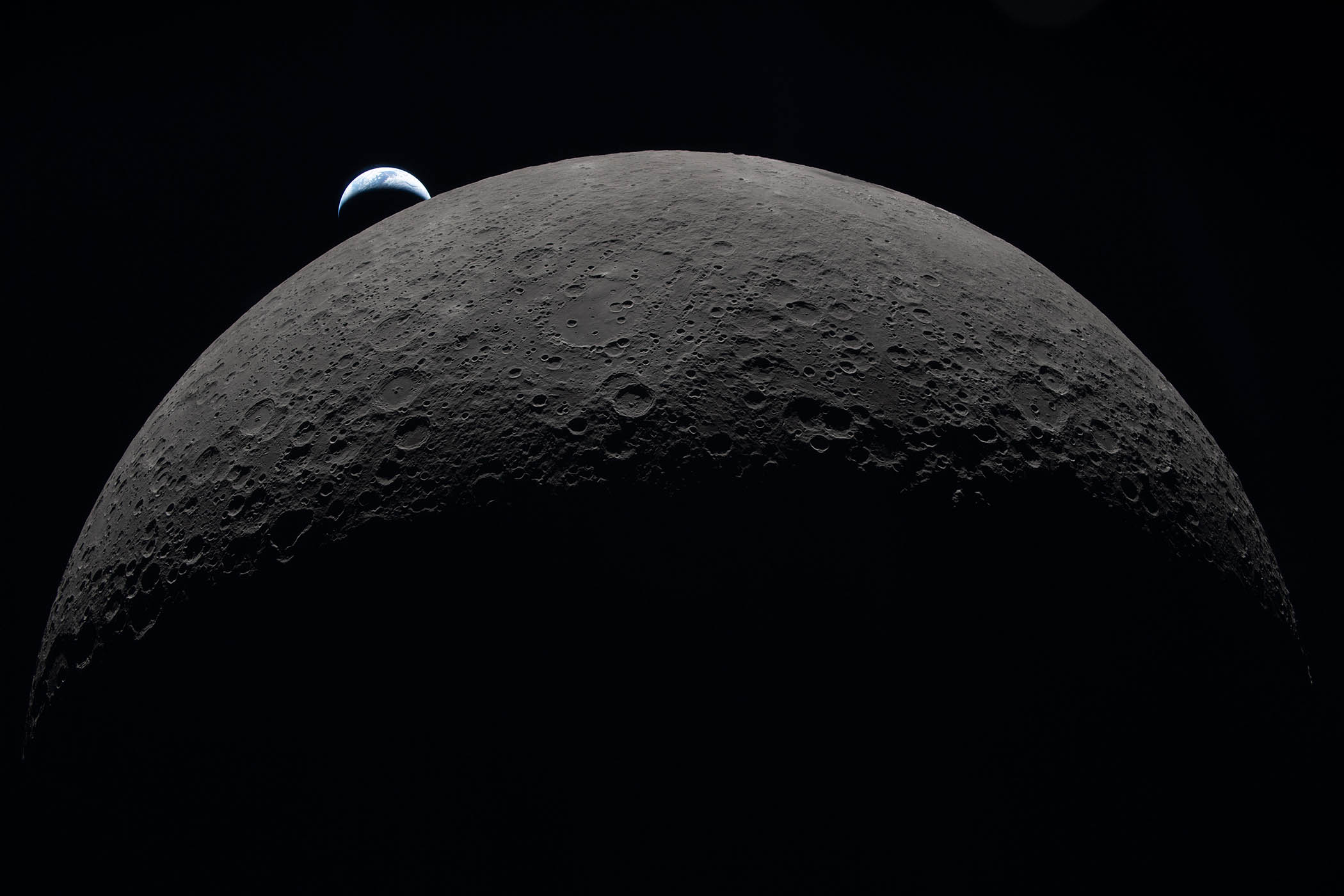
This is silence. On Monday, the crew reached the moon and flew around its far side, which had never been directly seen by the human eye. Lunar observations were conducted during a planned 40-minute communications blackout. Commander Reid Wiseman took a picture with his iPhone 17 Pro, but the whole spacecraft was equipped with cameras.
To boldly go. The crew identified two new craters. They named one Integrity, after their moniker for the craft, and the other Carroll, after the late wife of Wiseman.
To boldly know. It is hoped that further discoveries will be made on this and future Artemis missions. Unanswered questions include
•
how exactly the moon formed;
•
why one side looks so different from the other;
•
where its water came from and how much there is; and
•
what has kept it hot enough to stay alive for more than 4.5bn years.
Right back at you. Solving some of these mysteries might help us better understand how the Earth formed and evolved. While our planet has changed enormously due to tectonics, volcanism, oceans and atmosphere, the moon, in its calmness, is a relative time capsule.
And beyond. Another eventual aim is to create a lunar base that will allow humans to go on to Mars. The Artemis missions are designed as a way to test living and working in deep space. It is less risky to do this than on the Red Planet, which is six months from home.
Steady on, Houston. Despite the crew’s record-breaking feat, the hard bit is to come. While Neil Armstrong and Buzz Aldrin went to the moon with a lander strapped to their command module, the idea this time is to put the lander in orbit around the moon in advance.
The problem is that this lander, which has been entrusted to Elon Musk’s SpaceX, is still in development and has faced a number of delays. Its major hurdle will be to refuel itself in space, which will require around a dozen other crafts to act as storage tankers. Transferring cryogenic, highly explosive, propellants to a lander in bustling low Earth orbit has never been tried before and will be risky at the very least.
The timeline. Artemis III, scheduled for 2027, will test docking capabilities between Orion and a SpaceX lander. Artemis IV, scheduled for 2028, will attempt to put humans back on the moon for the first time since 1972.
Competition time. Any further delays may lead to geopolitical defeat. China has already landed robots and rovers on the moon and wants to get to the lunar surface by 2030.
Before worrying about that, the Artemis crew need to get back to Earth. On Friday, they are due to parachute into the Pacific after falling through the atmosphere at nearly 25,000mph. This will be the first time the Orion’s heat shield will be called into action to protect astronauts against exterior temperatures above 2,700C.
What’s more… The heat shield used for Artemis I, an uncrewed flight, threw up concerning issues. A new one hasn’t been built due to time constraints, but it’s hoped that an altered trajectory will be enough to keep the crew safe.
Photograph by NASA via Getty Images
Newsletters
Choose the newsletters you want to receive
View more
For information about how The Observer protects your data, read our Privacy Policy