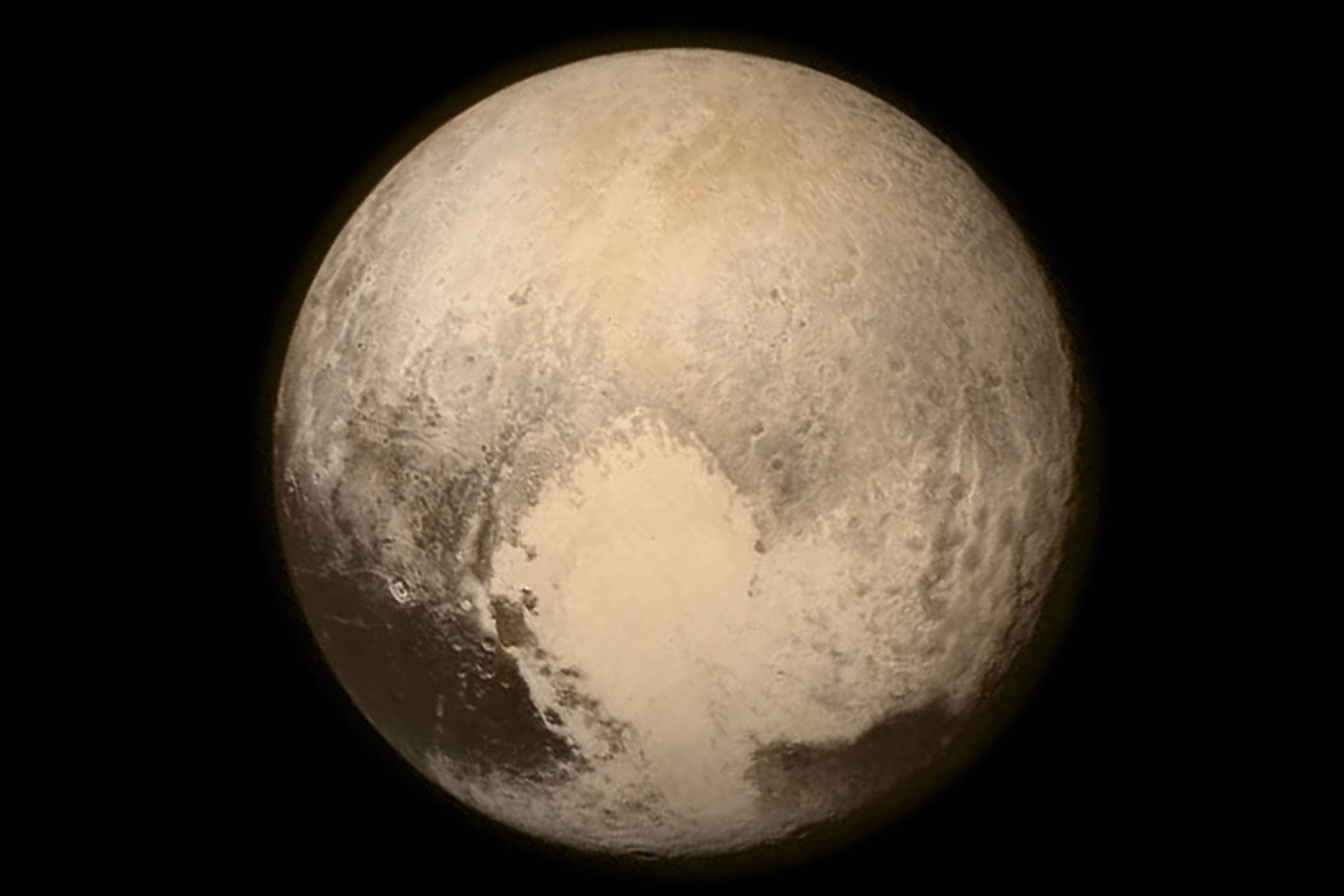


What’s in a name or, to be more specific, an astrophysical category? Rather a lot, according to Nasa chief Jared Isaacman. He recently informed a US senate committee that he was “very much in the camp of ‘Make Pluto a planet again’”.
Ever since it was discovered in 1930 by the self-educated astronomer Clyde Tombaugh, Pluto’s status has been a subject of, if not cosmic importance, then healthy disagreement.
For 76 years the tiny ball of rock and ice, about two thirds the size of Earth’s moon, was recognised as the ninth, smallest and most distant planet of the solar system, though some scientists such as the astronomer Brian Marsden maintained that it did not satisfy planetary qualification.
Then in 2006, nine years after Tombaugh’s death, members of the International Astronomical Union voted on the criteria for a planet. The backdrop was a growing concern that more and more objects in the Kuiper Belt, the outer-suburbs of the solar system that are filled with dwarf planets and comets, would join the planetary elite as our observational abilities increased.
IAU came up with three rules for qualification. A planet must orbit the sun, be spherical by force of its own gravity, and it must have “cleared the neighbourhood” around its orbit, meaning that it must be gravitationally dominant over surrounding objects.
Pluto passed the first two, but failed the third, because it shares its orbit with objects that it is too small in mass to eject. Thus its status as a planet was withdrawn, leaving only eight officially recognised planets in the solar system.
Many criticised the decision, the most vocal of whom has been the planetary scientist Alan Stern, the principal investigator on the New Horizons mission to Pluto. In 2015 the New Horizons probe sent back dramatic images showing a geologically active world with ice mountains.
“Science isn’t about voting,” Stern told me in 2016. “We don’t vote on the theory of relativity. We don’t vote on evolution.”
He welcomes Isaacman’s recent intervention.
“The Nasa brand is very strong and its credibility is very high,” he says. “I think a lot of the public will understand that as an authority speaking.”
Newsletters
Choose the newsletters you want to receive
View more
For information about how The Observer protects your data, read our Privacy Policy
Stern maintains that the overwhelming majority of planetary scientists are in agreement with him and Isaacman about Pluto. He cites a 2018 paper by Philip Metzger, a scientist at the Florida Space Institute, which examined the scientific literature for the past 200 years, and found only one paper, published in 1802, that stipulated orbit-clearance as a factor in planetary classification.
One scientist who has written about the role of orbit-clearance is Mike Brown, a professor of planetary astronomy at the California Institute of Technology. Following Pluto’s demotion, he published a book called How I Killed Pluto and Why It Had It Coming, a title that accurately conveys his sardonic dismissal of sentimentality.
“Alan is just mad that the IAU said dwarf planets aren’t planets,” he says of Stern. “I frequently get told that dwarf planets have to be planets because the word is in the name, and I tell them to tell it to the sea horse.”
He is equally disdainful of Isaacman’s intrusion into the debate.
“He has no background in science and likely knows little of the discussions that happened back in 2006,” Brown says.
‘Just as you shouldn’t go to a podiatrist for brain surgery, you shouldn’t go to an astronomer for expert advice on planetary science’
‘Just as you shouldn’t go to a podiatrist for brain surgery, you shouldn’t go to an astronomer for expert advice on planetary science’
Alan Stern, New Horizons mission
A billionaire entrepreneur, Isaacman was nominated by the newly re-elected Donald Trump in December 2024 to be the administrator of Nasa, only for the president to withdraw the nomination last May. Many observers saw it as a slap-down to Elon Musk, with whom Isaacman has business links. Seldom a stickler for procedural consistency, Trump then renominated Isaacman and he took up the job in December, promising a “new golden age of science and discovery”.
Last month a 10-year-old girl named Kaela sent an open hand-written letter to Nasa, urging the agency to make Pluto a planet again. “It would make me very, very, very happy,” she wrote. The letter went viral.
Although busy overseeing the world’s biggest space agency and its various exploration and aeronautical projects, Isaacson found the time to respond: “We are looking into this.”
Brown, for one, smells a diversionary PR campaign. “I assume all of this is a distraction from the Trump administration’s proposal to cut the Nasa science budget in half,” he says.
The White House budget request, released last month, called for a 47% cut to the Science Mission Directorate and a 10% increase for exploration funding.
“I guess with all of those pesky scientists out of the way, Isaacman can say whatever he pleases,” says Brown. “He has no special standing with the IAU, Nasa cannot force the IAU to reopen the discussion, and it seems exceedingly unlikely that the IAU will reopen it.”
For his part, Stern, who calls Isaacman “exceptionally talented”, says that the IAU’s opinion “doesn’t matter”. He has long maintained that most of the astronomers who took part in the vote were not well informed about the nature of planets. As he put it to me: “Just as you shouldn’t go to a podiatrist for brain surgery, you shouldn’t go to an astronomer for expert advice on planetary science.”
Yet if you Google how many planets there are in the solar system the answer will be eight, just as it is in textbooks in America and the UK. “Yes,” he acknowledges, “it’s bewildering to me why textbooks follow such an anti-science process”, although he says this is beginning to change.
Of course, Pluto will carry on orbiting the sun once every 248 years, regardless of how we classify it. The arguments made from an average distance of about 3.5bn miles may seem all too human, egotistical, even trivial, but then classification is how we make sense of the world and, indeed, the universe around us.
For Plutonists such as Stern, there is a rich history and complex geology to this distant object that is of planetary importance. For anti-Plutonists such as Brown, significance stems from scarcity. “The word planet is like the word continent,” he said. “There needs to be a smallish number of them. If every island was a continent, it wouldn’t mean anything.”
With its echo of Maga, make Pluto a planet again is a phrase that suggests a nostalgic journey back to a past of certainties, when everything was in its right place in the heavens. But actually it’s the Plutonists who represent the argument for radical change.
Stern has estimated that there might be as many as 1,000 planets in the solar system. He has also mocked anti-Plutonists for fearing that “schoolchildren won’t be able to remember their names”.
Whoever eventually wins the argument, the school of eight or 1,000 planets, the chances are that Kaela will not be very happy.
Photograph by NASA / Getty Images