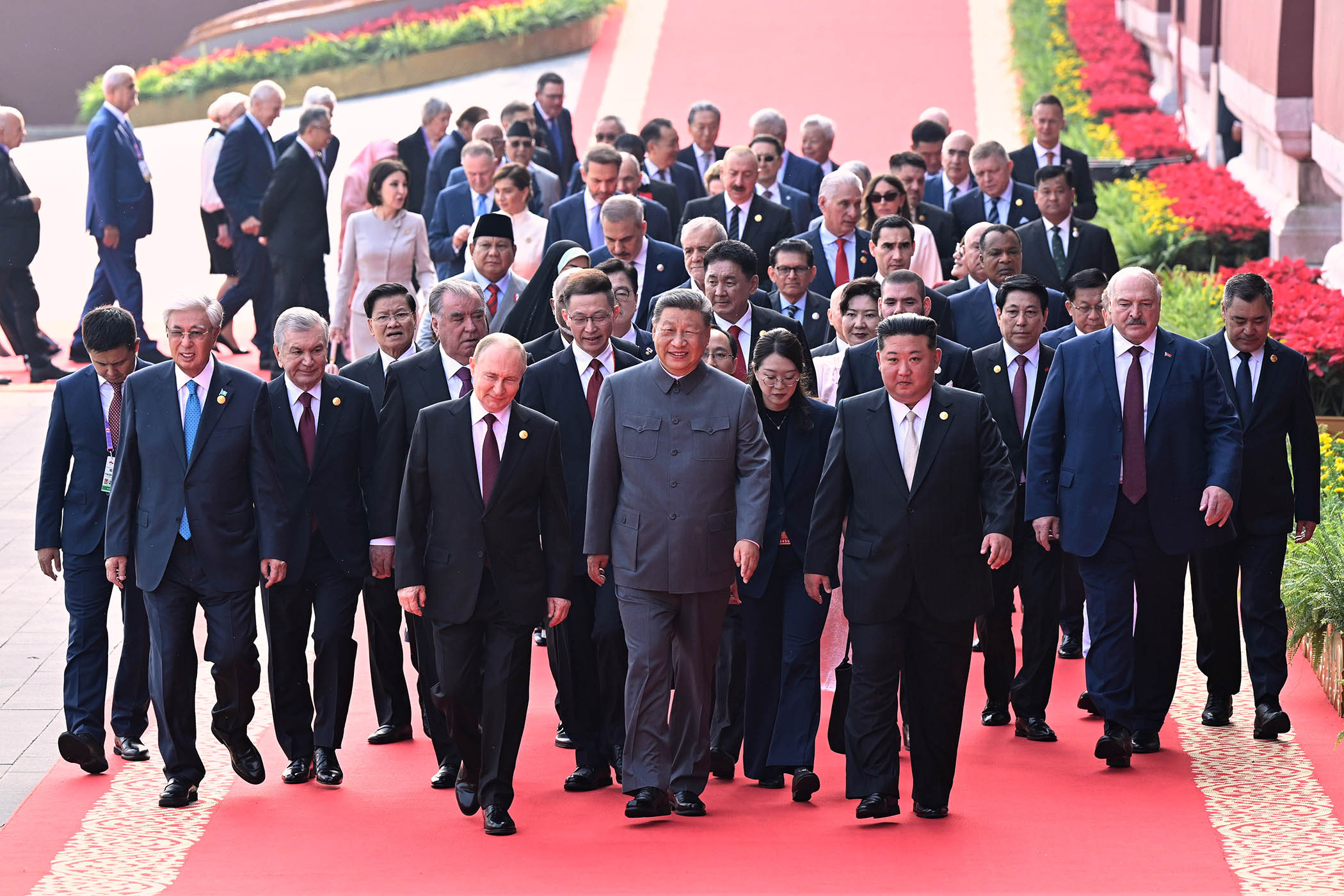



Global democratic freedoms have declined for the 20th consecutive year, according to a new report by the US thinktank Freedom House.
So what?
Authoritarian rule has become the norm. Democracy is an outlier. Civil liberties are being stripped back and free expression stifled. This trend is deepening; it affects every region of the world and has been partly, but not entirely, driven by the US.
New dawn
At the beginning of the 1990s, democracy was on a march that appeared inexorable. The Berlin Wall had just come down and a wave of political liberalisation was sweeping Europe, Africa and Asia, where one-party states were replaced with multiparty systems.
Triumphant
Francis Fukuyama, an American political scientist, called this moment “the end of history”. He argued that the ascendancy of the US and the breakup of the Soviet Union after the cold war demonstrated that western liberal democracy represented “the final form of human government”. In other words, democracy had won and it was here to stay.
Think Donald Trump riding a wave of discontent to win two elections
Think Donald Trump riding a wave of discontent to win two elections
On the slide
It didn’t turn out that way. Democratic freedoms have declined every year since 2000, according to Freedom House. Of the countries the organisation measures, only 35 have registered improvements, while 54 have seen declines in political rights and civil liberties. In the past two decades, the rights that have suffered most are media freedom, due process and freedom of expression.
Stark reality
Another recent report, Unravelling the Democratic Era by the Swedish research organisation V-Dem, paints the situation in even starker terms. It found that the proportion of the global population living in proper democracies – which combine free elections with individual rights and checks on executive power – fell from 17% in 2005 to 7% in 2025. The percentage of people living in autocracies is 74%, up from 50%.
Why?
Coups and armed conflict have taken their toll. These are a particular problem in places such as west Africa, where military juntas have overthrown elected governments in Burkina Faso, Niger and Mali. These leaders have stifled civil society, dissolved political parties and legislated to entrench themselves in power. Opposition is met with force. Existing autocrats, meanwhile, have dug in and deepened their repression.
Backsliding
Elected leaders have attacked democratic institutions and eroded freedoms. This trend is probably best typified by Viktor Orbán, who pioneered the model of illiberal democracy in Hungary. But it is also present in Brazil, where transparency and anti-corruption safeguards took a hit under Jair Bolsonaro, and in India, where Narendra Modi’s Hindu nationalist government has cracked down on civil groups and the media.
Losing its shine
The US is now at the forefront of this trend. Its score in V-Dem’s index has fallen by 24% under the second Trump administration. The speed and scale of this drop is “unprecedented in modern history” and has taken civil rights back to the late 1960s, according to V-Dem. The second biggest decline in recent history? Donald Trump’s first administration.
Underfoot
During both his terms, V-Dem said, Trump has managed to outdo “the most prominent autocrats of the last 25 years” in how quickly he has trampled on his country’s democracy. This includes eliminating checks on presidential power, undermining the rule of law and seeking to silence critical media voices.
Ripple effect
This matters beyond America’s borders for two reasons. First, because the US has long led by example as a “shining city on a hill”. Second, because it has spent decades trying to foster democracy in other places through the US Agency for International Development (USAID) and media such as Voice of America. These programmes are mostly gone.
The playbook
According to the Lowy Institute, democracy does not disappear overnight. Instead it is rolled back through a steady process of erosion, a process that has several steps.
•
Certain conditions need to be in place. These range from economic inequality and social change to distrust in institutions and political polarisation.
•
There need to be would-be autocrats skilled enough to exploit points of discontent to seize power. Think Trump riding a wave of discontent over migration and the cost of living to win two elections.
•
Once installed, they eat away at democratic norms and institutions, hollowing them out from within. Power is consolidated in the executive; opposition parties are cowed; and the courts are hamstrung.
The result
This process rarely results in complete dictatorship akin to North Korea’s. “Democratic erosion can lead to autocracy but more often it results in lower democratic quality short of complete breakdown,” says the Lowy Institute.
Grumbles
Alarmingly, dissatisfaction with democracy is growing. A 2020 report found that this has become the majority view around the world, identifying 2005 as the beginning of what has been called a “global democratic recession”. The trend was only bucked by an “island of contentment” comprising Denmark, Switzerland, Norway and the Netherlands.
The alternative
The evidence is mixed as to whether people would prefer to live in an autocracy. Ben Seyd, a political scientist at the University of Kent, argues that low levels of political trust may compel citizens to elect authoritarian leaders who then undermine democratic institutions, but this doesn’t mean these citizens want to do away with democracy itself.
Rising up
This is evidenced in the gen Z protests that have swept many parts of the world. Young demonstrators in Serbia, Nepal and Kenya live in what Freedom House calls “partly free” countries, which hold elections but where some freedoms are curtailed. Their various demands ranged from an end to corruption to an end of police brutality.
In other words, they want better governance. Not authoritarian rule.
Photographs by Shen Hong/Xinhua News Agency via AP
Newsletters
Choose the newsletters you want to receive
View more
For information about how The Observer protects your data, read our Privacy Policy