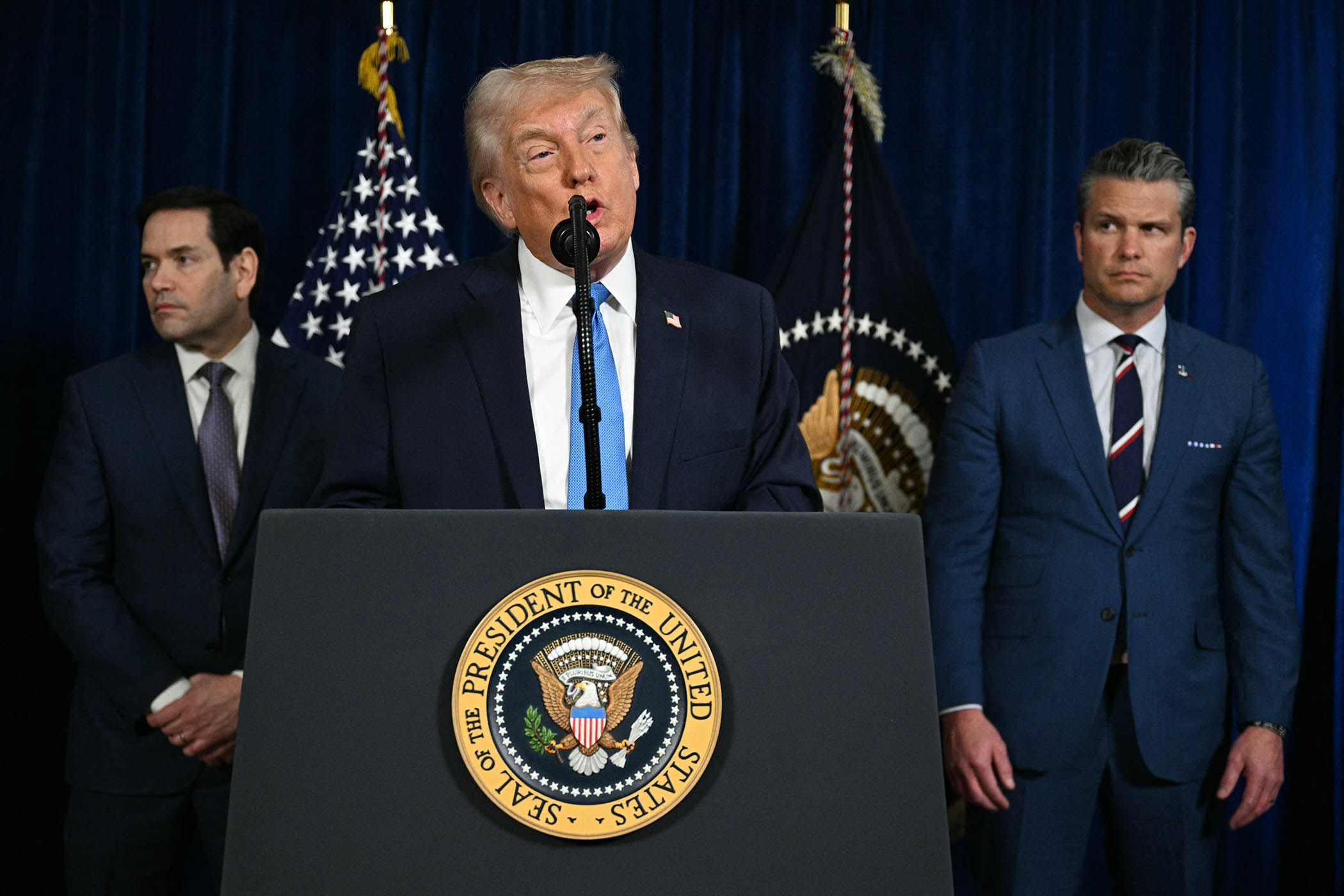

Two moments in yesterday’s press conference at Mar-a-Lago captured its unhinged tone and its profound significance. First, having said he would follow the arrest of Venezuela’s President Maduro by “running” the country in his place, President Trump was asked how. With “a team”, he said. Further details were not forthcoming. Then, when asked how taking over the administration of a South American country chimed with his America First philosophy, Trump simply said it did, and pivoted almost at once to the theme of extracting Venezuela’s oil wealth with the help of the American oil majors.
More or less continuously from before 1945 until the second Trump administration, it was possible to make the case that the greatness of American power rested not just on its capacity to apply military force, but on its capacity to inspire. The US has had its quarrels with the UN but it has broadly supported the international institutions it set up after the second world war. It has broken its own rules in the past, but especially during the Cold War it could at least attempt to argue that the ends justified the means. At home and abroad, it has spoken up for due process and the rule of law in principle, if not always in practice.
That changed on Saturday morning. No one should doubt that Nicolás Maduro destroyed most of what remained of the Venezuelan economy when he inherited it from Hugo Chávez. And, of course, a case can be made that he was a regional menace, supported in office by another regional menace in Cuba. But Trump’s decision to decapitate the regime and send its leader blindfolded to Manhattan via an aircraft carrier parked in the Caribbean was a Rubicon crossed. It is nigh on impossible to argue this time that the ends justified the means. This was the clearest possible signal from a US administration that it has abandoned a foundational principle of the postwar order: that independent, sovereign nations enjoy certain equal rights under international law, no matter their size or wealth, or lack of it – among them a reasonable expectation that their borders and leaders cannot be changed by force. Team Trump has declared instead that might is right.
A wise observer last night noted that Trump recently told the Atlantic magazine that “America First” means whatever he wants it to mean. In case anyone was in any doubt as to the implications, his secretary of state stepped up to the microphone at the press conference to note that Cuba’s leadership should be worried too. The recently published US national security strategy filled in some gaps: any Latin American country Washington chooses to accuse of narco-terrorism should now consider its leadership on notice. The reassertion of a “hemispheric” zone of influence revived the threat of a US takeover of Greenland.
In Caracas yesterday, America exercised untrammelled military power, and lost authority. The US is probably more feared now as a result, but less respected. It is exercising power as a bully, not a leader. And the sheer hubris of Trump’s announcement that the US will now run Venezuela for a transitional period, with an unspecified team led by two men with no experience of nation-building, leaves one wondering if the leader of the free world has any memory of the last time his country tried running another – in Iraq. The definitive account of that experiment was titled “Fiasco”.
The decapitation of Venezuela’s government will be interpreted by Vladimir Putin as implicit endorsement of his war on Ukraine, and by Xi Jinping as an invitation to attack Taiwan. It leaves Europe’s leaders in an awkward situation, but not one they should overthink. They should not walk into the trap of defending Maduro; neither should they abandon the rules-based international order as Trump has. It remains the world’s best defence against tyranny, which is now in danger of acquiring an American face.
Photograph by Jim Watson/AFP via Getty Images
Newsletters
Choose the newsletters you want to receive
View more
For information about how The Observer protects your data, read our Privacy Policy