

Typically, when a US president convenes a meeting in the White House situation room, the purpose is to discuss a question of national importance on which a decision is needed. He hears options from senior staff and picks the best or least bad among them. On Friday he spent two hours there talking about proposals to extend a fragile ceasefire in Iran, and decided nothing.
He had no good options. Even now, three months after the US and Israel started a war of choice with bombing raids across Iran, Washington and Tehran have incompatible sets of demands on sanctions, nuclear enrichment and the Strait of Hormuz. As a result, the strait remains all but closed and oil prices remain 30% to 40% higher than before the fighting started.
There are no clear winners in this war, but there are clear losers. They include the 156 civilians, including 120 children, who lost their lives when US forces bombed a school in southern Iran on the first day of the bombardment; consumers worldwide dealing with an energy price spike that is turning into a plateau; and Trump. Despite killing Iran’s supreme leader and much of his entourage, he has failed to achieve any of his war aims, namely to topple the regime, eliminate its ballistic missiles and deny it a nuclear capability. Instead, he has handed it a new weapon in control of the strait, which was always available to Iran in principle but is now an actual tourniquet on a fifth of the world’s oil supply.
Trump’s best-case scenario is to get back to a strategic balance roughly similar to that of three months ago, albeit with the knowledge that a new generation of hardliners is now in control in Tehran and can reapply the tourniquet at any time.
That will always suit Vladimir Putin, for whom this war has been a lifeline. In February, four years after his full-scale invasion of Ukraine, sanctions were at last starting to bite in earnest. But in March Russia’s oil earnings surged by $9.3bn month-on-month to $19bn, according to the Kyiv School of Economics. The larger context is still bleak for Putin.
He too has failed to achieve his war aims and last week his finance minister forecast a $28bn overspend on the war this year relative to the 40% of the Russian federal budget already earmarked for defence and security. But Putin still has a staunch ally in China’s Xi Jinping and, in Trump, he has what would have been described in the cold war as a useful idiot.
The cap fits. Trump has often behaved as if he were a paid-up Russian asset, regurgitating Kremlin talking points and trusting Putin over his own intelligence agencies. But so far the evidence is that he is more straightforwardly bedazzled by Putin’s ruthless exercise of power; a capitalist equivalent of the west’s socialist fellow travellers in the Stalin years.
Trump is not just a useful idiot. There is no shortage of evidence of other forms of presidential idiocy. The narcissistic variant was on show when he exploded on social media last week, after a judge had ordered that his name be removed from the Kennedy Center for the Performing Arts. The corrupt variant is exemplified in his request for nearly $1.8bn of public funds to compensate supposed victims of “lawfare” by the Department of Justice during the Biden years, among them hundreds of 6 January rioters jailed for insurrection. And it is the vainglorious, impulsive variant which has left Trump without decisive leverage over Iran’s new supreme leader.
In practice this president is too gifted as a politician and too shameless as a populist to be written off as an idiot. But he was extraordinarily foolish to start a war with Iran without a plan to end it, and Putin will be grateful as long as it goes on.
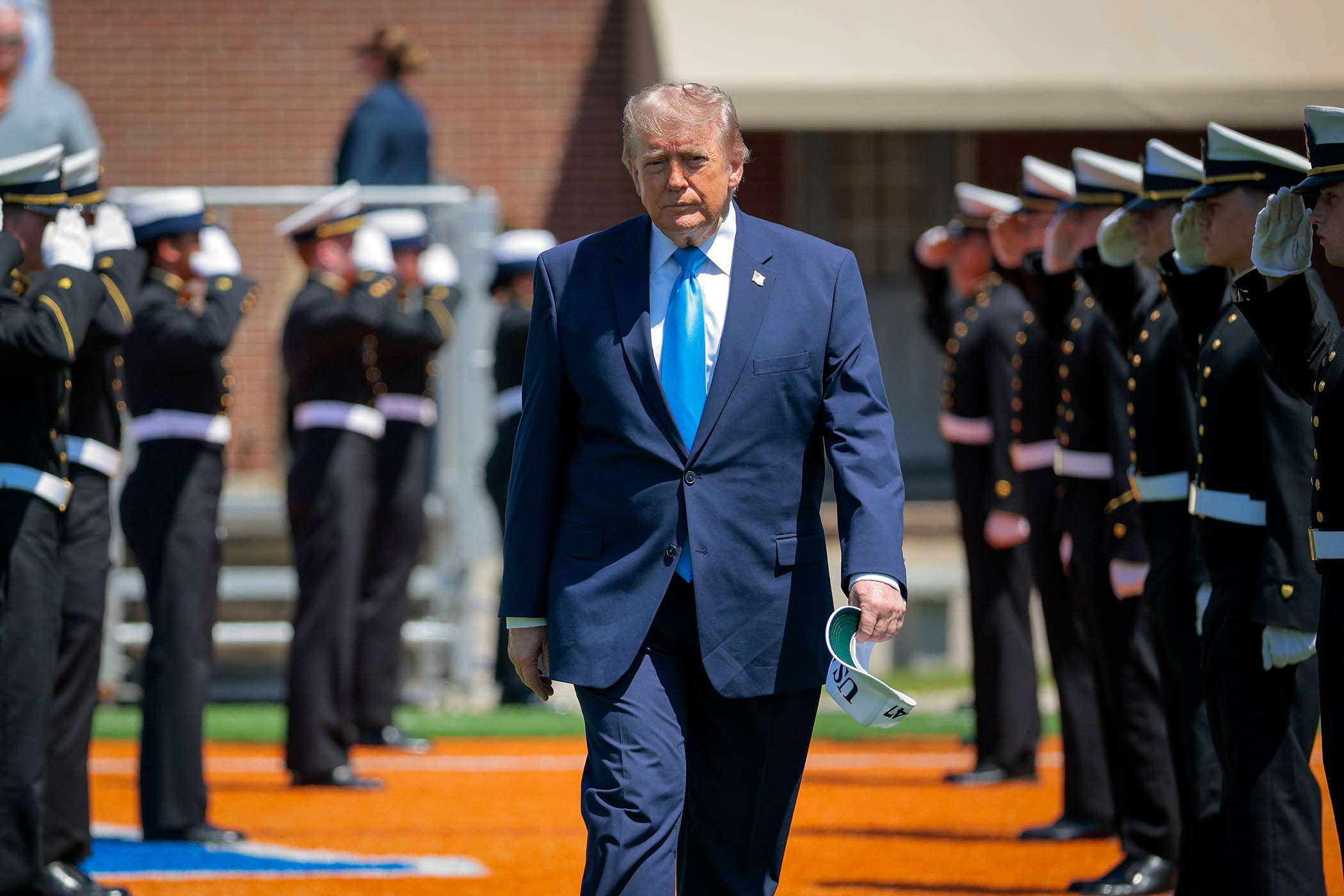
Photograph by Chip Somodevilla/Getty Images
Newsletters
Choose the newsletters you want to receive
View more
For information about how The Observer protects your data, read our Privacy Policy