
The future doesn’t have to be dystopian, according to The Observer view, if we keep our heads (“AI is not a magical power. We need to keep our heads”, 24 May). But we have already lost them to the bosses of corporations who consistently and relentlessly put profit before people.
Big tech, big pharma, big food and agriculture, big oil and big media are not serving the common good. They are sacrificing human health, wellbeing and dignity on the altar of money. Unless corporations are forced to prove the benefits of their operations to the betterment of humanity we are lost as a species.
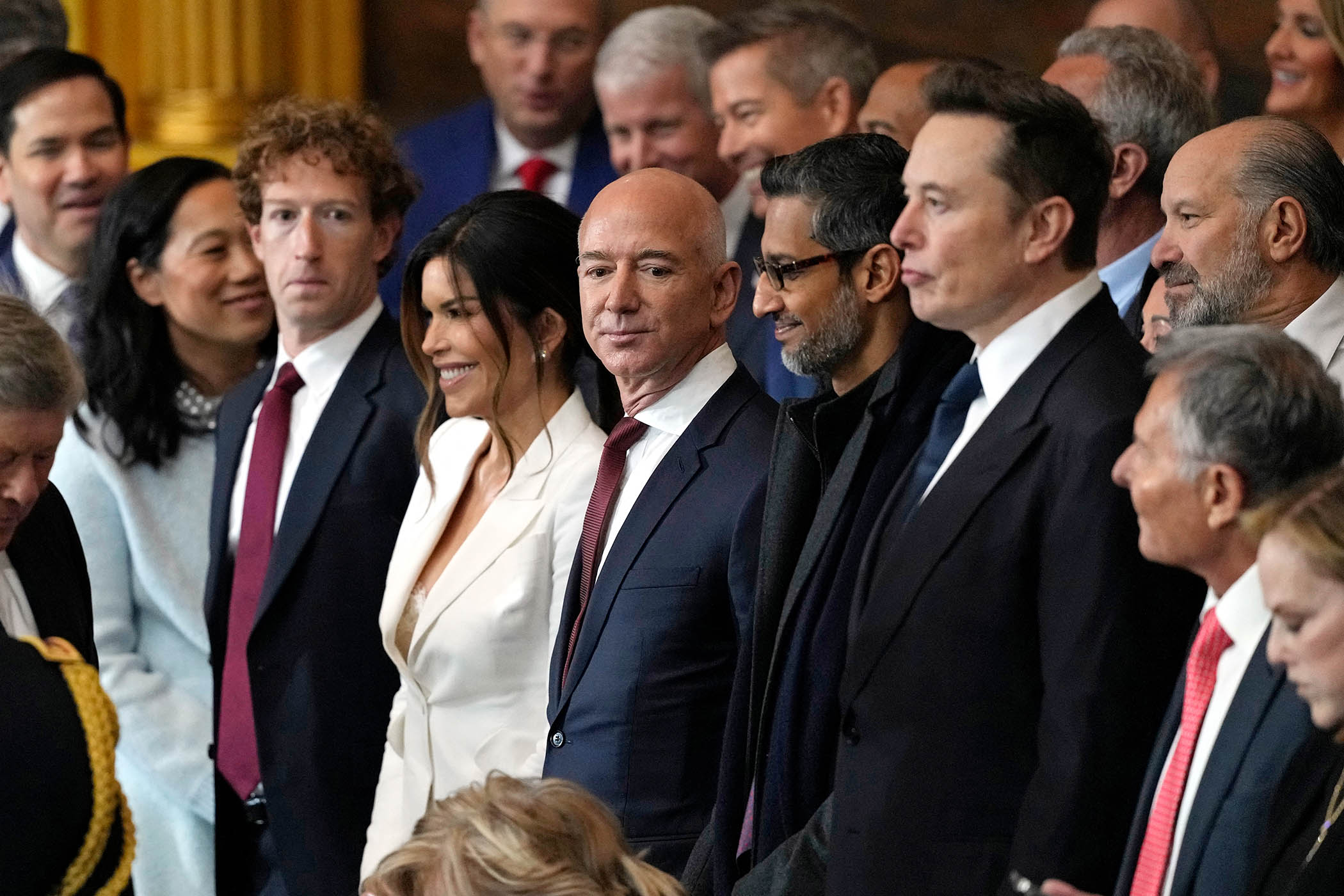
The ever increasing disparity between rich and poor is a danger to us all. It was profound social inequality that led to the French Revolution. We need governments across the world to work together and stand up to the likes of Elon Musk, Peter Thiel, Mark Zuckerberg, Donald Trump, Rupert Murdoch and the many others in the billionaire club who are trashing people and planet, on our watch, for personal gain.
Fiona Carnie, Isle of Coll, Scotland
Reform to curb Reform
Andrew Rawnsley touches on the issue of scrapping first past the post as an electoral system and replacing it with a proportional system (“Whatever your fantasy of the perfect Labour leader, Andy Burnham wants to be it”, 24 May). He goes on to write that such a change “could not happen without a referendum” and points out there was nothing in the 2024 Labour manifesto promising electoral system change.
I strongly disagree. The 2019 general election gave Boris Johnson an 80-seat majority on 43.6% share of the vote. Even more unbalanced, the 2024 election bequeathed a 174 majority to Labour on just 34% share of the vote.
The first-past-the-post (FPTP) system needs to be scrapped as a matter of urgency.
For decades the Electoral Reform Society has made an intellectually compelling argument for switching to the single transferable vote (STV).
With no change in the electoral system it remains within the bounds of possibility that in 2029 Reform could gain a parliamentary majority on 34% of the vote. For over 50% of the UK electorate such a result would be anathema. This contingency can be headed off by the present government moving quickly to switch our system from the discredited FPTP to STV. The government has the parliamentary majority to enact this. Over 80% of Labour party members support proportional representation, while there is also strong support among the Liberal Democrats and the Greens.
Newsletters
Choose the newsletters you want to receive
View more
For information about how The Observer protects your data, read our Privacy Policy
There is no statute requiring that a successful referendum precede any change. Labour had no manifesto commitment to retain FPTP. The government could argue “force majeure” and enact a change that would clearly be in the public interest.
John Cole, Shipley, West Yorkshire
Snake in the crass
It doesn’t really matter whether The Serpent in the Grove was written by or with the assistance of AI. (“‘My writing process is unusual,’ says prize-winning author accused of being AI”, 24 May)
What the story does is tick all the boxes for a team of judges who are geared to cater for the whims and prejudices of a publishing industry looking for middlebrow exotica. After the opening paragraph’s references to “sun”, “drumskin” and “porridge”, the story goes on to offer a woman “brown like dust” and another woman who “wore the island’s mixed bloodlines like a crown” while having the “kind of walking that made benches become men”. Crass and sexist – AI or not.
Whether by AI or via the shrewd spinning of cliches, this is giving the judges just what the industry wants.
Nick Moss, London NW10
Another man’s poison?
A most interesting article on the CIA allegedly banking on a Brazilian victory in 1970 by poisoning Gordon Banks (“Did the CIA poison England’s chance of being 1970 World Cup champions”, 24 May).
It must also be recalled that the then US national security adviser was one Henry Kissinger, a football fanatic from his German childhood. Indeed it was he who realised that soccer goalposts on fields in Cuba in 1970 were for Russian soldiers, not baseball-mad Cubans, which nearly triggered a rerun of 1962’s Cuban Missile Crisis.
Harold Wilson thought it was Sir Alf Ramsey’s removal of Bobby Charlton that caused the defeat of the England side of 1970 to West Germany in the quarter finals. “Why did he take Charlton off?” Wilson asked in Downing Street the morning after the game. He knew that was the reason for England’s and, a few days later his own, defeat.
Surely poisoning Bobby Moore and Charlton, would have been more useful directly before a potential final against Brazil?
Reserves Peter Bonetti (The Cat) and Alex Stepney were very fine goalkeepers, and Moore and Charlton were the more crucial elements of the England team.
Martin Spector, London NW11
Starmer’s parting shot
It appears Keir Starmer wants to secure a “legacy” before the premature end of his premiership. Apparently there’s no point in “dilly dallying around” (“Starmer eyes his legacy after accepting that his time in Downing Street ‘is at an end’”, 24 May).
The PM has had two years to introduce the change he promised the electorate, but somehow he’s galvanised into action for a few weeks if it might show his term in office in a better light.
Where has he been for the last two years? Sadly for him and, more importantly, the country his procrastination, lack of leadership and U-turns may well lead to a Reform government. That will be his legacy.
Debbie Cameron, Formby, Merseyside
In your article on Keir Starmer you state that there are “at least 50 programmes run by 17 organisations to overcome economic activity”. While I am sure that many weary business leaders would agree that is what it feels like, I am reasonably confident you meant overcome economic INactivity.
Keith Edkins, Cambridge
Photograph by Julia Demaree Nikhinson /AFP via Getty Images