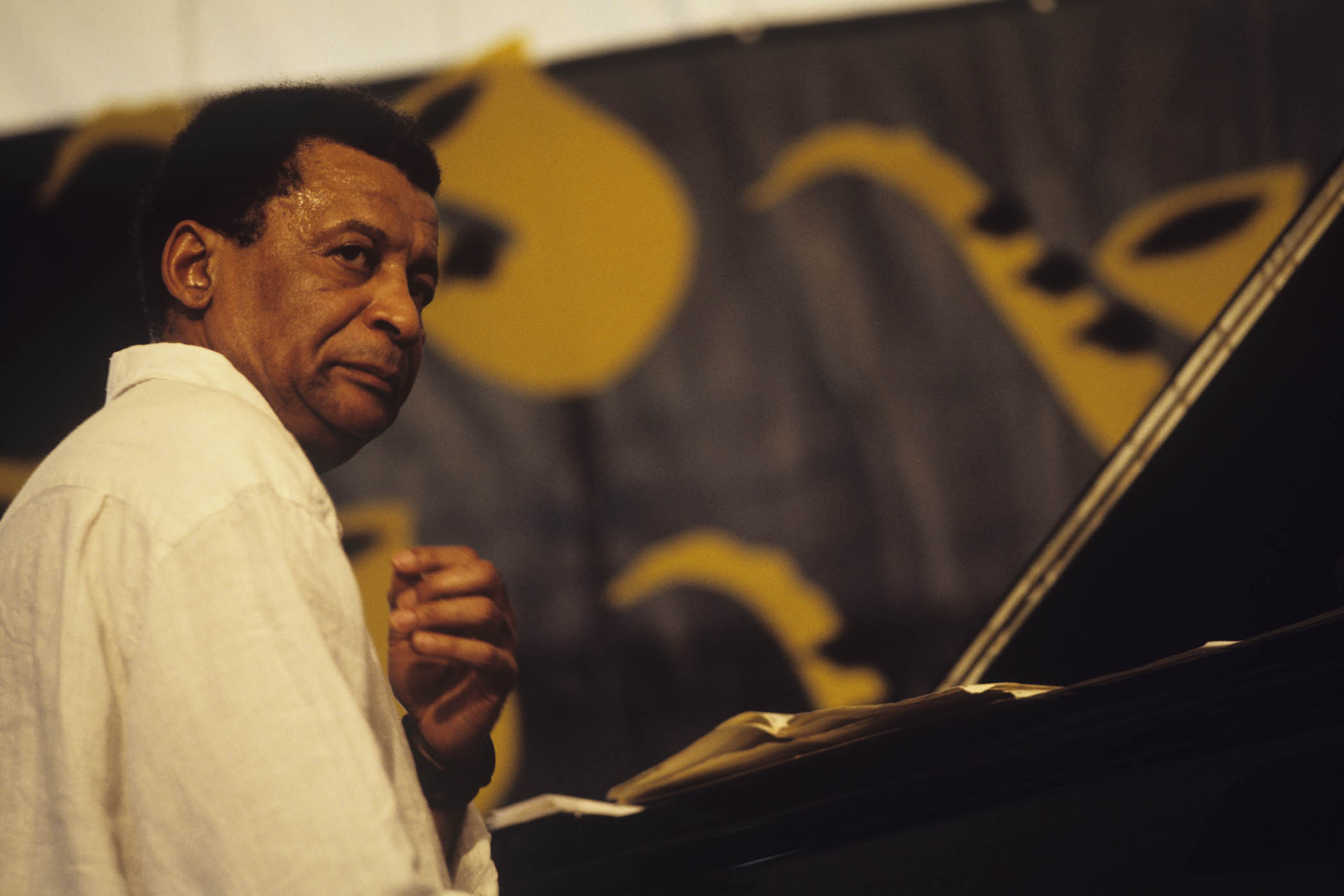

In June 1974, four days into a recording session in Cape Town that had already produced enough material to fill five albums, Abdullah Ibrahim moved across from his grand piano to an old upright that had thumbtacks pushed into the hammers, giving it a metallic sound, and trotted out a simple seven-note riff.
Liking the tune, Ibrahim signalled to his band – Basil Coetzee on tenor sax, Robbie Jansen and Morris Goldberg on alto – to join in and improvise while Monty Weber’s easy, jaunty drumming kept the rhythm flowing. After 17 minutes and supposedly just one take, Ibrahim felt they had a track to lead their next record. It would become one of the anthems of the anti-apartheid movement.
Ibrahim, a Cape Coloured jazz pianist who had made his name as Dollar Brand before his conversion to Islam, told the band that as they played he’d had a vision of an elderly woman walking down a street in one of the townships. When Goldberg said he was going to visit his parents’ former housekeeper, Gladys Williams, in Manenberg, Ibrahim said Mrs Williams from Manenberg was a great title. In the end, the record was released as Mannenberg – ‘Is Where It’s Happening’, with an unexplained extra N. A photograph of Mrs Williams appeared on the cover.
It became a huge hit. Rashid Vally, the producer, played it on loudspeakers outside his record shop, Kohinoor, in Johannesburg and people rushed in. The record sold 5,000 copies in a week and 43,000 in seven months when 20,000 sales was regarded as good. It fused jazz – though Ibrahim, like his mentor Duke Ellington, disliked that label – and funk, but with elements of local genres such as marabi and langarm that were distinctively South African. Ibrahim felt its success was “an affirmation that our inherent culture is valid”.
The piece was given new life when it became a favourite at ANC rallies in the 1980s. A copy was smuggled on to Robben Island and Nelson Mandela, upon hearing it, reportedly declared: “Liberation is near.” In 1994, Ibrahim was invited to perform at Mandela’s inauguration, where the new president described him as “our Mozart”. Mannenberg continues to have an influence decades later. The piece was chosen for Zohran Mamdani’s inauguration as mayor of New York City at the start of 2026.
Ibrahim was born Adolph Johannes Brand in 1934 in Kensington, a poor suburb of Cape Town. His father came from the Sotho people and was shot dead when Brand was four. His mother was mixed-race and he was given her family name to earn the slight advantage of being classified as Coloured. He was raised believing she was his sister. His mother and grandmother were church pianists and he was given lessons from the age of seven.
Brand gave his first performance at 15 and played with local swing bands. While many contemporaries in District Six, a crime-ridden community at the foot of Table Mountain, were lost to alcohol, drugs and gang violence, Brand said he was saved by music. “In all that horror it was at least clean,” he said. “You were dealing with something beautiful.”
He got the nickname “Dollar” for his love of buying records from black GIs. “We never regarded the music as foreign,” he said. “It was just the music of our brothers and sisters in another part of the world.” In 1958 he formed the Dollar Brand Trio and then the bebop sextet the Jazz Epistles.
After the massacre of 91 protesters at Sharpeville, mixed-race bands were persecuted. Brand left the country with his girlfriend, the singer Sathima Bea Benjamin, and got a three-year contract to play at Club Africana in Zurich. In 1963, Ellington heard Brand play there in his trio and invited them to a recording session in Paris, which led to gigs across Europe.
Brand and Benjamin married in 1965 and had a son, Tsakwe, and a daughter, now known as the rapper Jean Grae. They moved to New York, where Brand sometimes led the Ellington Orchestra, befriended the pianist Thelonious Monk and studied at the Juilliard School. In 1968, they returned to Cape Town, where Brand converted to Islam, changed his name and began to record with Vally. After the deadly Soweto Uprising in 1976, they went back to New York and founded the record company Ekapa.
Newsletters
Choose the newsletters you want to receive
View more
For information about how The Observer protects your data, read our Privacy Policy
In a catalogue of more than 100 albums, a highlight is Ibrahim’s 1985 record Water from an Ancient Well, with the joyous opening track Mandela, which was included in the book 1001 Albums You Must Hear Before You Die. His 1989 album African River and African Suite from 1997, with its 17-piece string section, are also classics. His last album was released in 2023.
Ibrahim, who died in the Bavarian spa town where he had lived with a partner after his divorce from Benjamin, was a black belt in martial arts and had a lifelong interest in zen philosophy, saying that in order to compose, one needs to be composed. Having been thwarted in his childhood dream to become a doctor because of his race, he was fond of saying that he tried to achieve therapy with his music. “Mandela would explain to us,” he said, “that the most important aspect of our lives is that we must heal.”
Abdullah Ibrahim, South African pianist, was born on 9 October 1934 and died on 15 June 2026 aged 91
Photograph by David Redfern/Redferns