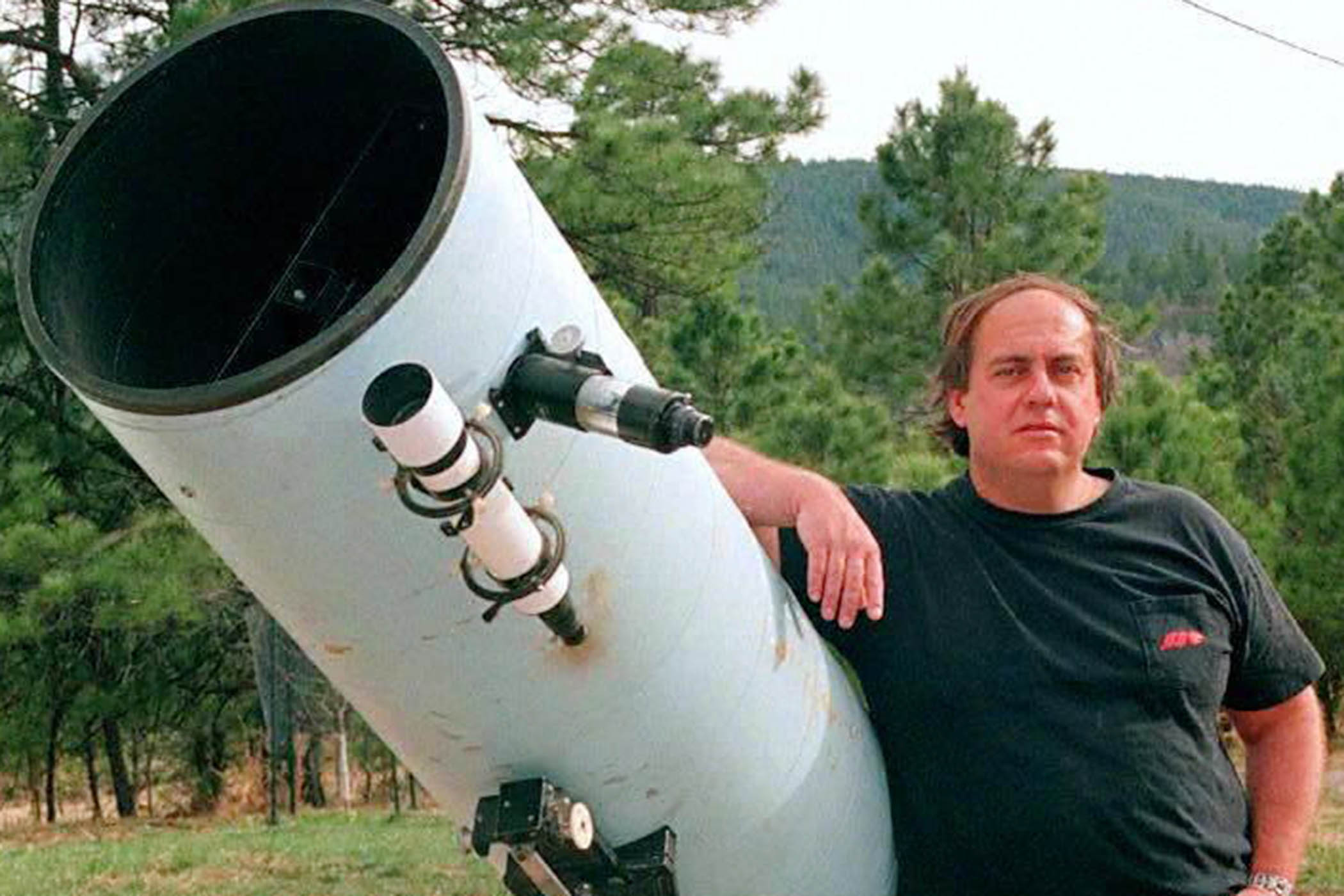



The writer Isaac Asimov reportedly said that the most exciting phrase you could hear in science, the one that heralded a new discovery, was not “Eureka!” but “That’s funny…”. It was a line that the astronomer Alan Hale liked to use when speaking of the moment of serendipity in 1995 that led to his name being written in the stars.
On a clear July night in the mountains of New Mexico, Hale went outside to check on the brightness of a comet he had been researching for a newspaper column. Finding his view blocked by his house, Hale did some idle stargazing while waiting for the comet to rise, and focused his telescope on the constellation of Sagittarius. There he noticed a “fuzzy object” that had not existed the last time he looked. “That’s funny…” he thought.
Hale logged its position, measured its brightness, consulted his database and then returned to check the object again. It had moved a bit to the west. At this, an excited Hale sent an email to the Central Bureau for Astronomical Telegrams (CBAT), in Massachusetts, and went upstairs to wake his wife. He asked: “Do you want to have a look at Comet Hale?”
He was not the only person to have seen it that night. On a ranch in Arizona, more than 400 miles away, a construction manager and amateur astronomer called Thomas Bopp was staring through a friend’s telescope when he saw the same blur. While this was the 199th comet observed by Hale, it was Bopp’s first. But he knew what it meant.
Lacking mobile phone reception, he reported it to CBAT hours later by the archaic route of a Western Union telegram. He and Hale were given a joint naming credit. The next day, Hale contacted Bopp, introducing himself with the words: “I think that we have something in common.”
No amateur astronomer had discovered a comet so far from Earth – between Jupiter and Saturn – and this one was huge. Its nucleus, up to 37 miles in diameter, was six times the size of Halley’s Comet, which had appeared 10 years previously. As it increased in speed, to a peak of close to 100,000mph, Comet Hale-Bopp became visible to the naked eye in May 1996. By the year’s end, it was bright enough to be seen even in light-polluted cities. It had last come this way in about 2215BC.
Hale-Bopp was at its closest to the sun on 1 April 1997, passing 122m miles from Earth: not quite a near enough miss to justify April Fools’ Day jokes about it wiping out humanity. After Sirius, it was the brightest object in the night sky. By the time it moved away, it had been visible without a telescope for 18 months, twice as long as the Great Comet of 1811, the previous record-holder. It will next return in 4385.
In those fledgling days of the internet, Hale-Bopp became an astral celebrity, its progress tracked and photographed. Scientists observed that, unlike other known comets, it had three tails, one made of sodium, to go with the usual two, composed of gas and dust, as well as carbon compounds and other elements. This discovery supported the theory that the building blocks of life on Earth had been brought by a comet’s impact.
It also encouraged cranks. When an amateur astronomer claimed to have identified a UFO tracking the comet, Hale joked to USA Today that he would meet the aliens when they landed at Roswell. He was not impressed that, from a 45-minute interview, this was the only line reported. More seriously, 39 members of the Heaven’s Gate cult killed themselves, believing that they would be taken away by the comet from a doomed Earth. Hale, an atheist, called it “another victory for ignorance and superstition”.
‘The sky looks the same from Iran as it does from here in the US. Science does not know political boundaries’
‘The sky looks the same from Iran as it does from here in the US. Science does not know political boundaries’
Alan Hale was born in 1958 in Japan, where his father was serving in the US air force, and raised in Alamogordo, New Mexico. He remained in the state for most of his life, later joined by his wife, Vickie, and two sons. The clear night skies there were perfect for stargazing, and, inspired by the space programme and the original Star Trek TV series, the young Hale began to explore the heavens. He saw his first comet at the age of 11.
He graduated from the US Naval Academy with a degree in physics, and three years later joined the Jet Propulsion Laboratory, in California, working on Nasa’s Deep Space Network project. He was involved in studying information gained by Voyager 2’s fly-by of Uranus in 1986. After completing a PhD in astronomy, he joined the New Mexico Museum of Space History.
In 1993, Hale founded the Southwest Institute for Space Research, later the Earthrise Institute, to encourage students to explore the night sky. After observing his 400th comet in 2007, he launched a project called Countdown to 500, promising awards to anyone who observed 10 of his next 100. His final tally, logged in April this year, was 774. Bopp, who remained an amateur astronomer, died in 2018.
Hale wrote three books: Everybody’s Comet: A Layman’s Guide to Comet Hale-Bopp, Great Balls of Ice: A Century of Comets and The Comet Man: A Memoir. He also led three expeditions of astronomers and students to Zimbabwe and Iran to take part in what he called “science diplomacy”. He believed that science is a universal language that can bring people of different cultures together. As he noted in 2013: “The sky looks the same from Iran as it does from here in the US. Science does not know political boundaries.”
Alan Hale, astronomer, was born on 7 March 1958, and died on 6 June 2026, aged 68
Photograph Karen Lowe/AFP/Getty Images
Newsletters
Choose the newsletters you want to receive
View more
For information about how The Observer protects your data, read our Privacy Policy