
Related articles:
It was the uniform of late-20th-century America. A clothing empire that at its peak was worth $16bn and had 3,500 shops selling simple, crisp casual-wear – denim, chinos, khaki, T-shirts – was founded by a couple in San Francisco in 1969 because Doris Fisher’s husband, Don, couldn’t find trousers to fit him.
For four decades, as Gap’s chief fashion merchandiser, no product was launched without Doris’s approval and she knew what young people wanted. Even if she complained to her son in her 80s that teens wore their trousers too low-slung for her taste.
On Doris’s 90th birthday, the company’s chief executive called her “the original arbiter of cool”. She also came up with the name. Don, whose original vision was to sell records alongside trousers, wanted to call their shop Pants and Discs; Doris, inspired by a conversation at a cocktail party about the differences between the generations, convinced him to go for something snappier: The Gap.
With its well-stocked shelves of clothes for every size, lots of changing rooms and a simple design of white walls and polished wooden floors, it appealed to the masses but won celebrity fans. Mick Jagger wore a Gap T-shirt at Live Aid in 1985, the same year that Marty McFly went back to the future in one. Sharon Stone wore one of their $25 black turtlenecks to the Oscars, while the cover of the 100th anniversary issue of Vogue in 1992 had 10 supermodels in the brand’s white jeans and shirts. The New York Times called it “as ubiquitous as McDonald’s, as centrally managed as the Soviet Union”.
In an episode of Friends, the sitcom that defined US culture in the 1990s as Gap did fashion, Joey is peeved when he sees Ross wearing the same shirt. “Stupid Gap on every corner,” he grumbles. But as online retail took off, Gap’s share price and number of stores slumped, though Doris was still worth $1.7bn at her death.
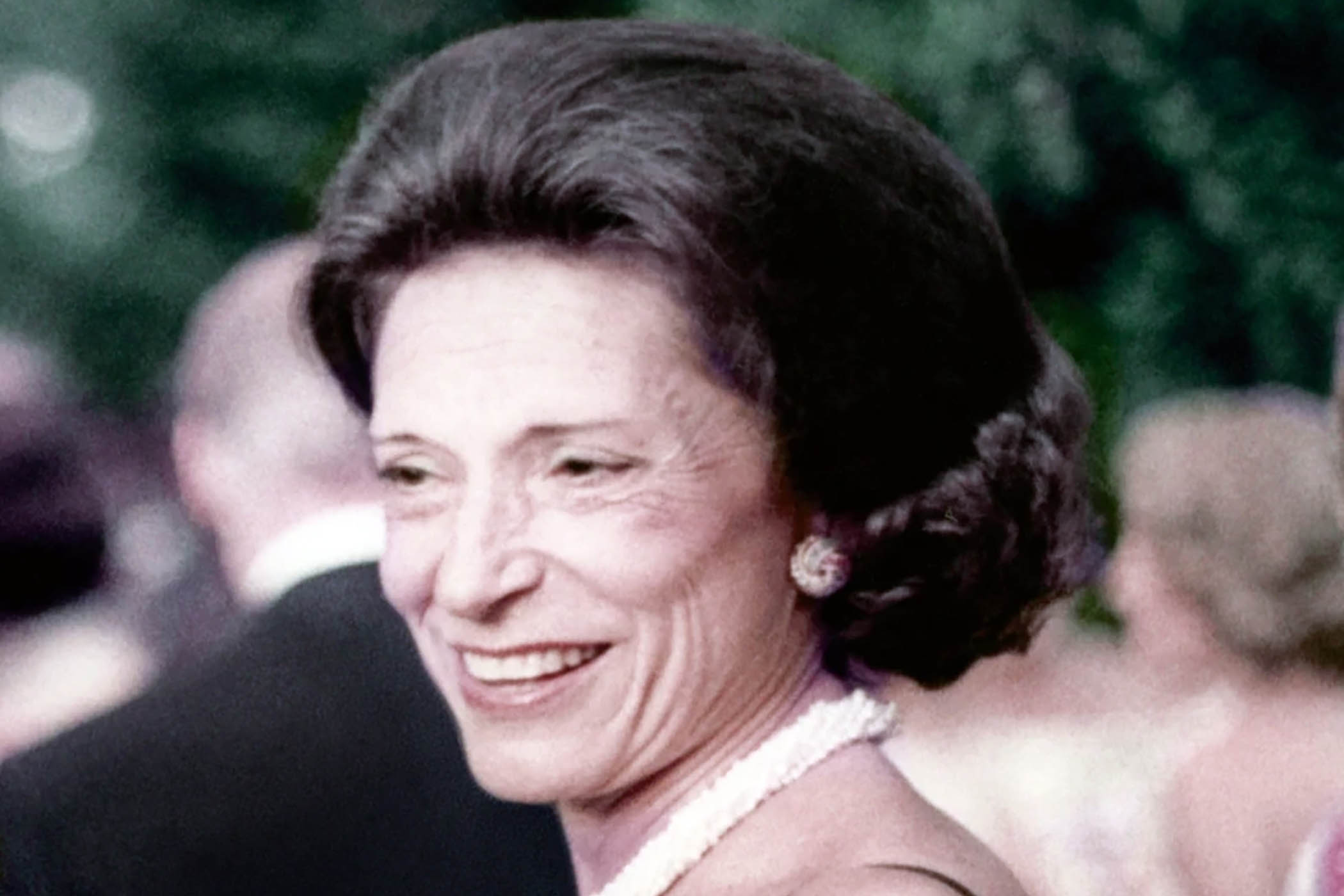
Doris Lee Feigenbaum was born into a wealthy family in San Francisco in 1931. She was one of the first women to earn an economics degree from Stanford University and in 1953 married Donald Fisher, a long-term family friend who at the time worked for his father’s cabinet-making business. They had three sons: Robert, William and John.
In the late 1960s, when Don was renovating hotels in Sacramento, he leased retail space to Levi Strauss, the jeans manufacturer, and told the manager how hard it was to find a pair that fitted. He had seen another shop advertising a “tower of shoes”, boasting that it contained whatever brand, style or size you wanted, and wondered if the same could be done with a wall of Levi’s. He offered to stock their jeans in every variety they had and they guaranteed he would never be out of stock with nightly replenishment.
The first Gap opened on 21 August 1969, at 1850 Ocean Avenue, San Francisco. The couple had each sunk $21,000 into it, adding a third share from their children’s savings with the promise to pay it back. Doris took the same salary as Don. “Frankly, I would always have assumed women were getting paid the same as men for doing the same jobs,” she later said. “But of course they weren’t.”
Related articles:
Don later praised his wife for maximising the range of clothes. “[Doris] went for the wildest stuff [Levi’s] had,” he wrote. “There were stripes, checks, houndstooth and a variety of plaids. The shelves emptied as fast as we could fill them.” She often worked in the shop and wore Gap clothes. “I could always sell what I was wearing,” she said.
In 1970, Gap opened a second shop in San Jose. By 1973, it had 25 and had spread to the east coast. The next year it began to sell its own-brand clothing. The LPs had long been ditched. They became millionaires in 1975 and billionaires in 1991, the company turbocharged by the appointment of Mickey Drexler as chief executive in 1983.
Newsletters
Choose the newsletters you want to receive
View more
For information about how The Observer protects your data, read our Privacy Policy
Gap bought the Banana Republic chain, started another brand, Old Navy, and developed GapKids and BabyGap. While among the first brands to voluntarily increase the minimum wage of its American workforce, the company was criticised for the working conditions in its overseas factories.
The Fishers spent some of their huge wealth on political donations. They backed Arnold Schwarzenegger as governor of California and other senior Republicans and contributed to a fund that sought to block Barack Obama from becoming president, but donated to Democrats they liked, such as Nancy Pelosi. They gave more than $70m to a programme creating charter schools.
They also amassed a vast art collection, first to fill the white walls of Gap’s headquarters and stores. Two days before Don’s death, the San Francisco Museum of Modern Art announced a partnership to house the couple’s 1,100 pieces for 100 years. They included 21 Andy Warhols, 23 works by Gerhard Richter and pictures by David Hockney and Roy Lichtenstein. The collection was worth an estimated $1bn. Not a bad return for a venture that began with a simple wish, as Don put it, to “take the nightmare out of shopping for Levi’s”.
Doris Fisher, fashion entrepreneur, was born on 23 August 1931, and died on 2 May 2026, aged 94
Photograph courtesy of GAP