In every sound there is a potential song, in every noise a new chord in nature’s symphony. As a young mother living by the airport in Nice in the 1950s, Éliane Radigue would listen to the whirr of aircraft propellers and the roar of the Mediterranean surf and use the emotions they stirred in her to create music.
Radigue, one of France’s leading abstract composers, found music everywhere, even in the moves on a chessboard as her then husband, the avant-garde artist Arman, played with Marcel Duchamp. She felt that music was always in the ear of the listener and never sought to tell people what they should feel. “We all have a little music in us,” she said. “It’s the way we listen that makes the music.”
When she heard a radio broadcast of Pierre Schaeffer’s Étude aux Chemins de Fer she realised that the rattle of the railways at the Gare des Batignolles had sung to him the same way the planes did to her. She got an internship at Schaeffer’s Studio d’Essai in Paris, working with him and Pierre Henry, another pioneer of what they called “musique concrète”, exploring how to blend sounds.
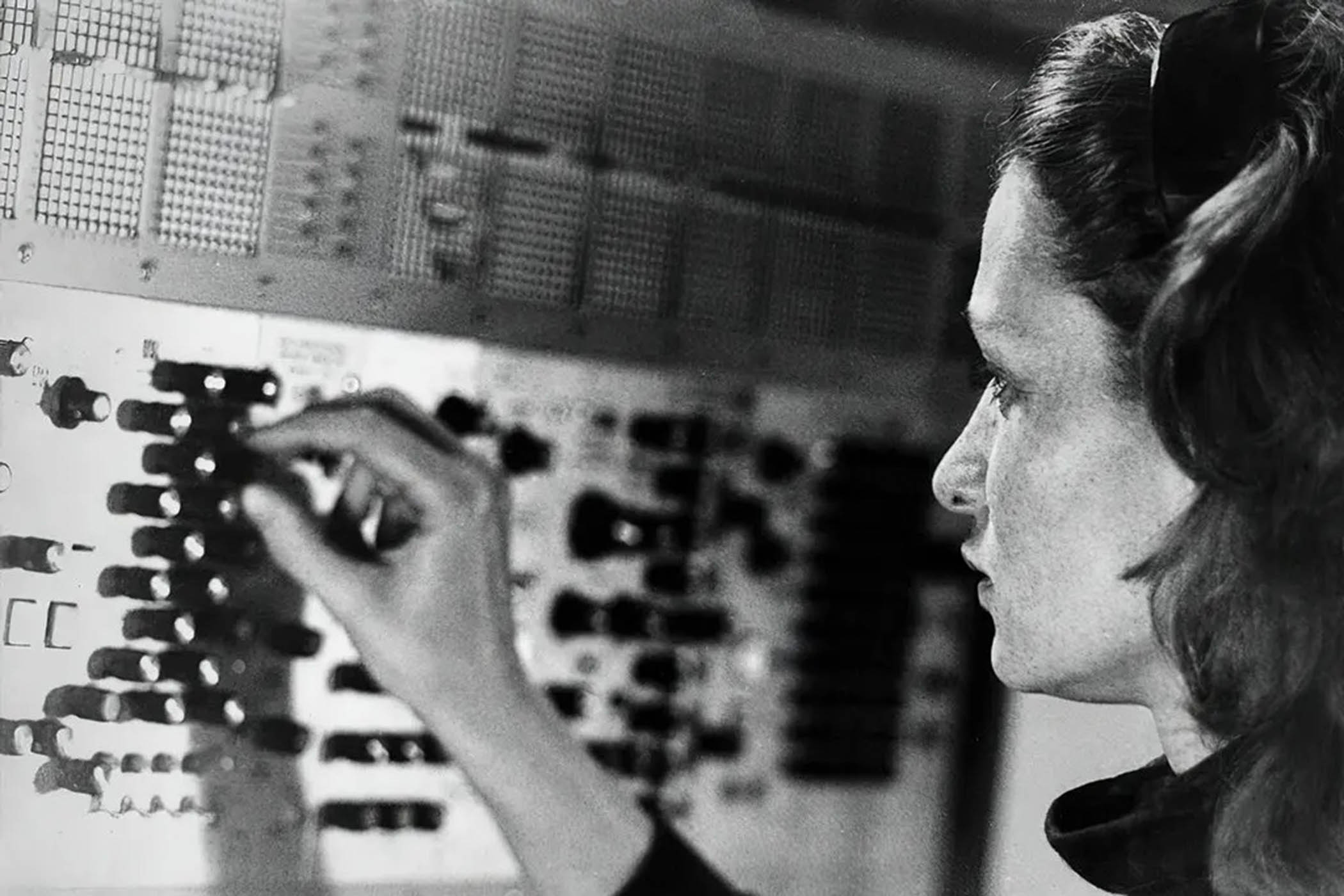
Radigue found her fulfilment in New York in the early 1970s when she first met a large American with a “magnificent voice” whom she called Jules, though formally he went by the name ARP 2500. “It was love at first sight,” she said of the modular synthesiser used by David Bowie and the Who. It was also the tool by which Earth communicated with aliens in the 1977 film Close Encounters of the Third Kind. Jules responded to her lightest touch on the 100 knobs and 240 switches to change sounds subtly, almost imperceptibly, and slowly unfold her imagination.
The New York Times wrote this of her 1987 work Jetsun Mila, based on the life of an 11th-century Tibetan yogi: “It doesn’t really have rhythm, it has oscillations. It doesn’t really have notes, it has frequencies with colors and depths. It is inclusive and suggestive and abstract. As it moves, you may automatically visualise what it reminds you of: chimes, vehicles, chants, wind currents, low-brass instruments. None of that is actually there.”
Éliane Louise Thérèse Radigue was raised amid the clatter of Les Halles, the old Parisian market place, the daughter of a shop-keeper. She sang in choirs and had a music teacher but in her late teens fled an authoritarian mother to live on the Côte d’Azur where she married Armand Fernandez, an artist who was part of the nouveau réalisme movement and worked under the name Arman. They had three children between 1951 and 1954 in four years, while Radigue studied the harp at the Nice conservatory.
She worked for Schaeffer and Henry in Paris in the mid-1950s but returned south to raise her children. As Arman’s career took off, the marriage failed. “Playing the master-artist’s wife was not at all my thing,” she said. Back in Paris in 1967, she worked again with Henry on his monumental 24-hour composition Apocalypse de Jean. In 1970, encouraged by the minimalist composer Steve Reich, she moved to New York, where she took a residency at the School of Arts and got to know John Cage, Philip Glass and Andy Warhol.
She worked alone, often at night, with only her cat as company. ‘I discuss everything with her,’ she said
She worked alone, often at night, with only her cat as company. ‘I discuss everything with her,’ she said
It was in New York that she began to compose using a synthesiser – a Buchla that looked like a telephone switchboard, covered in dials and wires. Her first work using the instrument, Chry-ptus, was performed in April 1971. She quickly won critical attention, especially once she moved to the ARP. A review in The Village Voice of Psi 847 in 1973 spoke of sounds “oozing” from the walls of the venue.
In the 1970s she took a three-year break to study Buddhism in the Dordogne under the guru Tsuglag Mawey Wangchuk, who encouraged the meditative quality of her work, evident in what many felt to be her masterpiece, the three-hour Trilogie de la Mort, based on the Tibetan Book of the Dead, composed between 1988 and 1993.
Radigue was a painstaking creator, spending weeks splicing and tweaking sounds by small degrees, often leaving a work for a few months to return to it with a fresh ear. Each listen, she said, was like looking at a flowing river: it appears the same but is constantly changing. She worked alone, often at night, with only her cat as company. “I discuss everything with her,” she said.
Newsletters
Choose the newsletters you want to receive
View more
For information about how The Observer protects your data, read our Privacy Policy
Her relationship with Jules lasted for 30 years but in 2000 she wrote her last electronic work, L’Île Re-sonante. The next year, at the request of the composer Kasper T Toeplitz, she created her first acoustic work, Elemental II, and spent the rest of her career writing for acoustic instruments, notably with the American cellist Charles Curtis.
In 2011, she began a series of collaborations under the name Occam with musicians she called her “chevaliers”, starting with a harp composition for Rhodri Davies. Occam XXV, which had its premiere in London in 2018 when she was 86, was her first piece for the organ. The British electronic composer Robin Rimbaud, who works under the name Scanner, said: “[She] taught us the radical power of slowness, of patience, and attention stretched to the threshold of perception. Her work will continue to resonate – slowly, endlessly – like a tone that never quite fades.”
Éliane Radigue, composer, was born on 24 January 1932 and died on 23 February 2026 aged 94