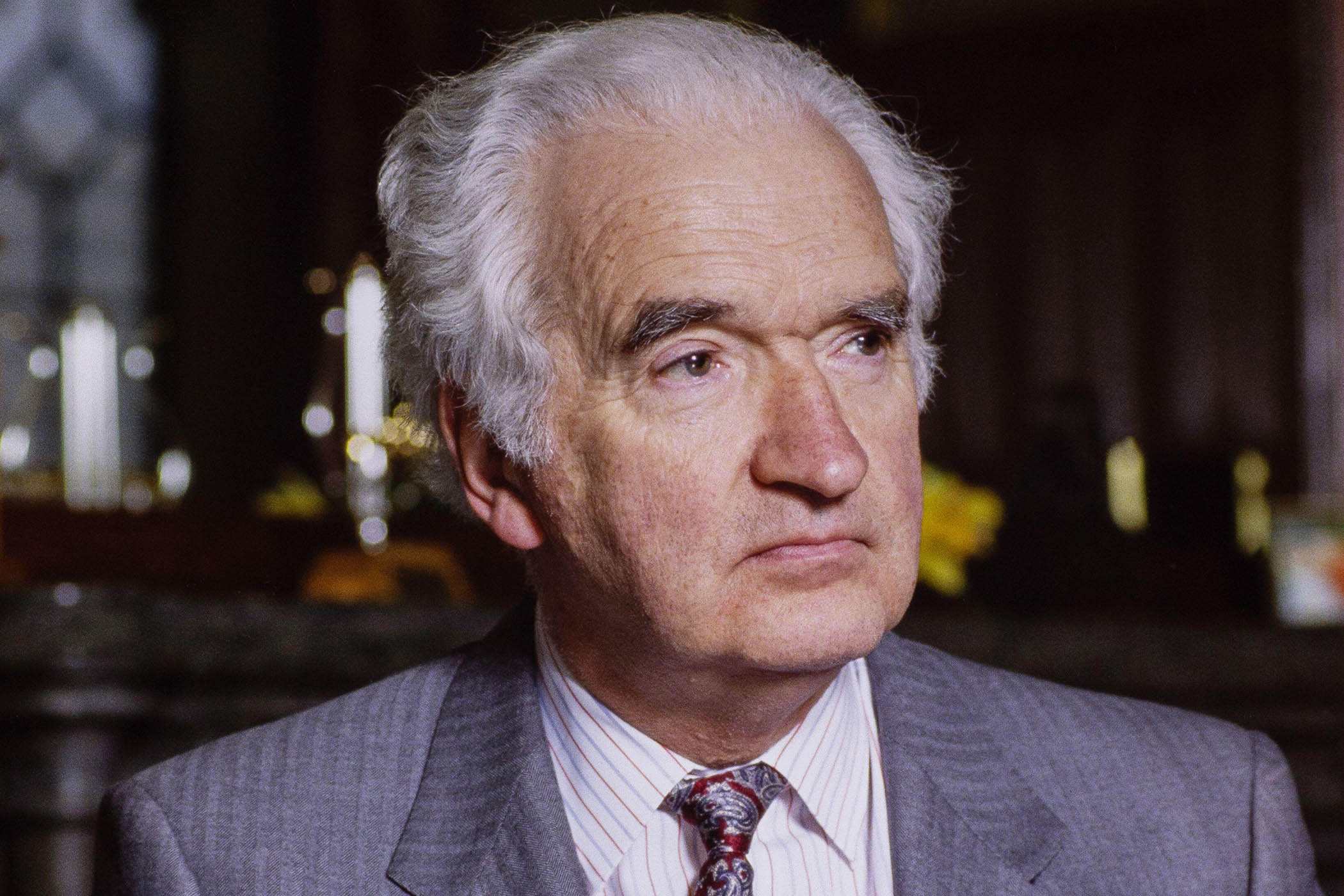
When Margaret Thatcher asked James Mackay to be her lord chancellor in 1987, many were surprised. The thoughtful, courteous lord advocate had quite a different personality from the quick-tempered extrovert Quintin Hogg, Lord Hailsham, Thatcher’s first appointment. Moreover, he had only practised law at the Scottish bar and was no rightwing ideologue. “Congratulations, James,” John Smith, the future Labour leader, told his fellow Scot, when he heard the news. “But I had no idea that you were a Tory!”
He wasn’t, especially. Lord Mackay of Clashfern, his title coming from the name of the cottage on the Sutherland coast where his grandfather had tended sheep, was the only child born to a railway signalman with tuberculosis and a boarding housekeeper who had previously been widowed. He had started his career as a mathematics lecturer, changing to law when he realised that he preferred people to equations.
As lord advocate from 1979, he handled the criminal justice (Scotland) bill, which curbed drinking at sports events and relaxed the law on homosexuality, and was then recommended to Thatcher by Norman Tebbit, who had consulted him over the law and trade union reform. He was in Thatcher and John Major’s cabinets for a decade, making him the second longest-serving lord chancellor since the 20-year reign of John Scott, the 1st Earl of Eldon, ended in 1827.
Mackay was the last lord chancellor to wear three hats simultaneously (matching the tricorn one he wore on state occasions, likened by a sketch writer to a Cornish pasty). He was head of the judiciary, speaker of the Lords and ran the government department in charge of courts and legal aid. His appointment was initially hailed by lawyers, though that turned to abuse when he dared to reform their profession.
His green paper in 1989, which sought to end the bar’s monopoly of the higher courts and bring in “no win, no fee” litigation, drew harsh criticism. Geoffrey Lane, the lord chief justice, called it “one of the most sinister documents ever to emanate from government”, while John Donaldson, the master of the rolls, told Mackay to “get your tanks off my lawn”.
Mackay sat on the Woolsack for the entire 13-hour debate on his proposals, which began with him leading prayers, since no bishop was available, and summed up what had been said with scant reference to notes. When one critic suggested the reforms would make the bar “wither on the vine”, Mackay wryly observed it would be an apt place for such a famously bibulous profession. His calmness under fire was his strength. As he said: “There’s no point in getting worked up about what people say about you.”
He counted the Children Act 1989 and the Human Fertilisation and Embryology Act 1990 as the most important legislation he introduced. He also brought in no-fault divorces, arguing that “the nature of human justice is imperfect”, and enjoyed the talent spotting that went with his patronage, promoting the likes of Tom Bingham and Brenda Hale.
One of his first acts was to lift the Kilmuir rules that stopped judges from speaking to the media. He announced it in a press conference that lasted for two hours, as he took every question put to him. He told journalists that he would speak to them on the record or not at all – and never on a Sunday, a result of his strict Free Presbyterian faith. He said that observing the Sabbath was “a good antidote to getting too high an opinion of yourself”.
James Peter Hymers Mackay was born in Edinburgh and went to George Heriot’s school. He read maths and physics at the city’s university, then lectured for two years at St Andrews before moving to Trinity College, Cambridge. It was there that he realised he had chosen the wrong career. He learned Latin in three months to qualify him to study for a law degree before being called to the bar back in Scotland.
In 1958, he married Elizabeth Hymers, who survives him. They had two daughters and a son. He became a QC when he was 38, two years after he was a junior advocate in the divorce of the Duke and Duchess of Argyll, known as “the headless man” case because of photographs of the duchess engaged in a sex act with an unidentified friend. He became dean of the faculty of advocates – the leader of the Scottish bar – in 1976.
Newsletters
Choose the newsletters you want to receive
View more
For information about how The Observer protects your data, read our Privacy Policy
After his role as lord chancellor ended in 1997, Mackay remained an active peer. He spoke in 20 debates in the six months before he finally retired in 2022, aged 95. He led the opposition to his party’s proposal in 2012 to charge single parents a fee for using the Child Support Agency. He also opposed withdrawal from the European convention on human rights, criticised Liz Truss’s ignorance of the law when she was justice secretary, and attacked Boris Johnson for breaking Covid rules and showing no respect for truth and integrity. “Thatcher was very law-abiding,” Mackay observed. “On the other hand, she was very good at using the law to do what she wanted.”
News of his death was met with sadness in the Lords as the house remembered his old-fashioned courtesy. As Liberal Democrat peer Rosalind Scott had said in response to his valedictory speech in 2022: “To be making incisive contributions… in a way that is entirely unconfrontational is a real lesson to those who think that shouting and being unpleasant is how to get what you want.”
Lord Mackay of Clashfern, former lord chancellor, born 2 July 1927, died 7 July 2026, aged 99
Photograph by Neil Turner/Alamy