24 January
The managing editor of the Washington Post, Kimi Yoshino, sent sports staffers a memo informing them that the paper would no longer send journalists to Italy to cover the Winter Olympics. As the Post had already booked accommodation worth $80,000, this was something of a Pyrrhic saving.
It confirmed the journalists’ worst suspicions, which had arisen earlier that month when Washington sports teams were told that the paper would not require press access to home and away games.
25 January
The first of three letters arrived from Post employees to Jeff Bezos, signed by 60 foreign correspondents and editors, asking him to preserve the paper’s foreign coverage amid rumours it would be cut.
26 January
Bezos and his wife, Lauren Sánchez, arrived in Paris for Fashion Week. Sánchez, said Vanity Fair, “did not leave her front row seat vacant”.
27 January
The second staff letter, asking Bezos to preserve local coverage, was sent and on 30 January the Post’s White House reporters – whose jobs are not threatened – sent the third, urging him to avoid cutting coverage areas as “in a typical month, some of us have found that more than half of the new subscribers we brought to the Post came from stories and scoops that relied on desks such as International and Metro”. None of these letters received a reply.
30 January
Amazon’s Melania documentary was released to overwhelmingly negative reviews from critics. It has grossed $9.5m on a $40m production budget with a $35m marketing campaign.
4 February
All Washington Post staff received an email at 6am announcing “some significant actions”. They were instructed to stay at home and attend a “Zoom webinar at 8.30am”. Publisher Will Lewis retired to his office on the executive floor, two storeys above the newsroom, and restricted elevator access to his executive leadership and finance teams. At 8.30am, executive editor Matt Murray and HR chief Wayne Connell announced the closure of the Post’s sports department, its books section and the flagship podcast Post Reports. Foreign desks were reduced to 12 locations from more than 20, and cuts were made to Metro staff.
At 8.58am, more than 300 journalists received messages confirming they were part of the layoffs. “Following up on today’s communication, I’m writing to share the difficult news that your position is eliminated as part of today’s organizational changes…” it began, ending “we appreciate your contribution to the company”.
Murray gave an interview to Fox News at around 10am defending the cuts, as well as Bezos and Lewis’s absence from the Zoom call. Lewis, he explained, “had a lot of things to tend to today”. Later he gave an interview to Dylan Byers at Puck, outlining the Post’s targets: subscription growth, deeper engagement, big scoops and saying “we want to be relevant”. He explained that Lewis decided it was best to have divisional leaders relay the layoffs to their various teams.
“When historians write the chronicle of this scoundrel time, they will point to what Bezos did for Melania, while gutting his own newspaper as the most glaring symptom of cultural collapse in a democracy hanging on to truth and knowledge by the barest of threads,” Simon Schama posted on Twitter.
Newsletters
Choose the newsletters you want to receive
View more
For information about how The Observer protects your data, read our Privacy Policy
5 February
Lewis flew to San Francisco for a long weekend of Super Bowl festivities with Robert Lawson, an old friend from university who runs the Marylebone Cricket Club. In the afternoon, former Post reporter Nicki Jhabvala posted his picture at an NFL red carpet event on X. The reaction is best described as stunned disbelief.
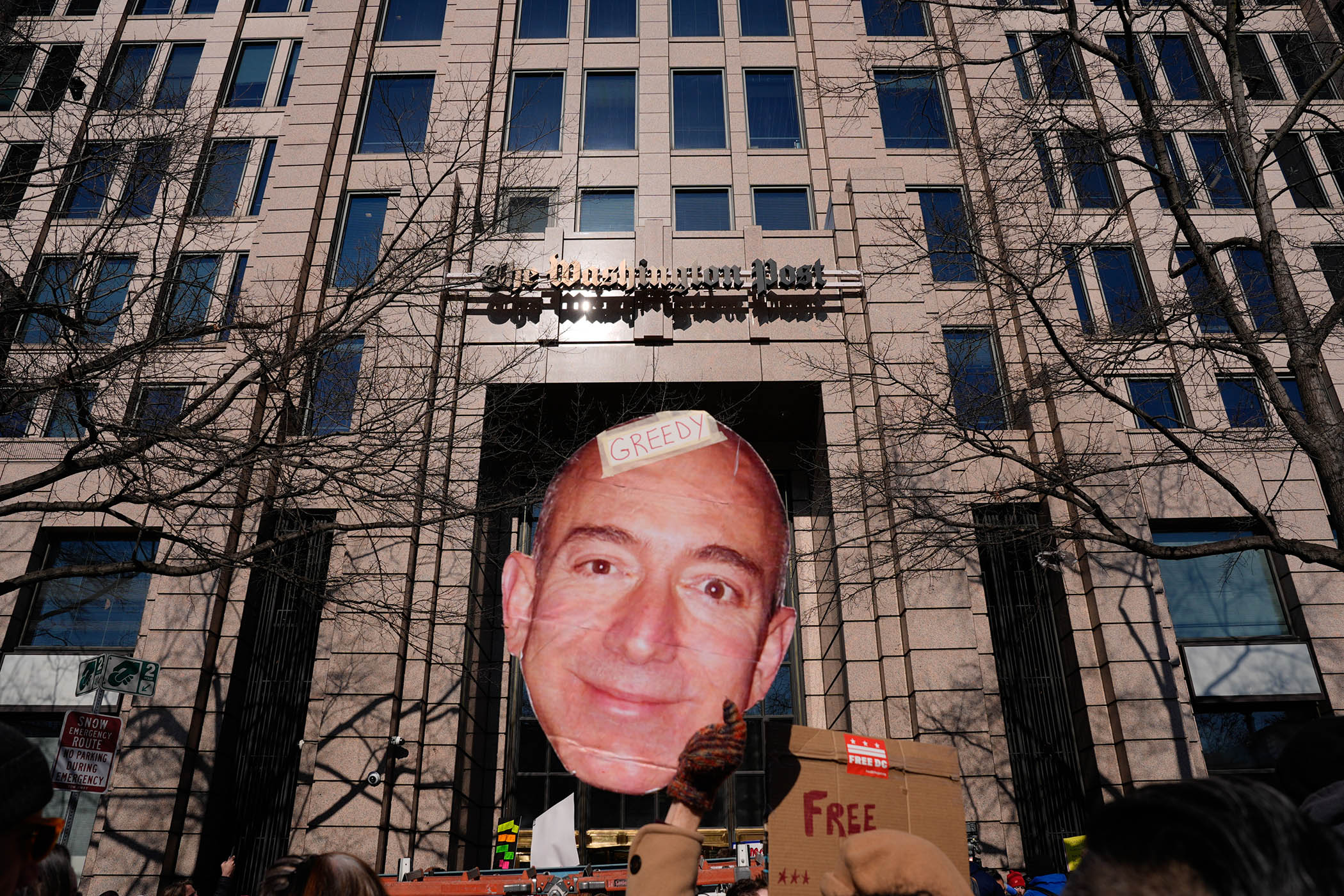
On the same day, the Washington Post Guild’s protest outside the building, planned the previous week, attracted hundreds of current and former staff. The Post’s union fundraising campaign to support laid-off workers reached $400,000.
7 February
In the late evening, Lewis announced he was leaving the newspaper. “During my tenure, difficult decisions have been taken in order to ensure the sustainable future of the Post, so it can for many years ahead publish high-quality, nonpartisan news to millions of customers each day,” he wrote in a message to staff, shared online by White House bureau chief, Matt Viser.
“Obviously, he was fired,” one staffer said. “He claimed he had seven years to reorient the Post and he lasted two. The NFL was the straw that broke the camel’s back. Lewis was behind lots of failed projects and was always overpromising. When [former editor] Don Graham was making cuts, he was in the newsroom alongside top editors making the announcement. He felt our pain. He was not on the NFL red carpet.”
10 February
At a bitter, angry town hall meeting with staff, Murray was asked about accountability for executives who contributed to the Post’s financial challenges. “We have a new CEO. You can draw whatever conclusions you want from that,” he replied.
Murray’s irritation was not entirely surprising. The two men had a fraught relationship. They met when Lewis arrived at the Wall Street Journal in 2014, the paper where Murray had spent his entire career. Bezos first recruited Lewis – who clashed with the Post’s previous editor, Sally Buzbee, when she ran an article reporting a judge’s ruling that Lewis’s name could be added to a list of News International executives involved in a plan to conceal evidence of hacking at the newspapers. Murray replaced her but continued to back the paper’s reporting on Lewis’s past career for some time.
Gradually, the two achieved a rapprochement, but as Bezos lost faith in Lewis, tension returned. Bezos leaned on Murray to come up with plans for the newsroom after rejecting Lewis’s vision and Lewis felt increasingly marginalised. Staff say he went “into hiding”.
Murray covered for his absence over the layoffs but was stunned to see he’d absconded to California, when he’d believed he was in his office working on the planned restructure.
Murray’s newsroom comment is a scathing final review for Lewis, who was once known for delivering scoops such as British MPs’ abuse of parliamentary expenses but has become associated with job cuts at the Daily Telegraph and the Wall Street Journal, as well as the Post. It will be interesting to see where he surfaces next.
Photograph by Kent Nishimura/Bloomberg via Getty Images