

A lot of brainpower has been devoted to decrypting Donald Trump’s foreign policy. On the campaign trail, he was cast as an isolationist who wanted to end “pointless” wars and draw back from the world. More recently, he has been understood as a unilateralist, enthusiastic about using military muscle but uninterested in working with allies.
Neither of these characterisations capture the logic behind an expansive, vaguely defined war launched with Israel against Iran. Instead, the messaging coming from the White House increasingly reflects an “America, fuck yeah!” approach to international politics – a phrase from the theme tune of Team America: World Police, the 2004 satire by the creators of South Park, which mocked the thrusting militarism of the Bush administration’s war on terror.
For those who don’t remember, the film follows a crack squad of puppet soldiers as they blast their way around the world, pursuing bad guys in the name of freedom. The consequences are an afterthought, whether it’s destroying the Eiffel Tower, blowing up the pyramids or triggering a massive retaliatory attack. Team America doesn’t let a limited grasp of other countries stand in their way (“Cairo … that’s in Egypt”). They are focused on one thing: “Coming again to save the motherfucking day, yeah!”
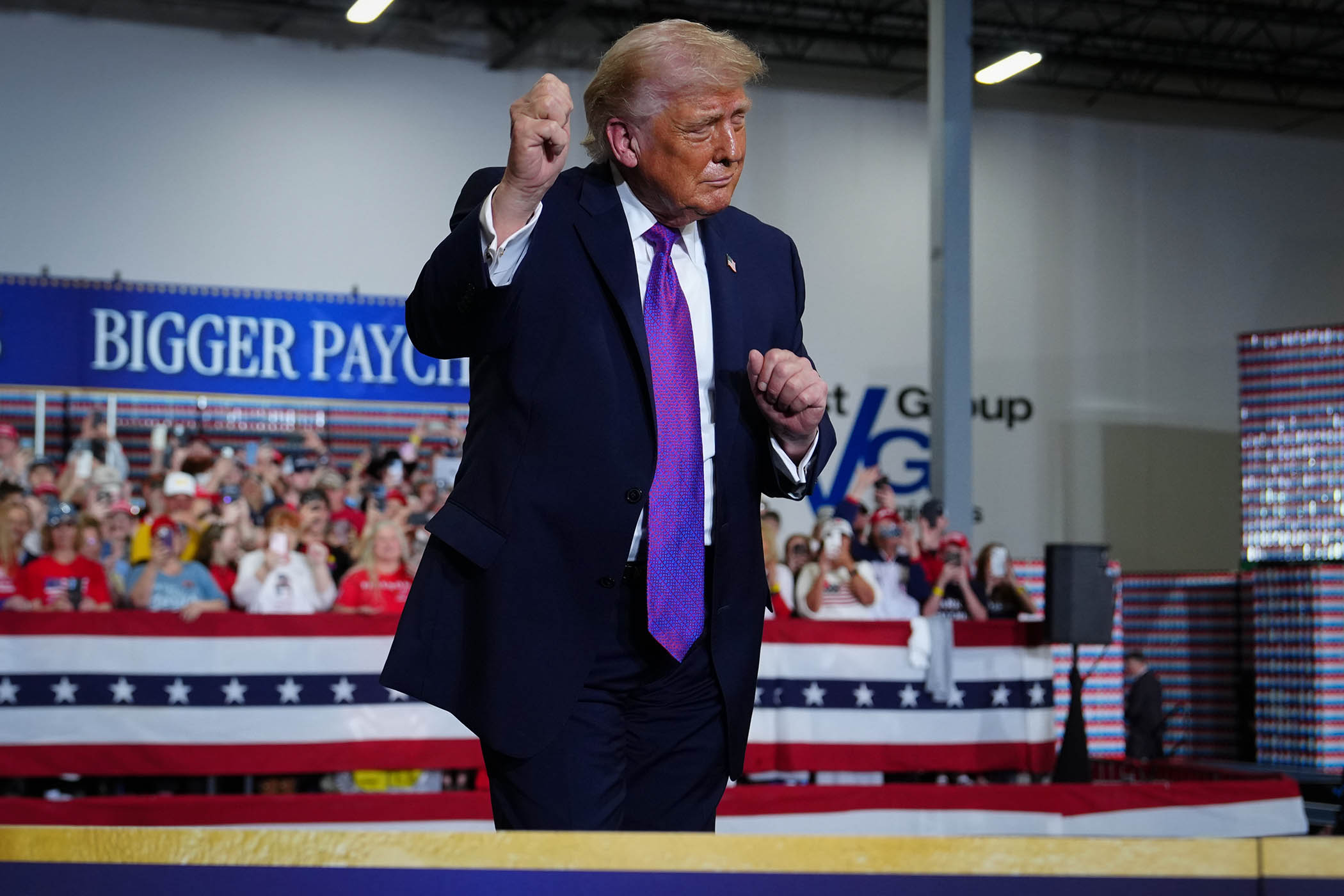
Like Team America, the Trump administration does not want for bogeymen. It has gone after “narcoterrorists” in Venezuela and actual terrorists in Nigeria. In Iran, in Trump’s words, the US is up against “a gang of bloodthirsty THUGS” and “a very evil ideology”. But fear not. Just like Venezuelan leader Nicolás Maduro, who “effed around and found out”, the Iranian regime is “toast, and they know it,” says “war secretary” Pete Hegseth, a former Fox News host who himself looks like a Team America puppet.
Except, it’s not quite true that the Iranian regime is toast. Though severely weakened by a terrifying display of American and Israeli firepower, Iran’s regime has proved resilient. Mojtaba Khamenei, the son of the slain ayatollah, has just been installed as the new supreme leader. If he survives wounds sustained in an airstrike, he is expected to continue the hardline approach of his father and could give freer rein to the Revolutionary Guards, who have become a brutally powerful ideological and military group. And although the pace of Iran’s retaliatory strikes appears to have slowed, tanker traffic in the Persian Gulf remains at a near standstill.
Qatar’s energy minister warned last week that the conflict could “bring down the economies of the world”. Trump has dismissed the logjam as a “brief disruption”.
But the extent of Iran’s retaliation appears to have surprised an administration that went into Iran without a clearly defined set of war aims, still basking in the success of the Venezuela operation. Was it trying to rein in Iran’s ballistic missiles or curb a nuclear programme that was supposed to be “totally obliterated”? Was it trying to free the Iranian people? Does Trump want to topple the regime or just tame it? After nearly two weeks of bombing, there are no clear answers.
See also: Team America, whose initial aim is to stop “9/11 times 100” (“91,100”), which then becomes “9/11 times a thousand” (“911,000”). Eventually they are faced with the prospect of “9/11 times 2,356” (“My God, that’s … I don’t even know what that is.”)
All this has left Trump without a clear exit strategy, and an outcome that would enable him to call off the attacks and convincingly declare victory. It has also led to mixed messages. On Monday, when oil prices rose to nearly $120 a barrel, Trump said the war was “very complete, pretty much”. A day later, Hegseth announced “the most intense day of strikes” so far.
Leslie Vinjamuri, president of the Chicago Council on Global Affairs, said the confusion is a result of a foreign policy doctrine of “disruption”, a shock approach intended “to create uncertainty and try and force through dramatic changes”.
American wars of unintended consequences are hardly new in the Middle East. Team America, after all, came out just after the George W Bush administration’s invasion of Iraq. A key difference between that war and the current one is the bellicose approach of Trump’s team. Before Bush went into Iraq, he got Congress’s approval and sought a UN Security Council resolution permitting the use of force, albeit without success. The war was couched in the language of democracy. By contrast, under Trump there will be “no stupid rules of engagement” or “politically correct wars” about nation-building, according to Hegseth.
This approach is Team America nationalism all over. The war in Iran has gone down terribly with the American people, supported by just 41% of citizens, making it the least supported conflict in modern US history. But Trump’s base loves it: 85% of Maga Republicans approve, despite comprising a group usually understood as isolationist.
Jon Hoffman, a research fellow at the Cato Institute, believes “hubris” coupled with a “fundamental misunderstanding of the region” is driving Trump’s war in Iran. “It’s very much an immediate post-cold war foreign policy, where the United States does whatever we want, wherever we want, however we want,” said Hoffman. He added: “Under Trump this has been taken to the nth degree.” Just like in the movies.
Photograph by Julia Demaree Nikhinson / AP
More from The Observer
Newsletters
Choose the newsletters you want to receive
View more
For information about how The Observer protects your data, read our Privacy Policy