
Related articles:
A bespectacled man is drinking coffee in a normal suburban house. Beside him, having created a ragged hole in the wall, stands a stern-faced rhinoceros with two hoops on its horn. The caption reads: “Having a reliable bagel delivery service did make life a touch more tolerable”.
Such were the elements of a Glen Baxter cartoon. Mundanity meets absurdity in a surreal mishmash, a very English form of art, from Lewis Carroll and Edward Lear to Monty Python, Vic Reeves and the Mighty Boosh. A profile in 2020 on the WePresent arts platform described Baxterisms as “the artistic equivalent of gherkins dipped in peanut butter”, yet his bizarre juxtapositions worked. He liked to wrongfoot viewers by, as he put it, “colliding” concepts.
Take the boy scout scaling a vast bookcase as if it were the Matterhorn, with shelves marked “Köln”, “lettuce”, “Ipswich”, “ankles”, and the caption “For ten years I worked for the archbishop, collating and updating his collection of pornography and railway memorabilia”. Or the hall of aghast Vikings offered “roast haunch of tofu on a bed of poached spinach with an orange scented bagna cauda vinaigrette” by their cook.
Fixated on the word “clandestine”, he kicked around ideas for ages, finally drawing three cowboys gathered on a moonlit prairie with the caption “Clandestine meetings of the Jane Austen Society were held every other Thursday”.
He had a taste for exuberant language. His characters never ‘say’, they ‘splutter’
He had a taste for exuberant language. His characters never ‘say’, they ‘splutter’
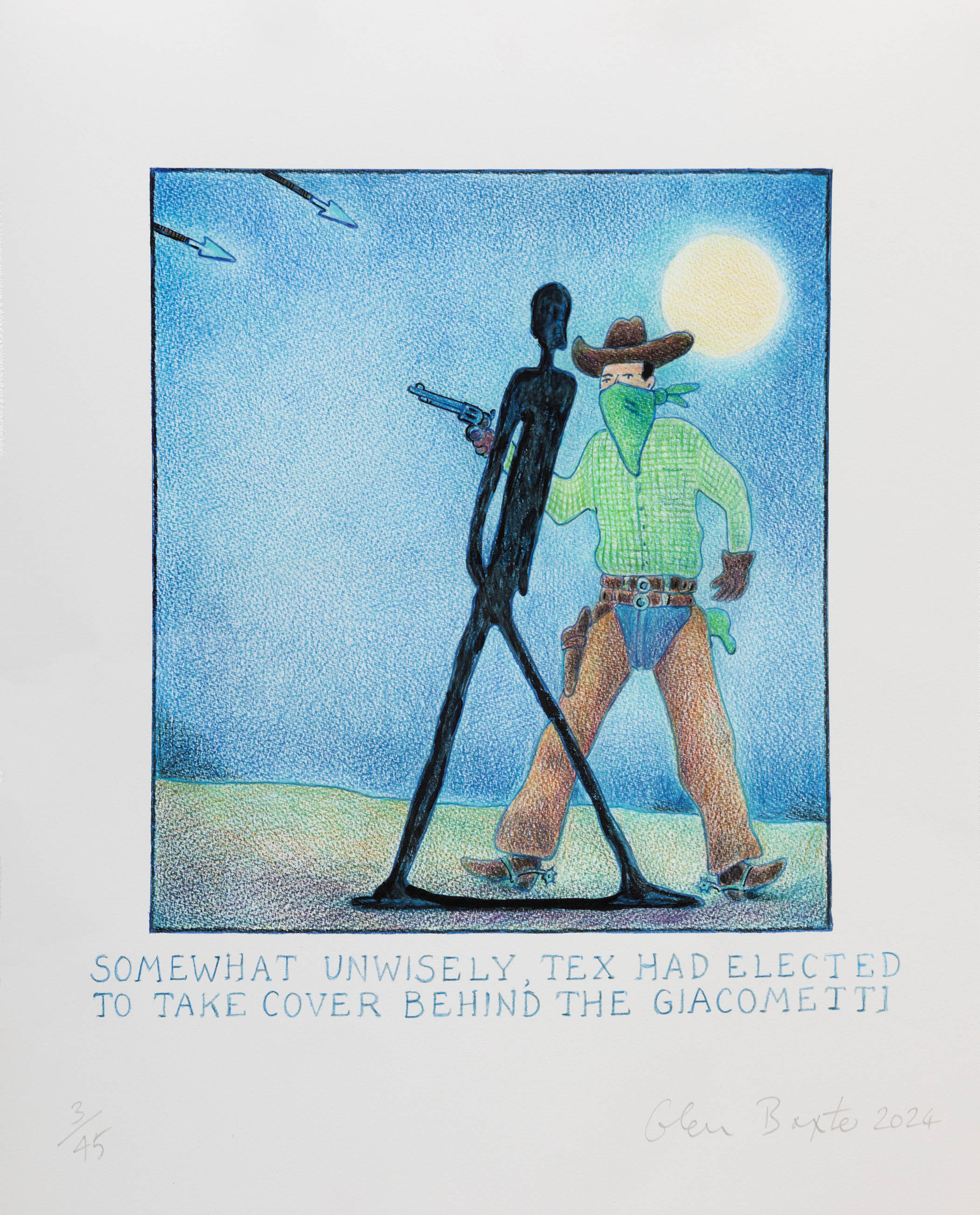
Cowboys frequently appeared in his work, reflecting a childhood watching westerns; he was known to wear a Stetson to get in the mood. Modern art was another theme, such as the cowboy barking: “But I distinctly requested a Rothko!” to a dog with a Mondrian in its mouth.
He had a taste for exuberant language, developed from reading Biggles books. His characters never “say”, they “splutter” or “blurt”.
These simple one-frame designs, drawn in ink in the style of Boy’s Own comics and softened by crayon, with a pithy caption beneath, brought him fame through greetings cards, but at home in Britain he was perhaps underappreciated as a wit and draughtsman. In France critics compared him to Jonathan Swift, and “un Baxter” became a common phrase for an absurd situation.
Baxter was born in Leeds, the son of a welder. When he was four his mother visited his nursery. Three trestle tables were covered in models. Which were done by her son? “These two tables,” the teacher said.
Related articles:
As a child he had a bad stammer and needed to rehearse conversations carefully. Sent to the haberdashery to buy collar studs, he was so focused on what to say he didn’t realise he had walked into a furniture shop. As he later reflected, this combination of the right words in the wrong place gave him an early taste for surrealism. This was developed at Leeds College of Art, where he became fascinated by André Breton and Max Ernst, and hated the teachers’ enthusiasm for abstract. “There was no room for cowboys,” he complained.
He moved to London and took a job as a football and pottery teacher in Leytonstone, then taught at the V&A and Goldsmiths College as well as at a school in Islington, where he met his wife, Carole. They had two children.
Newsletters
Choose the newsletters you want to receive
View more
For information about how The Observer protects your data, read our Privacy Policy
He enjoyed Soho’s counterculture, working with an alternative theatre group that went to the Edinburgh festival, and wrote poetry, some of which was published by a surrealist magazine in New York.
Baxter called himself a “failed poet” who turned to cartoons. In 1979, the Dutch publisher Jaco Groot published an anthology of his art called Atlas. This led to an exhibition at London’s Institute of Contemporary Arts and glowing reviews in national newspapers. Books followed with titles such as The Impending Gleam (1981), Jodhpurs in the Quantocks (1986) and Blizzards of Tweed (1999). He exhibited regularly at the Flowers Gallery in Mayfair, London.
His work also appeared in the New Yorker for 36 years. His first cartoon for the magazine had two explorers hacking through the jungle to find a sign for Hoboken, then a down-at-heel New Jersey town. “On the third day out, our morale was dealt a crushing blow,” it says. His latest, this month, shows a man in a barrel being approached by a hotel bellboy and the caption “After many hours of tense negotiations, I was finally allowed an upgrade”.
One of his fans was the comedian Phill Jupitus, who said: “His affectionate mockery of the world of jolly hockey sticks girls’ boarding schools, the Wild West, golden age Hollywood and stiff upper lip Brits was unmatched.” The Baxter family noted his death on Instagram with a non sequitur he would have appreciated: “He went forward with the clocks at the Spring Equinox on World Piano Day.”
Glen Baxter, cartoonist, was born on 4 March 1944, and died on 29 March 2026, aged 82
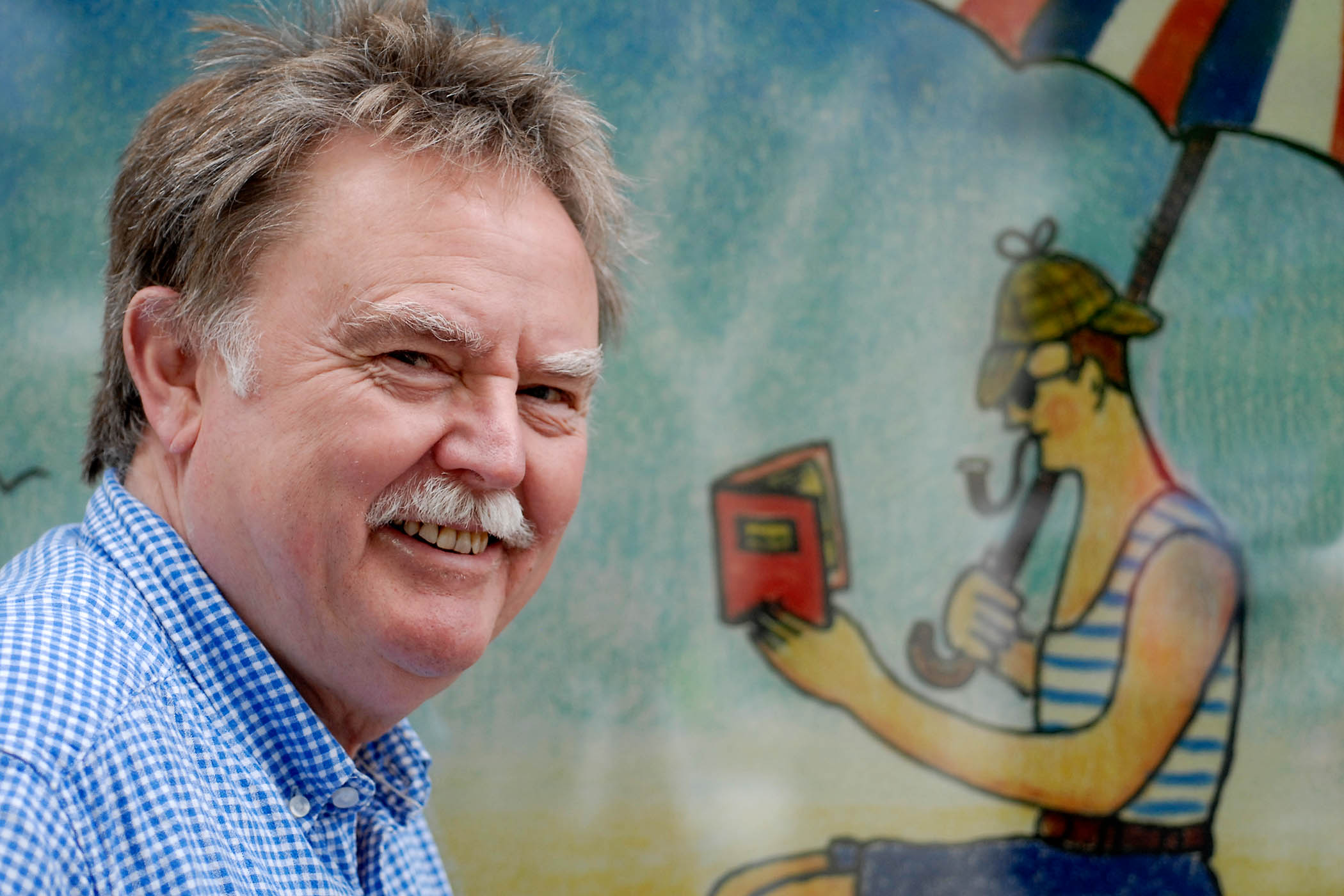
Photographs by Ulf Andersen/Getty Images; courtesy of Flowers Gallery