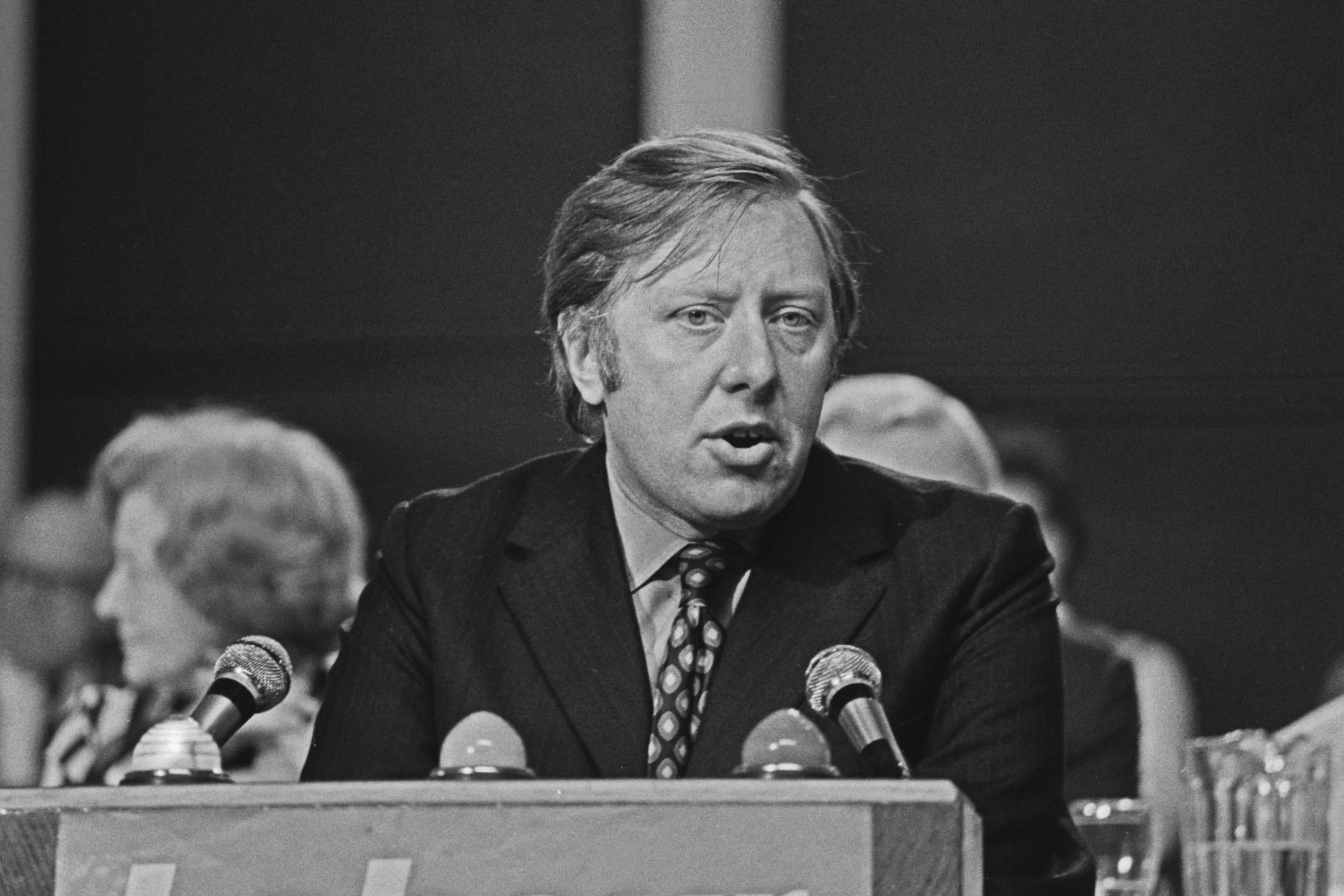
Few felt a greater tingle of excitement about the post-war Labour government of Clement Attlee than the young Roy Hattersley. When the coal industry was nationalised, he got on his bike to cycle to the local pit simply to admire the sign announcing that it was now owned and operated on behalf of the British people by the National Coal Board.
Labour politics was at the core of the being and the achievements of the former deputy leader who has died at the age of 93. Born in December 1932, he was of the generation who came into the world during the Great Depression. Their formative memories were of Tory austerity and then the rationing and traumas of the second world war. The welfare state was dawning as he approached early adulthood. As he later recalled at a literary festival: “It was a time of hope. Many of us really believed - though most of us were proved wrong - that nothing was beyond us.”
His own upbringing was secure, but it had unusual origins in an extraordinary love story. His mother, Enid Brackenbury, was a city councillor. His father, Frederick, was a Catholic priest who had abandoned holy orders to elope with Roy’s mother only a fortnight after presiding over Enid’s marriage to another man. Discovering this only many years later, Hattersley joked: “I have been a professional politician for 25 years and often called a bastard. But this is the first time I realised it was true.”
He described the Labour party as “a family into which I had been born”. He was Sheffield’s youngest ever councillor at the age of 23 and became an MP in 1964, representing the Sparkbrook constituency of Birmingham for the next 33 years. He aligned himself with the Croslandite “revisionist right” who believed the party had to rethink its approach towards the economy. He was fiercely ambitious, but time and chance conspired against his hopes of holding any of the great offices of the cabinet. He was the youngest person at the top table during three years as secretary for prices and consumer protection under James Callaghan. But Labour then lost office in 1979 and by the time it returned to power in 1997 his moment at the zenith of Labour politics had passed.
He was fiercely opposed and sometimes despairing about his party’s suicidal lurch to the left after the 1979 defeat. But he was scornful of Roy Jenkins, Shirley Williams, David Owen and Bill Rodgers - the “Gang of Four” - when they broke away to form the SDP. Hattersley shared their views on Europe and the nuclear deterrent, but he was far too tribally Labour to ever split with the party. He instead put himself at the forefront of “Solidarity”, an organisation of Labour moderates who battled both the SDP and the Bennites who were running riot through constituency Labour parties in the early 1980s. He calculated – and about this was proven correct – that Labour would ultimately come to its senses and recover.
After the landslide defeat of 1983, he was elected deputy leader to Neil Kinnock. The “dream ticket” duo, as they were both celebrated and mocked, hauled the party back towards the centre. Though never exactly friends, the two men generally treated each other with respect. Hattersley did a lot of the intellectual heavy-lifting to position the party in a more ideologically coherent and attractive place. As shadow home secretary and then shadow chancellor, he worked hard to make Labour look like a party that was fit to return to government. It was not enough. Labour lost in 1987 and again in 1992.
While often described as a Labour “right-winger” this was a poor caricature of his views. He described himself to me as an “ethical Christian”. By this he meant that, while he did not believe in God, he did ascribe to the moral codes of the New Testament. Quite fiercely egalitarian, he loathed private schools and favoured wealth taxes. At the same time, he subscribed to the view that being a socialist doesn’t mean you have to live on a bed of nails. He reviewed smart cars for the Daily Telegraph, once pranging a new Lexus. He was a member of the Garrick and Reform private members’ clubs. He enjoyed the finer things in life, including a proper lunch. Satirists had plenty of fun at his expense. When he failed to turn up for a booking on Have I Got News For You, the production team placed a tub of lard in the empty chair. He claimed not to mind that his jowly Spitting Image puppet spouted prodigious volumes of spittle.
Though he’d helped create the context for the emergence of New Labour and Tony Blair’s landslide victory in 1997, he didn’t hide his disdain for the party’s trajectory in this form, even if, and perhaps a bit because, it secured the election victories that had eluded him. He thought Blair was too fixated on wealth creators and not sufficiently animated by poverty. “Blair’s Labour party is not the Labour party I joined,” he complained. Hattersley’s tastes preferred the politics of Gordon Brown who he defended to the bitter end of that doomed premiership.
Related articles:
Roy was a politician with a commendably deep hinterland. Never happier than when writing, his elegant work for Punch, The Listener and the Guardian won him Columnist of the Year in 1982. He was elected a fellow of the Royal Society of Literature and published more than 20 books, including Choose Freedom, a work of political philosophy, The Maker’s Mark, an autobiographical novel, and A Yorkshire Boyhood, about growing up in his beloved county.
He wrote and spoke with authentic ardour about his love for cricket and football. Only a genuine fan could have a lifelong fealty to Sheffield Wednesday. Only a genuine devotee of the Labour party could have remained loyally wedded to that fractious family over so many decades of triumph and disappointment.
Newsletters
Choose the newsletters you want to receive
View more
For information about how The Observer protects your data, read our Privacy Policy
Roy Hattersley, author, columnist and former deputy Labour leader, was born on 28 December 1932, and died on 13 June 2026, aged 93
Photograph by Evening Standard/Hulton Archive/Getty Images