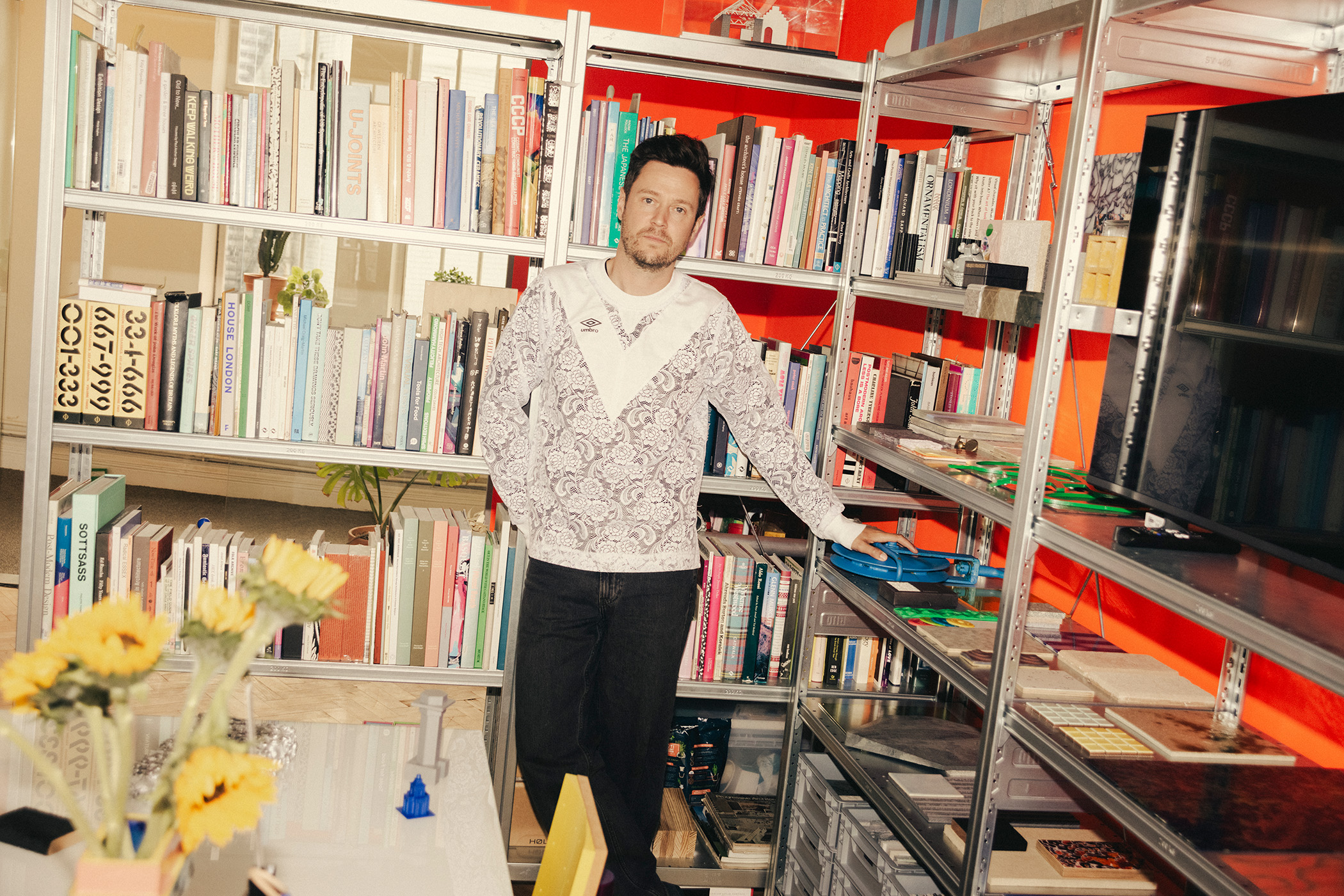


Like many couples who renovate their kitchen, Mat Barnes and his wife disagreed on matters of colour. Barnes, the founder of the small but zeitgeisty architecture studio CAN, is drawn to primaries: the red found on a stick of rock, or a Welsh rugby shirt; the blue of one of his children’s plastic trucks; colours that signal playfulness. His partner, Laura Dubeck, wanted sage greens and fading oranges, the calm of dried herbs and late afternoon light.
In their previous home, the pair had attempted the usual domestic compromise. “Then neither of us were happy,” Barnes tells me. This time, renovating their semi-derelict Edwardian terrace in south London, they tried a different arrangement: everything all at once. Candy-stick columns alongside grey-green splashbacks; aquamarine terrazzo counters beneath a putty-clay ceiling. “I don’t really believe in things clashing,” Barnes says, as we sit in front of the vast, bespoke sliding glass doors that slice open the house to a plunging view of its sloped garden, where birds urgently flit between the branches of a cherry tree.
Inside, craggy bricks mark the slenderest of borders between the kitchen and the rear extension, as if the back of the house had been blown out during the Blitz, then preserved rather than rebuilt. Above us, thin bright girders intersect a plywood box ceiling, the exterior crowned by a faux mountain gable inspired in part by Disneyland’s Matterhorn. The effect is not tasteful in the glossy home-magazine sense, but that is the point. For Barnes, British architecture is not nearly interested enough in the character and imagination of the people who will live inside it. Buildings, he believes, should make room for the peculiarities of their occupants. During our conversation, he says the word “weird”, devotedly, about a dozen times.
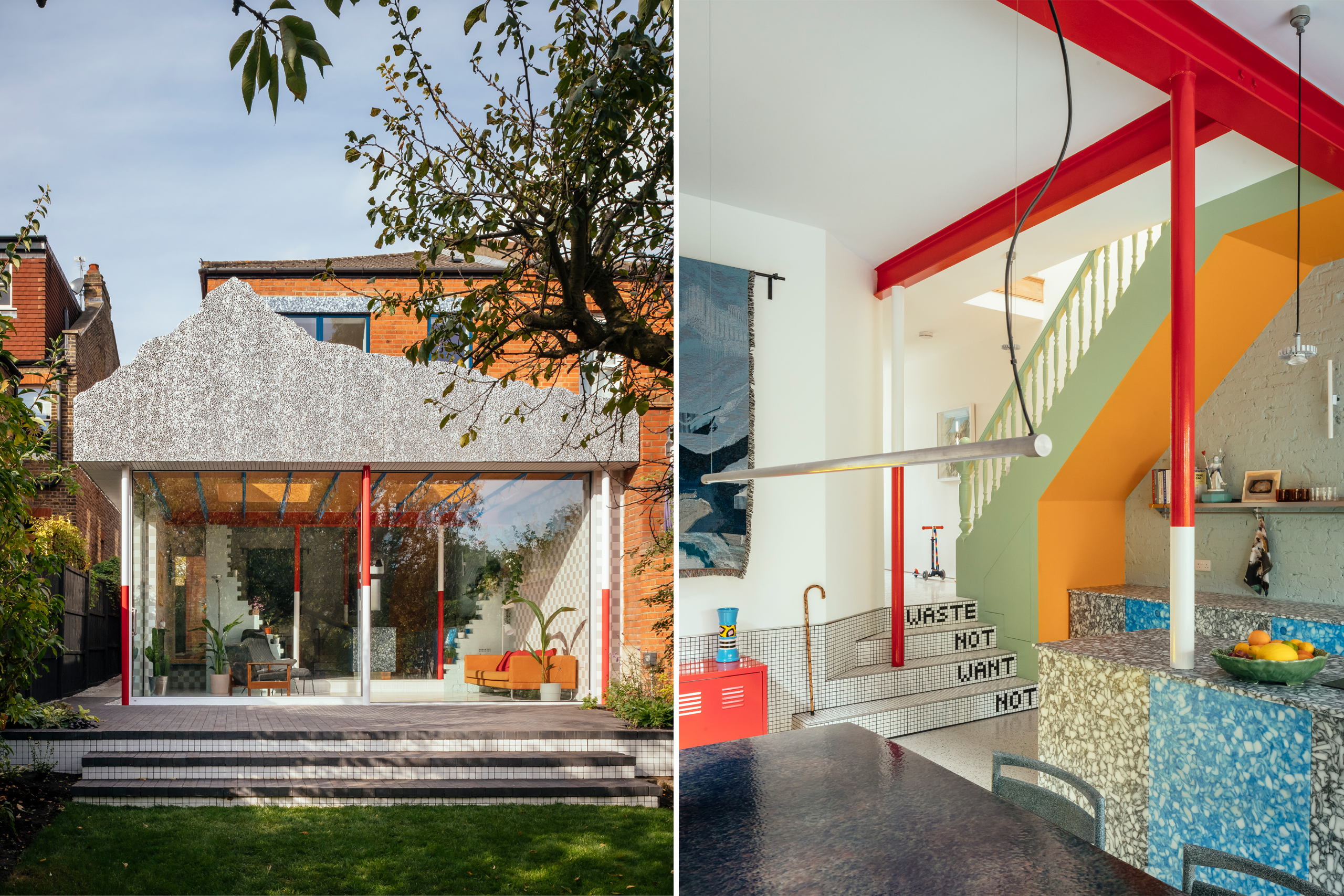
Mountain View by CAN Architects
At Mountain View, as the house became known, his argument was instantly validated. It was longlisted for House of the Year; Kevin McCloud, the serenely sceptical host of Grand Designs, came round to film; the architecture press seized on the work as a domestic-scale project of national-scale interest. The Observer’s architecture critic Rowan Moore wrote that the rebuild offered hope because it felt as though “someone had a good time while designing it, which is not an impression of which you get enough in architecture.” Last year, Building Design declared CAN its Young Architect of the Year. For much of the previous decade, the aspirational British home had leaned toward a narrow idea of calm rendered in pale wood and soft grey upholstery. The aesthetic travelled under various labels – Scandi, Japandi, quiet luxury, greige – but its emotional promise was broadly the same: calmness through subtraction. After years of estate agent-friendly understatement, Barnes’s vibrant maximalism coincided with a mood change.
‘Through making good, weird buildings you can connect to the general public – it makes them feel something, like an artwork should’
‘Through making good, weird buildings you can connect to the general public – it makes them feel something, like an artwork should’
Mountain View made Barnes look like an overnight original, but the instincts behind it had been forming for years, long before he had any clear idea of entering architecture. His mother, who presented Barnes with an application form for McDonald’s on his 16th birthday, had saved some money for his university fees, but there was a condition attached. She would never hand the funds over for anything indulgent or artistically speculative, she told him. If he wanted the money, he had to study a vocation. Barnes, who had grown up in Cardiff – his mother was a nurse, his father a haematologist – had already begun to suspect the obvious vocational route was not for him. Careers advice at school had worked with a blunt logic familiar to generations of British teenagers: what do you like? Animals. So why not be a vet?
Barnes did work experience at the PDSA in Butetown, a charity clinic where people who could not afford private veterinary care brought their animals. “It was carnage,” he says. While trying to put a drip into an Alsatian, Barnes recognised an aversion to needles and blood, and realised, “this was not what I want to be doing.”
At school, Barnes’s natural fine-art impulses had failed to take root. Whitchurch High School, one of the largest state schools in Britain, was better known for producing athletes than artists: Gareth Bale, Geraint Thomas and Sam Warburton all passed through its corridors before playing for Wales in their respective sports. “Art and design was very low on the agenda,” Barnes recalls.
Finally, his father offered a route forward. He knew an architect in London, he said, and the architect drove a Porsche. “In my head I thought, ‘Oh!’” Barnes says. As well as its sports-car promise, architecture felt to Barnes like a respectable compromise: practical enough to satisfy his mother’s sensible ambition for him, elastic enough to contain his aesthetic impulses. He applied to study architecture at Nottingham. He did not get the grades.
That failure proved essential. Nottingham told him that if he completed an Art and Design Foundation course and passed it, he could come back. Barnes enrolled near Cardiff and the course opened something in him. The first half of the year moved in two-week bursts through animation, fashion, illustration and 3D design, before students specialised. His final project was a vandal-proof bird hide. In the process, he came to view building design as part of a larger, porous creative world. If you were painting and needed to understand fabric, for example, you went to the fashion department. If you needed to make something stand up, you asked someone who knew how materials behaved. Architecture, he would later decide, too often forgot to do this.
He moved to London and joined Paul Archer Design, a residential practice then staffed by around 25 people, known for the sort of polished, glassy minimalism that had become the default language of high-end domestic architecture in the years before the financial crash. Barnes’s own interests were already pulling elsewhere. He had become excited by FAT, the now-defunct British practice whose cartoonish buildings showed how architecture could be at once funny and intellectually serious. But there was little room for that sensibility in client work defined largely by white walls and luxurious restraint. “At university you have all these amazing ideas and then you get to the real world, where you actually have to have a client to pay for these things,” he says.
Newsletters
Choose the newsletters you want to receive
View more
For information about how The Observer protects your data, read our Privacy Policy
What he did gain at Paul Archer was a working knowledge of how buildings are made. Archer threw him into responsibility early. “He was just: ‘You run this project and I’ll shadow you,” Barnes says. “It was a baptism of fire, but I learned how buildings get put together, working with builders, and all of the rest.” He enrolled on the second stage of his architecture training at Westminster. Around then, another truth began to dawn on him. “I very quickly realised that architecture is quite elitist,” he says. “You get sold this idea that all the success is because, if you do good buildings, you’ll get good work. But you’re not told that to get good buildings you need to know rich people who will give you work or trust you because they have a family connection or whatever. I didn’t have any of that.”
So, to satisfy his creative frustration, Barnes entered competitions. Drawing on the interdisciplinary habits he learned on his foundation course, he wrote to artists, sculptors and set designers whose work he found and liked on Twitter or Tumblr, asking whether they might collaborate. “There’s always small competitions,” he says, “like designing a bench or a pavilion.” The competitions were speculative labour but, with few responsibilities at home, Barnes committed and, through them, gained what architecture had not automatically supplied: collaborators and contacts, a scene of restless peers.
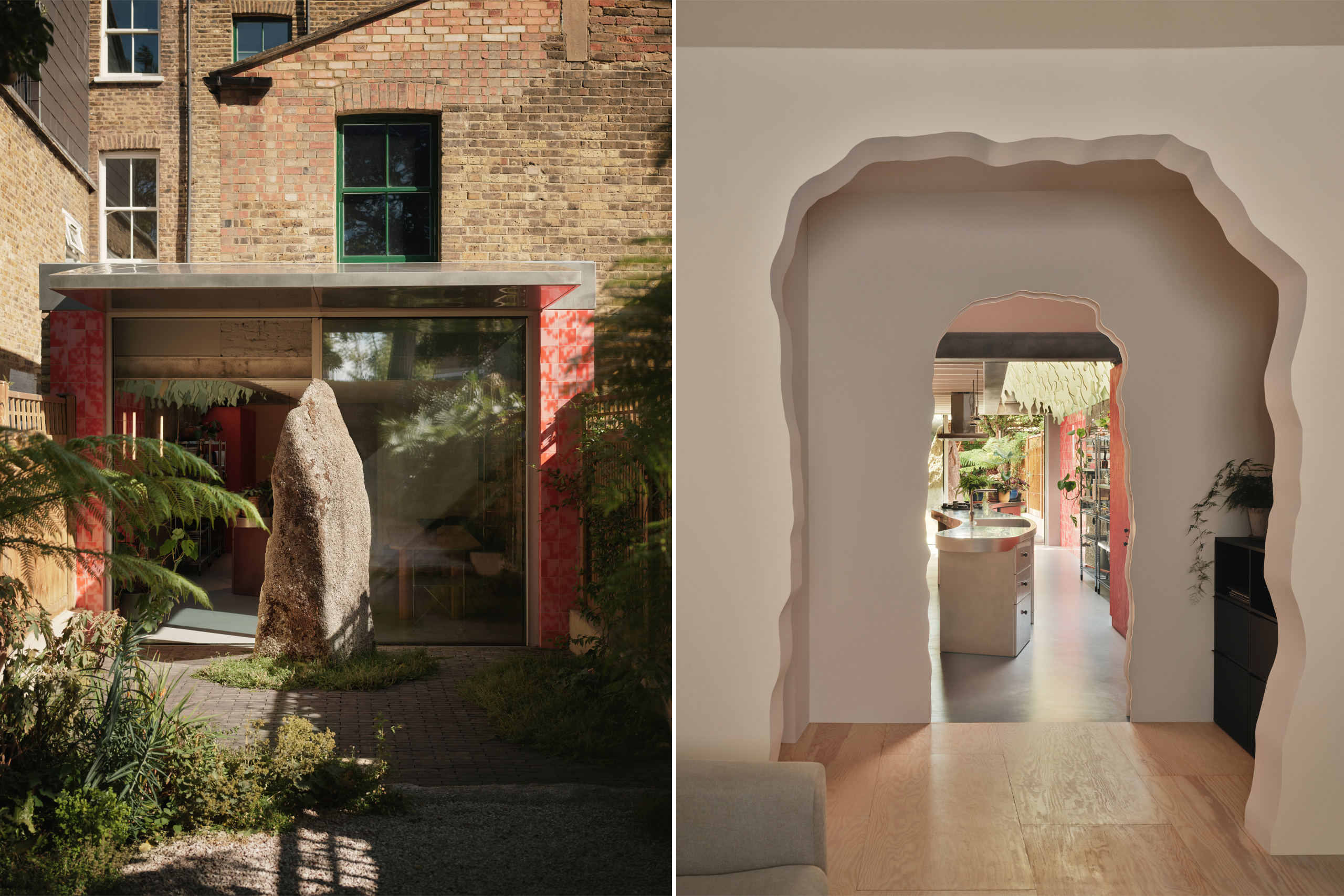
Druid Grove
One of the people Barnes approached was the set designer Anna Lomax. Together, they entered a competition run by Sir John Soane’s Museum to design a mausoleum, suggesting a modernist take. “We got shortlisted,” Barnes says. “We didn’t win, but it eventually led to CAN’s first building.” Later, he and his collaborators won a competition for a bench in Silvertown, made from Concrete Canvas, a material that begins as a flexible sheet and sets hard when made wet. “It’s got fabric on one side and plastic on the other,” Barnes says. They made it into something like a picnic table disguised as a tablecloth: a draped surface that was also a bench, with no support structure. “It was extremely heavy,” he says. Years later, when he returned to the site the bench was the only thing left, presumably too heavy to be moved on.
In 2016, Barnes formally founded CAN. The name originally stood for Critical Architecture Network, a title he later shortened partly because it was “a bit pretentious,” but mostly because the associated email address was too long. He had developed the idea of a collaboration-orientated practice with Eddie Blake, a friend from the competition circuit. Barnes, by then, felt ready to take the risk. Studio 54 Architecture, where he was working by then, gave him the flexibility to reduce his days gradually as CAN’s workload grew.
One of the first projects came as a hand- me-down from Paul Archer Design, because the budget, £40,000, was too modest for the firm. The commission was for a Grade II-listed townhouse in Highbury, where a rotten rear extension needed replacing. The clients wanted a glass box, but the planners needed an acknowledgement of the building’s history. Barnes’s solution was to design an external steel frame from which the glass could be hung internally. The components were ordinary I-beams, but by turning them upright he found the historical echo. “They hint at Georgian glass-house finials,” he says. “If you look at our work now, it’s a slight outlier, but it’s got that weirdness about it.”
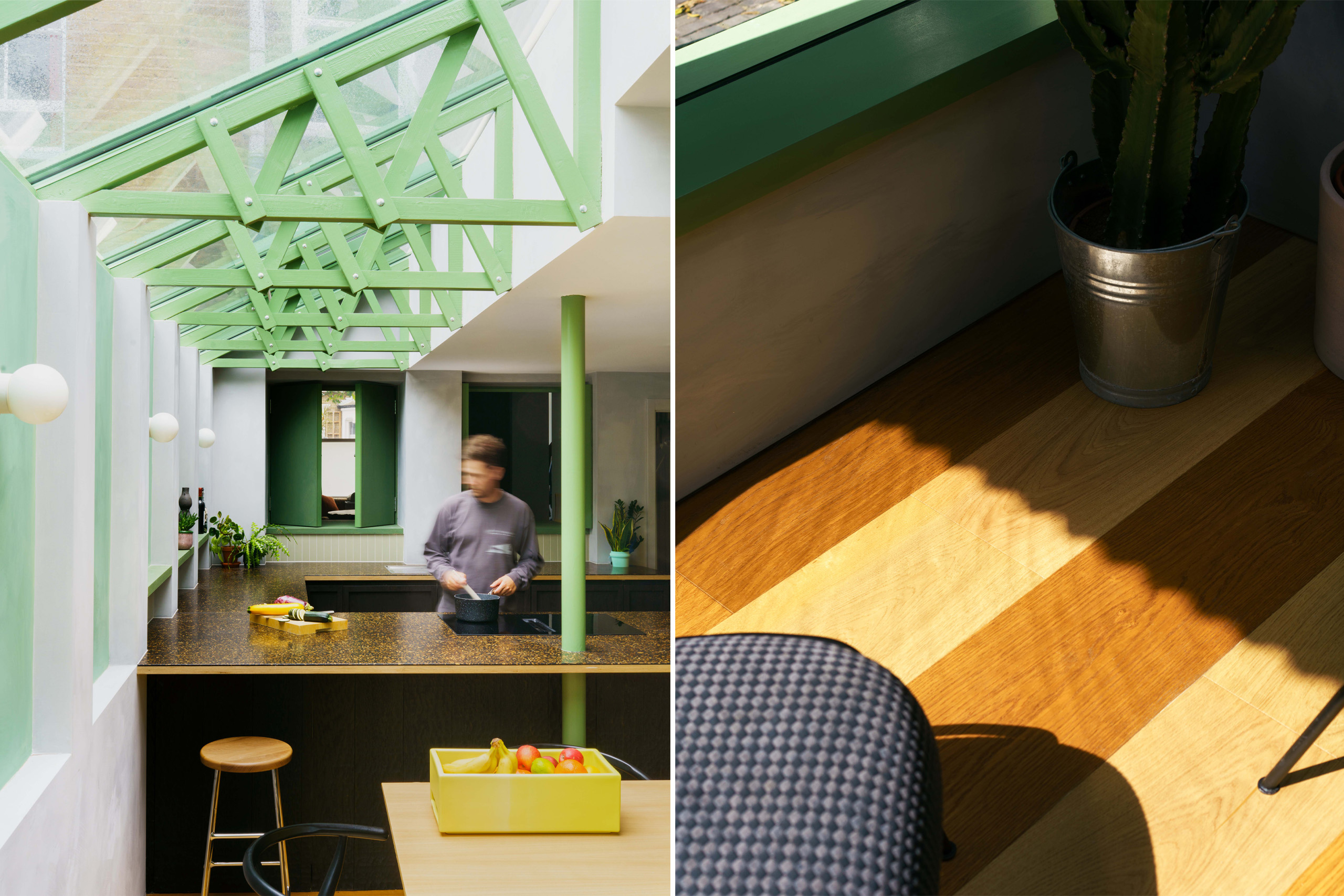
Verdant House
Barnes is now 40 and the Porsche is still yet to materialise. Instead, the vehicle for his ambitions turned out to be a neglected Edwardian terrace in south London. The house that became Mountain View came to him almost by accident. Dubeck’s best friend’s parents lived next door. The place had been empty for six years, inherited by a busy professional in Poland who hadn’t found the time to fix and sell it. She offered to sell it to the couple for £150,000 below market value. The discount left Barnes with enough capital to attempt a full refit.
Barnes knew CAN needed a project that could show clients what his interdisciplinary, highly personal, anti-generic approach could produce. Mountain View became part home, part manifesto. Even so, many of the decisions were made on the go, in the pressure and improvisation of the work site. The house that later looked like an exuberant thesis on domestic joy was, in practice, assembled under conditions familiar to anyone who has renovated a family home: haste, inconvenience, microwave meals and the relentless panic of having to make flash decisions you must then live with for years. Still, the result exceeded all expectation. After the rush of publicity, he found himself inundated with requests to renovate and extend London properties. “It went mental,” he says.
He is not yet over terraced re-imaginings, he says, largely because of his commitment to drawing out his clients’ personalities and private enthusiasms, ensuring no two projects look alike. And he is not afraid to turn away business when he thinks it is in the client’s best interests. “If the expectation is much higher than the budget, I tend to tell them that spending money on us is not value for money. If they’ve got 40 grand and they want to do quite a lot with it, that money is probably better put toward taps.”

But for Barnes, the long-term dream is not simply to make richer people’s kitchens more expressive, but to apply the same curiosity to buildings that might be used by anyone. Still, he is frustrated by how few opportunities exist for a small, experimental practice to work at a larger, more public-facing scale. “It’s a symptom of the safety nets in public procurement,” he explains. To bid for a school, a practice is often expected to show that it has already completed three similar projects. The system is designed to reduce risk, but it also reinforces existing power dynamics. “I try to remind commissioners of the fact that the average age of the team that put man on the moon was 27,” he says. “Like, we can design a building.”
On its website, CAN states that architecture should make the city more “joyful, inclusive and exciting.” Barnes thinks back to Cardiff, where, as a child, he had “no relationship to architecture whatsoever,” and wonders whether buildings might reach people who have no design education, professional vocabulary, or reason to care about the latest tasteful thing. “Through making good, weird buildings,” he says, “you can connect to the general public.” A person might walk into the foyer of a public building shaped like a cave and think, “Wow.” That feeling matters, he argues. “It makes them feel something, like an artwork should.”
Progress is slow. When Barnes studied architecture, it still felt like “architecture with a capital A,” an elite, gate-kept world. Some things have improved since then. Sustainability, for one, is now treated with greater seriousness, a concern that suits Barnes’s own interest, visible in the words “waste not want not” picked out in small tiles on the steps into his kitchen. But the working conditions have not. “I would not recommend my children to become architects,” he says. “I love my expression, but in terms of salary, workload and all of that, I just don’t see it’s going in the right direction.”
He is especially scathing about the institutions that are meant to protect the profession, which he believes remain too beholden to large practices and big funders. Riba, he says, “does not look after young or small practices at all.” His particular frustration is that the practices trying to behave well are often penalised for it. Many employment contracts still allow staff to be pushed far beyond standard working hours without proper compensation. “It’s totally exploitative,” he says. He and many of his peers refuse to operate that way, but in a system of tight fees and public procurement hurdles, such restraint often becomes a disadvantage.
Still, Barnes’s optimism persists, perhaps because it is attached to real places rather than institutional promises. Near him in Penge, he says, there is an almshouse that people love not because it is grand, or glossy, but because it’s strange. People value oddities in the local environment, something with character instead of the same cookie-cutter response. For all his frustrations with architecture as a profession, Barnes has not lost faith in the public appetite for the weird, or in the possibility that the things we are told will clash may, in the end, be the things that make a place beloved.
Additional images: Felix Speller; Jim Stephenson; Rick Pushinsky