



I call Debbie Harry on a Monday morning, the day after Mother’s Day is celebrated in America. I am at home in New York. She is at home in New Jersey where, she says, she has spent time catching up with friends and attending a grill party. Over the weekend, news broke that Harry, who is now 80, will appear in a new film, Maitreya, in which she will play Pamela Anderson’s mother. “It seems fitting I should be talking with you right after Mother’s Day,” Harry says, in that familiar, elegant drawl. “I’m a mother on film. I guess because of my age, a lot of the parts I see now are mothers.”
Harry was last in a film more than a decade ago. When I ask what drew her back, she says, “Well, Pamela Anderson, who I respect greatly, and who is very good at what she does. And she takes chances, which I’ve always appreciated. And she’s fantastic looking, and she’s adventurous, and she’s strong…”
All of which could also be said of Harry, of course, and it’s not hard to see the appeal of this casting confluence: Harry and Anderson, two iconic American blondes whose images came to summarise their respective cultural terrain, and who both at various stages perfected their iterations of glamour and also came to undo or toy with it. There is something charmingly forthright and direct about Harry’s appreciation for Anderson’s aesthetics as well as her other attributes – I can imagine a scenario in which Anderson’s latter-day renaissance as a respected actor and a beauty of a very different sort to her original 1990s kind could only be appreciated by politely ignoring her visual appeal. But Harry has a very good understanding of the fact that beauty does not have to imply paucity of artistic genius.
Some of Harry’s fans aren’t sure how to feel about the new film. On Reddit, there were worries that the news foretold a further delay of Blondie’s new, and perhaps final, album, High Noon. After 50 years, Harry’s devotees haven’t yet had nearly enough, and they hungrily exchange information and clues about when they can expect more, bemoaning the delay. High Noon is rumoured to have a distinctively heavy sound, and is the final studio recording of Blondie drummer Clem Burke, who died in April 2025.
On a separate call I have with Harry and her bandmate, ex-boyfriend and close friend Chris Stein, I ask when the album is due out, exactly.
“We don’t know,” Stein says.
“This year?” I ask.
Harry exhales an incredulous staccato laugh at the prospect.
“Allegedly!” she says.
Both Harry and Stein are eager to have the music out there in the world, they say. It’s been a while since they finished the project, and neither of them likes to dwell too much on what’s already been done. Harry and Stein broke up in 1987, but never fell out, and on our call their words weave in and out while they relay stories. In Harry’s memoir, Face It, she recounts being interviewed by the BBC and being shocked that the interviewer, Johnny Walker, repeatedly referred to her “walking out” on Chris. In reality, she became his carer after their break-up – he had been diagnosed with an autoimmune illness. “I’ve never stopped loving Chris,” she writes, “or working with him, or caring about him. And I never will.”
Newsletters
Choose the newsletters you want to receive
View more
For information about how The Observer protects your data, read our Privacy Policy
I guess because of my age, a lot of the parts I see now are mothers
I guess because of my age, a lot of the parts I see now are mothers
Harry often cites her partnership with Stein as having acted as a buffer while she negotiated the male-centric music industry. Though, naturally she didn’t always want or need his protection. When I ask if they had any music heroes, who might have helped them on their way, they both answer David Bowie and Iggy Pop, with whom they toured in 1977 promoting Iggy’s album The Idiot.
Harry recalls the experience in her memoir thus: “Offstage we would hang around a bit and talk, just day-to-day stuff, but it was a little different for me being the only girl there. I was with Chris, we were a couple, but there still isn’t anything to equate to being the only woman on the road with all guys.
“One time, David and Iggy were looking for some blow. Their connection in New York had suddenly died and they were out. A friend had given me a gram, but I had barely touched it. I didn’t care for coke too much – it made me jittery and wired and it affected my throat. So I went upstairs with my vast quantity of cocaine and they just sucked it right up in one swoop. After they did the blow, David pulled out his cock – as if I were the official cock-checker or something. Since I was in an all-male band, maybe they figured I really was the cock-check lady. David’s size was notorious, of course, and he loved to pull it out with both men and women. It was so funny, adorable, and sexy.”
Chris soon followed and broke up the party but, Harry says now, there wasn’t anything happening beyond tomfoolery. And anyway, “As Chris and I left the room, I had to wonder why Iggy didn’t let me have a closer look at his dick…”
I ask Harry to tell me about the start of things, back in the late 1970s, when Blondie formed and became a force. What spark created a new album? What did it feel like back then? What does it feel like now?
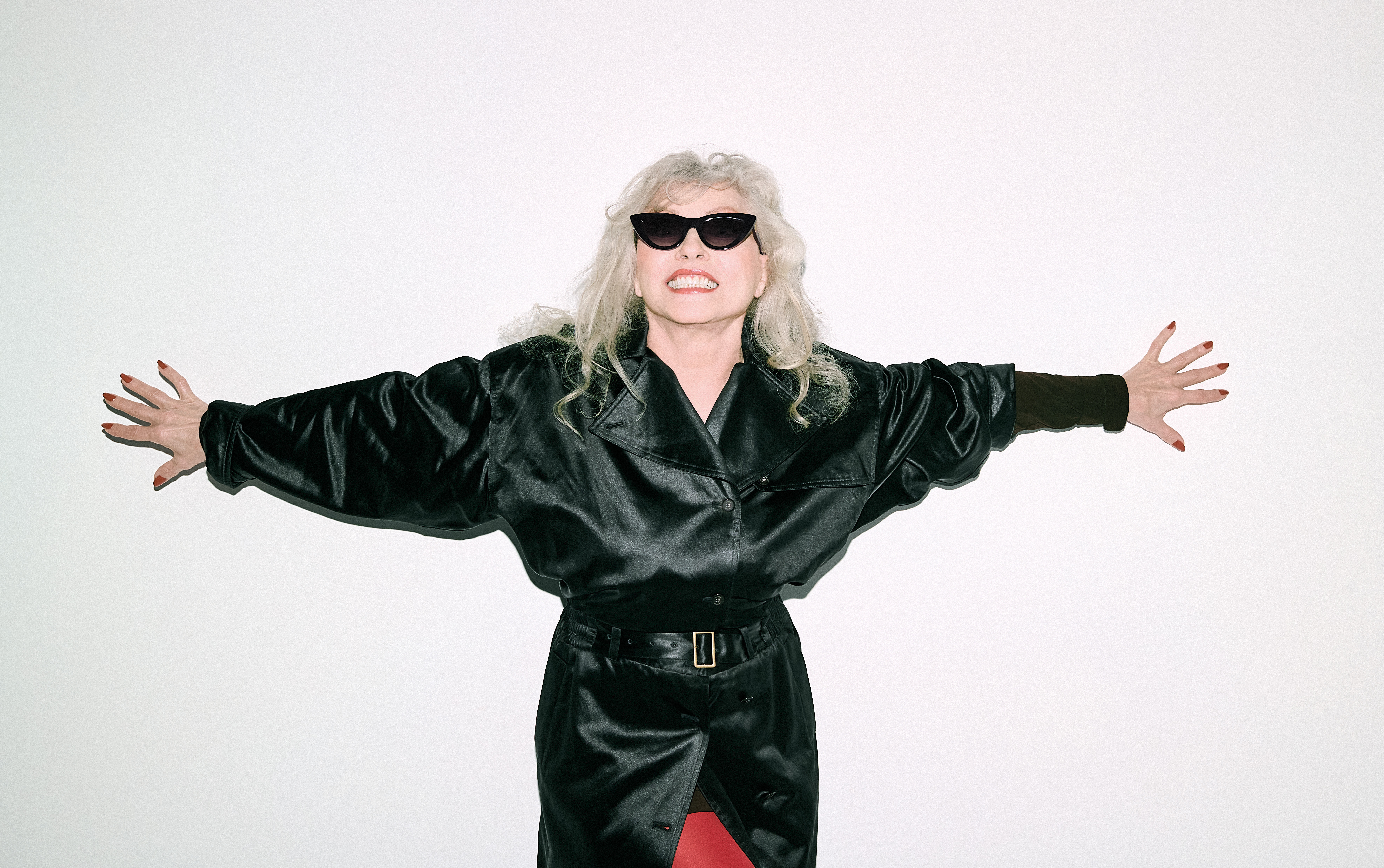
“Of course, back then it was more primitive,” she says. “In the beginning we were just in these dark rooms hitting guitars. But I think one of the lucky things for us was that technology was changing so rapidly and instruments were becoming so much more than they were, so we were sort of at the forefront of that.” Primarily, Harry wanted to “do music that was what we wanted to hear from other people. It was a direct attempt to be the opposite of what we called the good old boys – the very blues-based rock music. And we clearly stepped in many several different directions, including pop and rap and reggae and disco, and all the sort of outgrowths of the early 80s.”
Now, she says, the mechanics may be different than they once were, but the impulse remains: keep moving forward, like a shark.
Harry was born in Florida in 1945. She was adopted as a baby by a family who lived in Hawthorne, New Jersey. “I grew up in a small town, in an upper middle-class family, but I had a fantastic world that I had created in my mind,” she says. “And ultimately, it was real – it certainly became real.” As a young woman, she would “hear about different artists and writers, in particular the Beats, who I knew very little about, but who seemed wonderfully interesting and dangerous.” Counterculture meant something then, she says. “I don’t know if it’s that way now.”
Early on, Harry was drawn to a particular way of life, rather than towards the music industry specifically. “My ambition was not really to be in a band,” she says, “but to be a painter, even though I am not a painter.” She adds, “That part of society – that’s what I was drawn to.”
She moved to New York in 1969, and spent time working as a secretary and a dancer, and later, briefly, a Playboy Bunny. In the early 70s she joined New York punk band the Stilettos, which was when she met Stein, and the pair subsequently left and formed Blondie. Their first two albums were released in 1976 and 1977. Their third, Parallel Lines, released in 1978, propelled them to international fame.
I wonder what it was like, the sudden influx of adoration, and then the inevitable ebbs of attention that would follow, as in any long career.
“The mad rush of popularity?” she says. “I always felt the absurdity of it all, and maybe that was a safety net for myself. Me saying, ‘Oh, it’s absurd anyway, it’s a part of the business, it’s nothing to do with me.’”
The ability to dissociate public and professional perception from your internal sense of self is, famously, not a universally robust one. It’s almost impossible for me to imagine a young woman entering the macho world of musicians and businessmen while being able to hold on to a reliable core of autonomous strength. And yet I fully believe Harry when she says that this was her experience. Part of what has maintained her as a perpetually alluring emblem of downtown cool is the feeling she really couldn’t care less about the opinions of others.
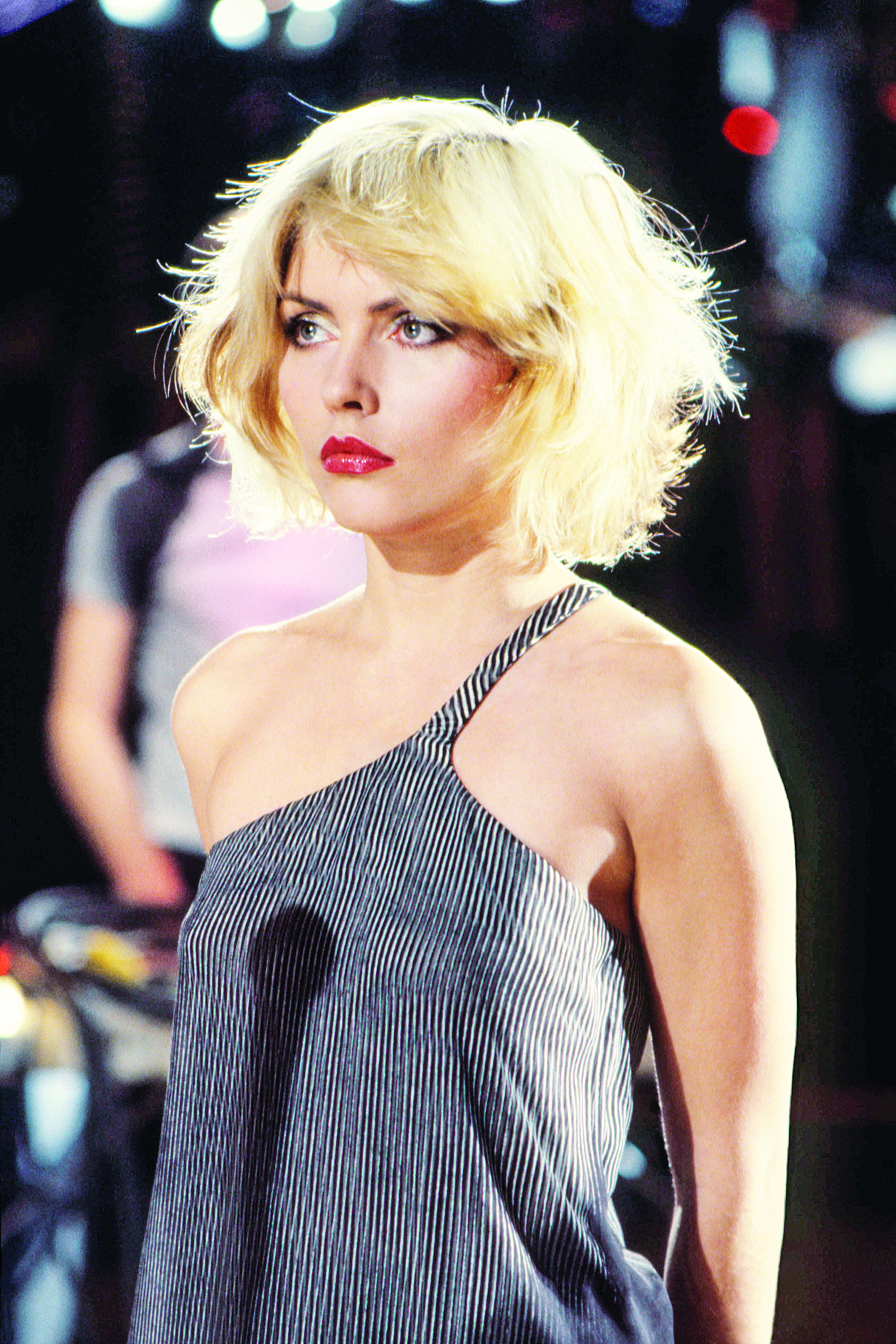
1978, on the set of the Blondie Heart of Glass music video
As with the summary of Anderson’s appeal, there is no need for Harry to diminish her own beauty to feel her value as a musician. At the time of her emergence, there were certainly examples of her artistry being trivialised because of the glamour. As recently as 2019, the Washington Post headlined a review of her memoir: “More than just a pretty blonde in tight pants.” Yet you would be hard-pressed to find evidence of Harry caring much one way or the other. When I ask how it felt to have her own image so inextricably aligned with the band’s fortunes and reputation, she responds simply. “Lead singers of bands have always been spotlighted for obvious reasons,” she says. “They’re telling the story. I understood that territory. The fact that I was a pretty girl was a very strong commercial aspect that obviously the record label and the press enjoyed – and I enjoyed, to an extent.”
Her image also led to collaborative relationships with visual artists, among them the artist Andy Warhol, whom Harry credits with teaching her about being forever future-oriented. She does say that the loss of anonymity hurt her. “It made me suffer a sort of a loss of privacy and I had really enjoyed walking around and being a local. But Chris always said to me that I never even really noticed it anyway.” People would always be looking at her, “and I guess I never really paid it any attention”.
Harry’s coolness is unusual, in that it appears completely uncultivated and is also not characterised by a lack of sincere engagement. Everything she says and does indicates a person who is a passionate artist and friend. She is forthright and clear. She doesn’t seem interested in assembling mystique. And yet there is something wonderfully unknowable about her. Perhaps it’s that she ascended during a time when the trade-offs for celebrity were not so dependent on intimate revelation or constant self-documentation, or maybe she would have been like this in any era, I find myself enjoying her slight remove, even as I’m trying to breach it. The only time during our conversations that I catch a glimpse of the dreamy small-town girl intent on claiming a different way of life is when she recalls a scene from the 1970’s Greenwich Village; “One of the highlights of my life was seeing Allen Ginsberg and his beautiful boyfriend walking down the street wearing these long, long kaftans,” she says. And she shakes her head in wonderment, even now.
There is still a little awe, too, when she speaks about David Cronenberg casting her in his 1983 body horror film Videodrome. For a woman enthralled with image-making and world-building, the movies were a natural progression. How did it feel to be cast?
“Cronenberg was always very ahead of the curve and he wanted me for that part. I was completely thrilled and overwhelmed, but he almost fired me, actually, because I had done my hair British Brown, and he wanted me as a blonde. Nobody saw me arrive. He was like, ‘What happened to the blonde hair?’ So, you know, but eventually he kept me anyway.”
I never really hated anybody, but tensionis good… When you are a creative person, oneupsmanship spurs people on
I never really hated anybody, but tensionis good… When you are a creative person, oneupsmanship spurs people on
In Face It she recalls her Videodrome co-star James Woods on set helping her develop as an actor, and cracking up the cast and crew with quips when things in a scene got too heavy.
“There’s one more Videodrome story I had forgotten until I saw an interview with David. There’s a scene in the movie where Max grows a big slit in his stomach that sucks things into itself. At one point even Max’s own fist gets ingested. After a long day wearing ‘the slit’, Jimmy cranked out on us. He complained, ‘I am not an actor any more. I’m just the bearer of the slit!’ To which I replied, ‘Now you know how it feels’.”
The night before I speak to Harry and Stein, I had seen a show in Manhattan opened by Lou Barlow of Dinosaur Jr, a band who played at the famous New York club CBGB in the generation that followed Blondie. Barlow had reminisced on stage about driving up to New York from Massachusetts to play early shows there, looking around at the other more famous bands and thinking, “Wow, they all really hate each other”.
I ask Harry what it’s been like being in a band this long, but really I want to know how it feels to know anybody at all for 50 years.
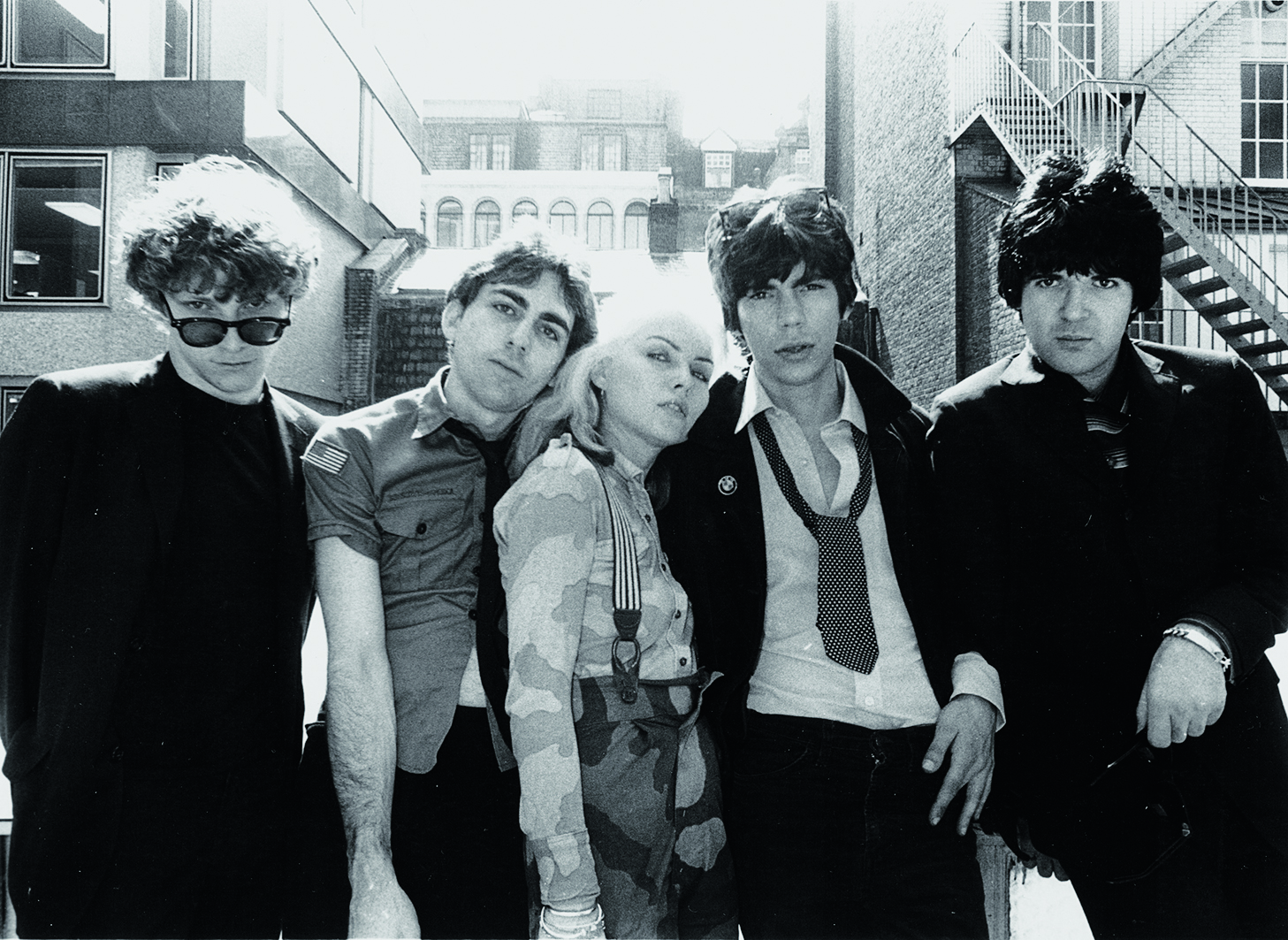
Blondie in London, 1976 (from left): Gary Valentine, Chris Stein, Debbie Harry, Jimmy Destri, Clem Burke
“I never really hated anybody,” she says, “but the tension is good, that’s part of it. We were all in this big mess together. And I think when you are a creative person, actually oneupsmanship is important, it spurs people on.”
There is a certain amount of mandatory nostalgia foisted on stars like Harry, who have reached icon status and have grown elderly in the public eye. Harry also has a particular generosity of spirit, and an interest in much younger artists. She recently had a quick cameo on Saturday Night Live, introducing Olivia Rodrigo. Last year, she was photographed on the subway sitting next to Cameron Winter for a New York Magazine story. How does it feel to have this elder statesman cache? Does she resist the nostalgia?
“It’s very nice for me to play a song I wrote 30 years ago, because it’s a time capsule of a cherished part of my life. I’m very lucky that way.” But, she goes on, “As far as moving ahead, I’ve always looked that way. I’ve always wanted to move on to the next thing. Thinking about that at my age right now, that’s sort of preposterous, but that’s how I’m programmed. I think when you hear some of the stuff on High Noon, you can see the full thread of what Blondie is about, musically and lyrically. I think the times have changed and that lyrics nowadays are much more sophisticated than when I started. That has been a great relief to me, in fact, that you can actually say what’s on your mind.”
There are other things in the works, she tells me: a film she can’t go public with yet, a documentary. She wants to perform again – she finds that she enjoys speaking to the audience in a way she never used to. This week, though, she is forcing herself to stay still, tracing the thread back, going through old photographs, footage, trying to assemble them in some coherent fashion.
“I’m beginning to get a strong impression of what the hell I’ve been doing all these years,” she says.
Cutler and Gross x Debbie Harry Sunglass Collection is available from 27 May (cutlerandgross.com)
Photographs by WireImage; Redferns