



We affirm that the world’s magnificence has been enriched by a new beauty: the beauty of speed,” wrote Filippo Tommaso Marinetti in his Manifesto of Futurism of 1909. “We will sing,” he declaimed, of “adventurous steamers that sniff the horizon; deep-chested locomotives whose wheels paw the tracks like the hooves of enormous steel horses bridled by tubing; and the sleek flight of planes.”
Marinetti was a poet, but his influence was on the visual arts as much as literature. He inspired the architect Antonio Sant’Elia to dream up soaring, multi-level cities built over the new infrastructure of transport, wielding what he called “dynamic” shapes with “an emotive power a thousand times greater than perpendiculars and horizontals.” Although he died in the First World War at the age of only 28, Sant’Elia’s unbuilt visions provided a rich source of ideas for 20th-century architects, Le Corbusier and Richard Rogers included.
The influence of speed in architecture takes at least two forms. One is the design of structures that serve fast-moving machines, such as airports, or Fiat’s wonderful Lingotto factory in Turin of 1928, which was built with a test track on the roof. The other is the design of buildings that seek to borrow the glamour of speed by emulating the look and logic of planes and cars. Buildings, with a few exceptions, don’t move. They have no practical need for speed.
Yet for that very reason the imagery of fast-moving vehicles has an allure for architects. They offer the romance of escape from their static and earth-bound profession. There can also be enviable clarity and inventiveness in the design of planes, trains and automobiles – the demands of performance and efficiency leave little room for superfluity. The design of buildings is a muddier, less precise, less focused business. The design of cars, wrote Le Corbusier in Towards an Architecture in 1923, involves “a search for beauty and harmony outside of brute practical fact,” which he compared to the evolution of ancient Greek temples towards ever-greater perfection. The buildings he designed were complex fusions of historic and sometimes primitive inspirations with the industrial and the technological, of the Parthenon with grain silos, bridges and ocean liners. They can be weighty as well as soaring.
The proponents of “streamline modern”, a version of Art Deco that flourished in the 1930s, were more explicit in their pursuit of the look of speed: they styled cinemas, factories, Greyhound bus stations and private homes with curves and horizontal lines derived from the aerodynamic forms of moving machines. Architects of the British high-tech movement would, from the 1960s onwards, produce their own interpretations of the technology of speed. Norman Foster, an enthusiastic pilot of planes, helicopters and gliders, would strive to translate their lightweight structures into buildings.
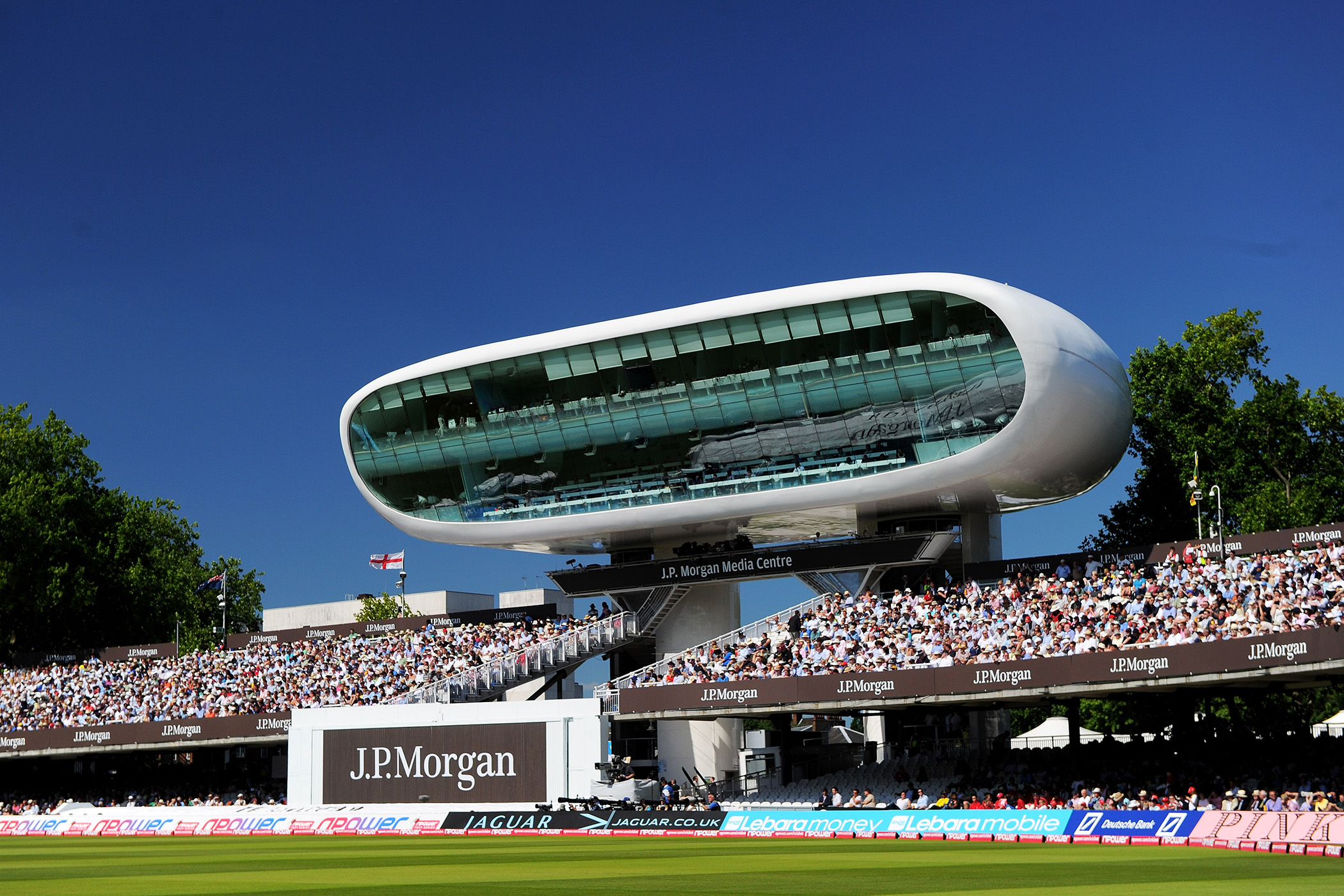
The media centre at Lord’s cricket ground
Future Systems, founded by an ex-employee of Foster, Jan Kaplický, went to another level, and designed buildings based on the capsules and satellites of space exploration. They went mostly unrealised until he and his partner Amanda Levete designed, somewhat improbably, the media centre at Lord’s cricket ground. Its UFO shape, built with the help of yacht-building techniques in the late 1990s, is now an international landmark of the sport.
It’s paradoxical to adapt the forms devised for zero gravity to earthbound buildings, just as it is to shape unmoving structures as if they were travelling at hundreds of miles per hour. It’s illogical to apply the rigorous logic of speed to immobile objects. But to criticise speed-inspired architecture for these reasons is to miss the point. It’s a fantasy, but a powerful one, that helped architects to design some of the most arresting buildings of their time.
Newsletters
Choose the newsletters you want to receive
View more
For information about how The Observer protects your data, read our Privacy Policy