


In 2013, the hottest restaurant in the world was Carbone, in Greenwich Village, New York. Part Italian-American trattoria, part pastiche of Godfather glamour, it was an immediate hit with high-profile diners. Barack Obama ate there while he was still president. Both Rihanna and Taylor Swift were photographed outside. A Michelin star came and went, but the hype remained, and its tables remained hard fought for. In 2017, the rapper Drake mentioned Carbone in the song Do Not Disturb, which travelled the world, establishing the restaurant in the cultural zeitgeist. Restaurant goers who had previously struggled to bag a reservation suddenly had even less hope.
Carbone’s founders, Mario Carbone, Rich Torrisi and Jeff Zakaznick, did what all canny restaurateurs do when they have a hit on their hands: they expanded. Over the past decade, Carbone transplants have appeared in Las Vegas, Hong Kong and Dubai. Last October, they opened a London outpost, as part of the £1b super-hotel the Chancery Rosewood, and it became the most anticipated city arrival in years. In the days before it opened to the public, both Leonardo DiCaprio and Kate Moss were photographed visiting. On social media, influencers suggested what to wear and order, if only they could bag a reservation. Despite lukewarm reviews in both the Times and the London Standard, which described it as “Pizza Express for the rich,” demand for tables remained high. Reservations for Carbone are released three weeks in advance, on Thursday mornings at 10.30am. Even now, several months after opening night, prime time tables in the main dining room are almost impossible to get.
Whether it’s an omnipotent host in Sex and the City or Patrick Bateman’s obsession with the fictional restaurant Dorsia in Bret Easton Ellis’s American Psycho, pop culture uses the reservation experience as a nod to power and status – or, crucially, the lack thereof. Dinner isn’t just dinner any more, it’s relevance. And in this era of the hype restaurant, getting a seat at the right table has never been more competitive.
It took me a month of daily refreshing to snap up a recent weekend reservation at Tiella, which, when it opened in February, became east London’s buzziest restaurant, even though I’m on first-name terms with the chef. Sally Abé, the chef-owner of Teal, in Hackney, says she’s hounded for tables from friends, peers and contacts – but tables are finite and she often can’t help them. A manager at a glamorous, hot central London restaurant told me that an assistant to a prominent international customer waited outside her restaurant for four hours, having being told by their employer not to leave until they secured a table. (She did, in the end, take pity on the assistant.) Much like Glastonbury tickets, alarms are set for when reservations drop and tables are gone within seconds, often secured with a deposit that may not be refunded without enough notice of cancellation.
People book multiple restaurants and put in their card details for the deposit or cancellation fee, then they cancel the ones they don’t want
People book multiple restaurants and put in their card details for the deposit or cancellation fee, then they cancel the ones they don’t want
And like gig tickets, black-market reselling is on the rise – opportunistic entrepreneurs block-book tables (sometimes using bots) as soon as they’re released, and resell them on peer-to-peer apps, a practice the government in New York has banned. In the UK, the problem is less prolific, though Rex-X acts as a secondary marketplace, so people can sell on individual bookings and recoup the cost of a deposit or prepaid menu. One senior executive at a large booking platform told me: “People book multiple restaurants and put in their card details for the deposit or cancellation fee, then they cancel the ones they don’t want at the last minute and freeze their card so they can’t be charged.”
Kimberley Coke operates a concierge service securing impossible reservations. “I’ve booked tables for Jake Gyllenhaal, Emily Blunt, the Ortega family that owns Zara,” she told me recently. “I now have three American directors on my books.” Increasingly, though, her customers are people who facilitate the lives of those with extreme wealth: local PAs and virtual assistants assigned to visiting CEOs, private-jet companies with concierge arms, sports agencies and luxury travel operators planning itineraries for “super rich Americans and Middle Eastern clients”.
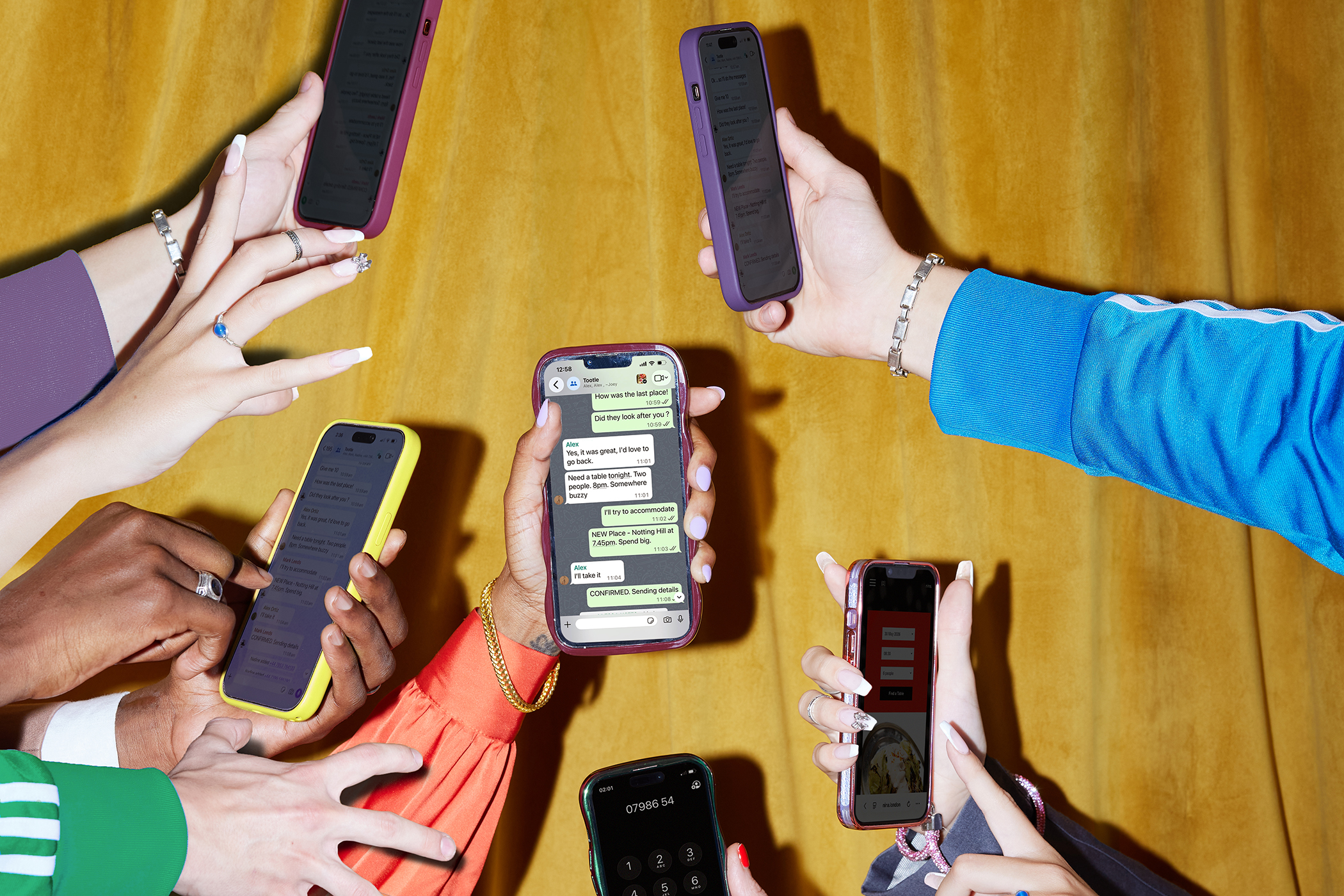
Much of her time is spent vetting new restaurants. “Sometimes people know exactly where they want to go,” Coke said. “But just as often it’s: ‘Where should I go tonight?’” Throughout the week, she fields requests that arrive via text and WhatsApp. “Everything happens on WhatsApp now,” she said, flashing a glimpse of a chat with the VIP line of Dorian, one of London’s buzziest bistros.
Requests can be blunt. “I get a lot of random numbers,” Coke told me. “On a Saturday night I might get someone like, ‘Can you get me into Zuma now?’” (Zuma is a sushi restaurant in Knightsbridge and, with even minor planning, it’s not that hard to get into – those messages are usually left on read.) Coke most enjoys working with fairly normal, fairly high-net-worth couples based in London who message her via their own dedicated WhatsApp group, with requests such as: “Kimberley, we want a date night on Friday. Where’s new and Mayfair?”
Different scenes appeal to different customers. “Gymkhana is the most requested by all my clients,” she said, adding that it’s Americans particularly who want to visit the Sethi siblings’ two-Michelin-starred Indian restaurant. Carbone attracts a different crowd. “It’s still quite popular, but not really with the foodie crowd – it’s more of a corporate crowd.” Other restaurants spike because of social media hype, like the outposts of the maximalist Big Mamma group. “When Jacuzzi in Kensington opened, it went mad,” she said. “I must have had about 30 requests a week from random famous people wanting to go there.”
As we were speaking, Coke was trying to secure a table for the CEO of food delivery service Doordash at the Quality Chop House, a contemporary British restaurant in Farringdon. As always, the key is not what you ask but who you ask. “You have to get to the top person,” Coke told me. “When I tried to get Jake Gyllenhaal into Rules, the reservationist was like, ‘No, sorry.’ I was like, ‘What?! It’s Jake Gyllenhaal’”
Newsletters
Choose the newsletters you want to receive
View more
For information about how The Observer protects your data, read our Privacy Policy
Part of Coke’s job is managing expectations. “I’ll be like: ‘So, at the River Café I didn’t get you 7pm, but I’ve got you 6pm,’” she told me. Regular clients understand. “If I can’t get them that table at Dorian at 8pm tomorrow, they’re not going to be rude, they respect and they trust me.” Sometimes, even if she can get a table, it’s about steering people elsewhere when a restaurant isn’t worth their time. “Some people are clueless. They want to go to…” She named an upmarket but critically derided restaurant. “I’ll say, ‘OK, well there’s a lot of brilliant new restaurants that you might want to consider.’”
Stephen Shamoon, owner of the Good Oak pub and bar, in Notting Hill, oversees one of the exclusive WhatsApp lines Coke interacts with. “We tend to keep it fairly under wraps,” he told me recently, noting that he keeps tables on the second floor free for regulars and neighbours who message at the last minute. “They’re the backbone of the business. Maintaining that direct, personal relationship with them is incredibly important.”
Joe Warwick oversees aspects of neo-gastropub the Fat Badger nearby, where I have spotted Olivia Rodrigo playing cards with her lover. When it first opened, it was reported that the buzzy dining room, behind an unmarked door, was only accessible to those in the know via a WhatsApp group. “There is no WhatsApp group,” Warwick sighed, when I pressed him for the second time in two weeks. He and his colleagues had previously built a reputation and customer rapport at sister west London destinations, including the Pelican and the Bull. “I often give my number to customers I like. Other managers and the owners do the same.” I asked for details on the vetting process. “Just nice customers in general,” he said. “Some are famous, some aren’t.” When I visited the group’s latest opening, CeCe’s, I saw two of the owners greet Cruz Beckham with a hug.
At Markus Thesleff’s London restaurants – which include the Mexican-Japanese restaurant Los Mochis and Juno, and the high-end Italian Sale e Pepe – bills soar when customers go all in on caviar and vintage wine and spirits. “Some of our regular guests spend £30,000, £40,000 or even £60,000 in a single visit,” he told me. For the CEOs, entrepreneurs, high-rollers who built up relationships with his staff, Thesleff has installed a dedicated VIP team. Customers bypass reservations platforms and speak directly with staff. “We have had extraordinary evenings where the bill has reached over £170,000. For clients like this, the experience has to feel completely personal and seamless.”
Dorsia is one of the new tech platforms promising priority access to restaurant reservations, named for the impossible-to-book restaurant in American Psycho. “I had previously done work with Bret Easton Ellis,” founder Marc Lotenberg, explains over Zoom from Miami. “He hated people coming up to him and being like, ‘Oh my God, Dorsia!’ That was cringe for him.” Lotenberg flew to Los Angeles to convince Easton Ellis to let him use the name for his app.
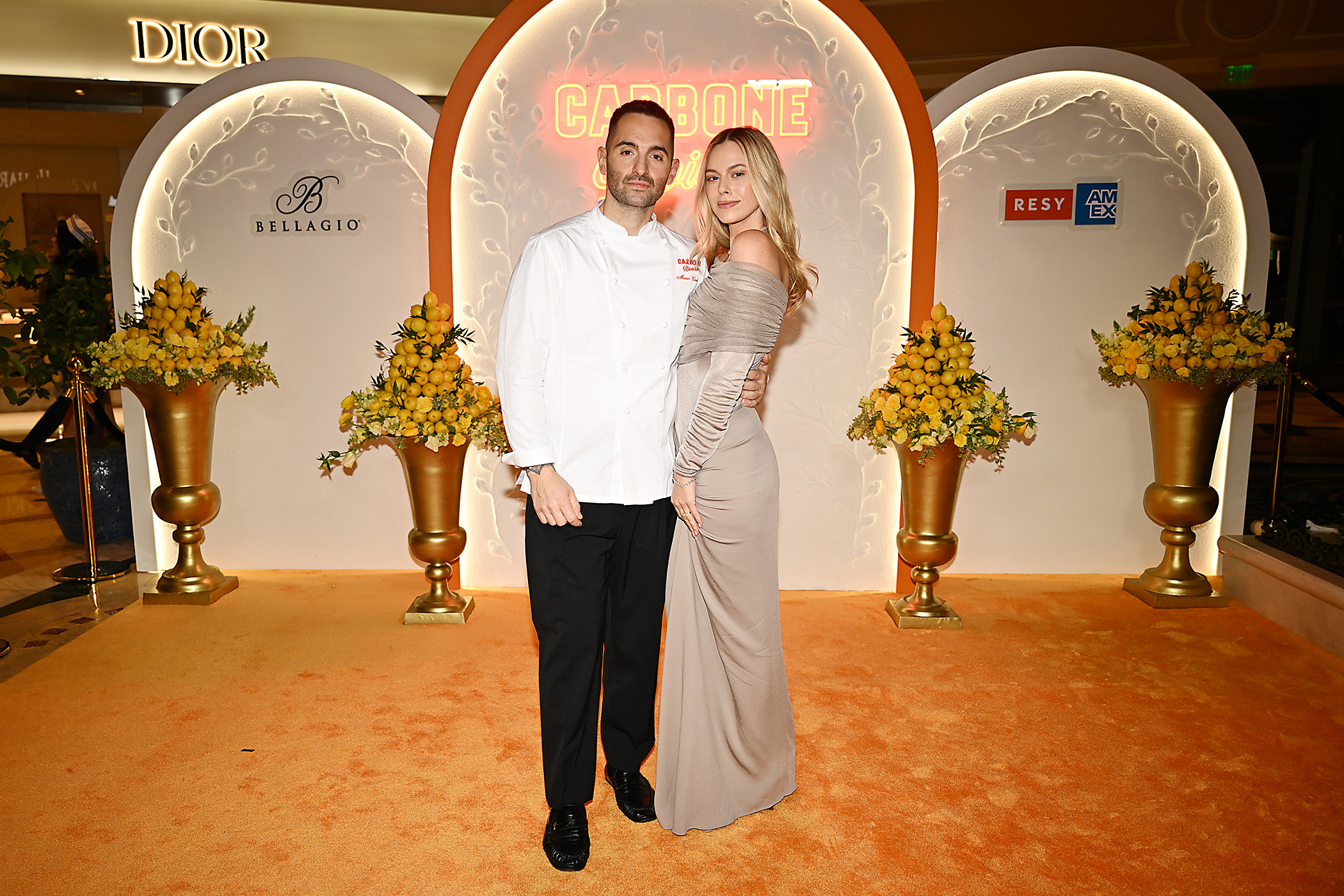
Chef Mario Carbone and Cait Bailey at the opening of the Las Vegas offshoot of his Carbone restaurant empire.
Dorsia membership promises access to certain restaurants across North America, Europe and the Middle East. In London, that includes Carbone, Bob Bob Ricard, Bouchon Racine and playboy chef Thomas Straker’s restaurant, Straker’s, which Dorsia reportedly invested in, to ensure they can access the best reservations. An entry level subscription, costing $200 per year, offers hard-to-secure reservations that are subject to minimum spends, paid at point of booking. (Carbone, for instance, is £300 per person.) Higher-tier memberships (up to $25,000) get earlier access and lower minimum spends, while part of the fee is parlayed into “fun coupons” to spend in restaurants and on events. Dorsia says that if subscribers pay with crypto currency there are “cash-back” benefits.
Lotenberg thinks many restaurants have lost control of who enters dining rooms and told me his job is to help them curate the “right crowd”. This could include: “A really cool artistic 18-year-old in southern Italy, or an 85-year-old in New York who’s a big art patron. It’s not about the age, it’s the vibe and the energy, and like, where you are in life.” Admission is operated through “degrees of separation” technology, linked to other members. “I’m not an inclusive person,” he told me. “It’s important to not be scared of exclusivity. That’s what tribes are, right?”
For those who are less set on finding their “tribe”, there are more affordable options. Free app Onezone offers a selection of restaurants curated by its founders, as well as perks such as free drinks, snacks and soft-launch invitations. The app Open Table has a loyalty programme; frequent users can unlock alerts for last-minute tables, and includes held-back tables at Trivet, Bouchon Racine and the Clove Club. Deliveroo recently partnered with reservation platform Seven Rooms to offer reservations through the takeaway delivery app, and is offering users monetary credit for booking with them.
For the late-decision diner, Seven Rooms also has an invite-only app that holds back tables for VIP diners which are released to the public 24 hours before the sitting. In a constantly busy new Mayfair restaurant, the operations manager – who is regularly approached by desperate diners offering to bribe her for a table – showed me the back-of-house technology. Each person’s name is accompanied by coloured tags, everything from their job to menu preferences. The more famous, influential or regular the diner, the more tags. “This person, I know exactly how much he’s spent every time he has come here,” the manager told me. “His favourite cocktail is a boulevardier and he only drinks sparkling water.” If multiple people have requested the same sitting, this data determines who gets it. “If we see they’ve cancelled a lot, that does matter.”
Technology is being used without diners’ consent elsewhere, in more unnerving ways. One London restaurant manager tells me they are trialling AI-powered software that screens diners when they book a table to give the restaurant information on how much money they are likely to spend, enabling the team to prioritise certain bookings.
Coke doesn’t see any of these technologies as a threat to her work. “Dorsia is great for restaurants,” she says, explaining that some customers turn up for a drink in some places and leave without using up the prepaid, non-refundable minimum spend. Pure profit for the restaurant, commission for the app, seat at the right table for the customer – everyone wins.
Jaclyn Sienna India, behind luxury concierge provider Sienna Charles, books restaurants and travel for clients including Mariah Carey and George W Bush. AI has helped streamline her business, but ultimately her clients crave focused attention. “The wealthy always rely very heavily on relationships. They want to know that they have my cell phone to call me,” she told me.
Some of the most successful restaurateurs in the UK are adamant in their resistance to apps. “I hate, hate, hate them,” said Martin Kuczmarski, of the Dover, Dover Street Counter and Martino’s in London. Frequently visited by celebrities, including Sarah Jessica Parker, Pedro Pascal, Jennifer Aniston and Harry Styles, getting a prime-time reservation can be a struggle.
Kuczmarski, who was Nick Jones’s right-hand-man at Soho House for 16 years, does have a direct line for urgent enquiries by “people we know”, and believes in a certain degree of guest curation. “Restaurants are like theatres,” he told me. “If you throw a party in your home and invite 10 people, you will think about who you’re going to invite. You want to make sure they talk to each other, have good fun, look good together.”
Still, he holds back a significant amount of tables for walk-ins: “The coolest people in the world are spontaneous.” Getting in is simple. You don’t have to be dressed in a particular way. “That’s a superficial way of judging a person,” he said. “What’s most important is that you are a nice person. The reception teams can figure it out within seconds. It’s an instinct. If you’ve got a nice smile, a nice twinkle in your eye, and your body language is nice, we’re going to do everything we can to give you a table.”
And if a table crops up on Res-X tomorrow? “I wouldn’t trust AI to give me the best table at the Dover,” Kuczmarski says. “And if you do, that means you have no style in your heart.” He waits a beat, before adding “Oops!” with a naughty giggle. Rounding off the call, the restaurateur is as hospitable as his reputation promises. “You must come in,” he urges, with genuine warmth. “You have my number, let me know, any time.” Perhaps being known is still the greatest currency.
A week after filing this feature I’m offered an interview with Mario Carbone for a different story. His team had previously ignored my request for comment on the subject of reservations, but I manage to slip in the question: “So, what’s the best way to get a table?” I hear his team of three laugh in the background. “Come for lunch,” he says.
Since my first attempt, the restaurant has opened a ground floor dining room and a terrace. A quick look at Carbone’s website tells me that now, getting a table upstairs is the problem – downstairs even has availability at 7.30pm. But do I want to book in now that tables are readily available? Everyone else has moved on.
Denise Truscello