


Food

Thursday 26 March 2026

Spring feasts for the Easter weekend

Now’s the time to linger over dishes, to cook more elaborate meals simply for the pleasure of doing so

Ingredients

large potato

1

apple

1

salt

(to taste)

duck fat or olive oil

1tbsp

large egg

1

kale or cavolo nero

(to serve)

Through the first cold months of the New Year, Easter is a beacon on the horizon, bank holidays sandwiching a weekend that promises days which will be brighter and longer and more verdant. I’ve felt a longing for it this year more than any before; the January rain was relentless, the February skies were oppressively grey. But Easter is almost here, the clocks went forward this morning, and it’s finally spring.

I grew up Catholic, taking seriously my role as Pontius Pilate at Easter Sunday Mass. But in my family now there are no specific rituals attached to Easter – no anticipated shape, no two Easter weekends that ever look entirely alike. Perhaps it’s the untethered nature of the date, the vague late March to late April of it all, the way people always seem surprised when it arrives, that ensures the expectations attached are more fluid, too. Easter has become a festival of feasting that suits my sensibility – the longest long weekend of the year spacious enough to allow for lazy mornings at home alone, as well as dedicated time with people I love.

It’s a perfect weekend for lingering over planning and cooking and eating, for making elaborate meals simply for the pleasure of doing so. Despite the hungry gap – that period we find ourselves in once the winter crops have bolted and before the earliest summer harvests are ready – it’s a joy to cook at Easter. It’s a time of optimism, of anticipating abundance, a season of rebirth and new growth, and patience rewarded as the world comes back to life. I’m a person who loves to be in the kitchen – alone or alongside my most beloved people – and at Easter I make time for it, for delighting in something new to enjoy.

The recipes that follow are exactly what I want to be eating for the long weekend: a rösti just for me, for a late-morning brunch on Friday; baked cheese and baked apples one quiet evening on the sofa; a salsa verde and roast lamb feast for Sunday lunch with the family; and a skordalia to be employed in many guises, including alongside the lamb. It’s a farewell to the darkest days of the year. Whether it’s warm or not, it’s a weekend (and a menu), that makes me want to fling the windows open.

Serves

1

| Time

25 mins

large potato

1

apple

1

salt

(to taste)

duck fat or olive oil

1tbsp

large egg

1

kale or cavolo nero

(to serve)

Serves

1

| Time

25 mins

Method

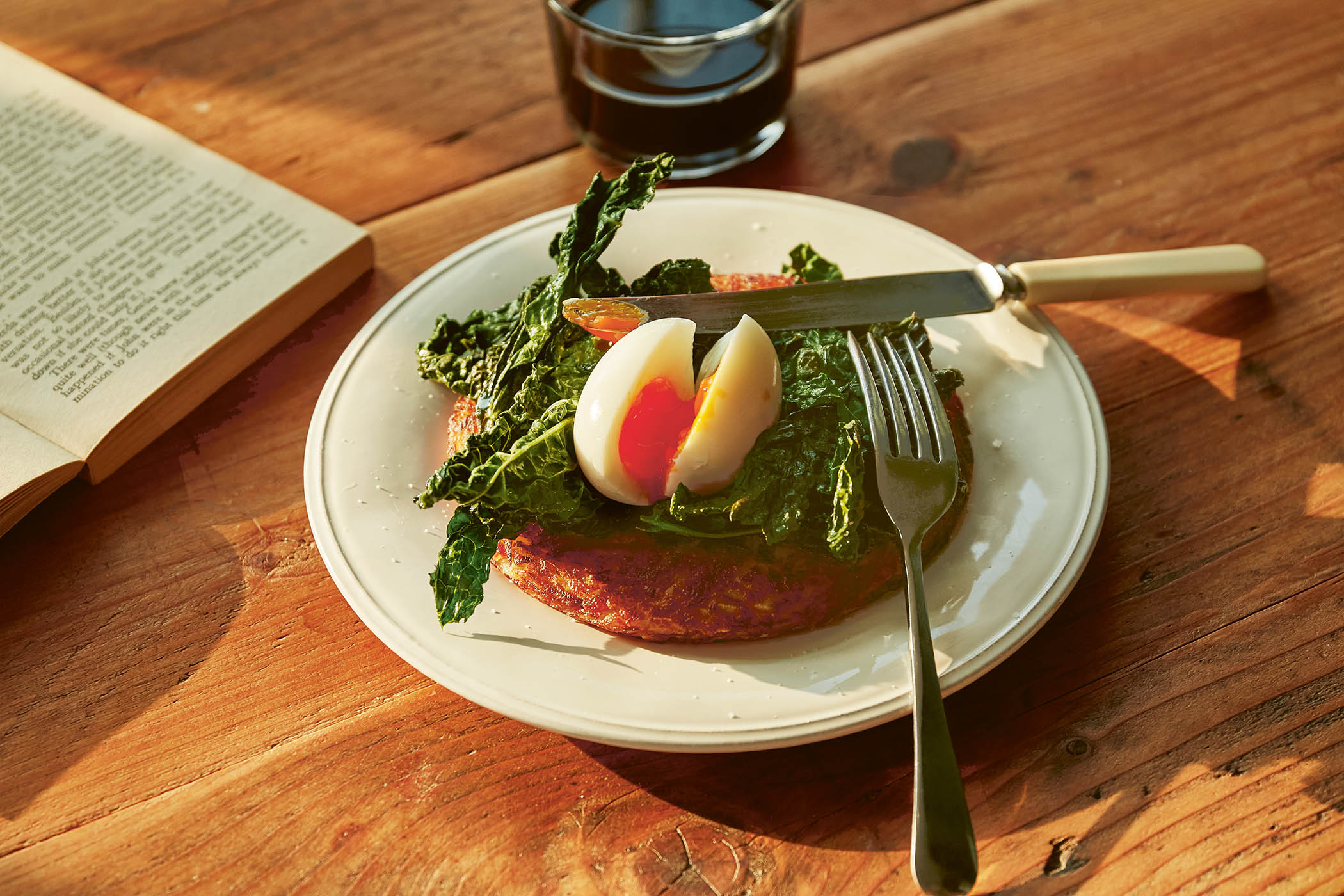
Grate a large potato, and a moderately sized apple into a bowl. So long as they're clean, don't worry about peeling either one first. Transfer to a sieve over the sink, add a pinch of salt, and squeeze the grated potato and apple together until they feel dry.

Warm 1 tbsp of duck fat (if you have it, olive oil if not) in a frying pan over a low heat, and form the very well-squeezed ingredients (I cannot emphasise this enough) into a ball. Put into the pan and push the top of the ball down until the rösti is 1cm thick. Cook for about 10 minutes, until crisp and golden, then flip and cook for 10 minutes on the other side. When the rösti is close to being cooked, add a little more fat to the pan.

As your rösti is cooking, boil (lower into simmering water for 5½ minutes) or fry (covered, in a little fat) 1 large egg. I also like to sauté a handful of torn kale or cavolo nero to serve alongside; strip the stem out, tear it up roughly, then heat some more duck fat or oil in a frying pan, drop in the leaves and cook for 5 minutes until crisp. Pile everything up on top of each other.

This is the rösti I keep returning to. But don't shy away from playing around with it: try celeriac, try sweet potato, try beetroot, try turnip, try parsnip – they all have their merits, and you'll find your own favourites, too. Whatever you're trying, though, do add some apple; it's a reliable joy.

Ingredients

large potato

1

apple

1

salt

(to taste)

duck fat or olive oil

1tbsp

large egg

1

kale or cavolo nero

(to serve)

Method

Grate a large potato, and a moderately sized apple into a bowl. So long as they're clean, don't worry about peeling either one first. Transfer to a sieve over the sink, add a pinch of salt, and squeeze the grated potato and apple together until they feel dry.

Warm 1 tbsp of duck fat (if you have it, olive oil if not) in a frying pan over a low heat, and form the very well-squeezed ingredients (I cannot emphasise this enough) into a ball. Put into the pan and push the top of the ball down until the rösti is 1cm thick. Cook for about 10 minutes, until crisp and golden, then flip and cook for 10 minutes on the other side. When the rösti is close to being cooked, add a little more fat to the pan.

As your rösti is cooking, boil (lower into simmering water for 5½ minutes) or fry (covered, in a little fat) 1 large egg. I also like to sauté a handful of torn kale or cavolo nero to serve alongside; strip the stem out, tear it up roughly, then heat some more duck fat or oil in a frying pan, drop in the leaves and cook for 5 minutes until crisp. Pile everything up on top of each other.

This is the rösti I keep returning to. But don't shy away from playing around with it: try celeriac, try sweet potato, try beetroot, try turnip, try parsnip – they all have their merits, and you'll find your own favourites, too. Whatever you're trying, though, do add some apple; it's a reliable joy.

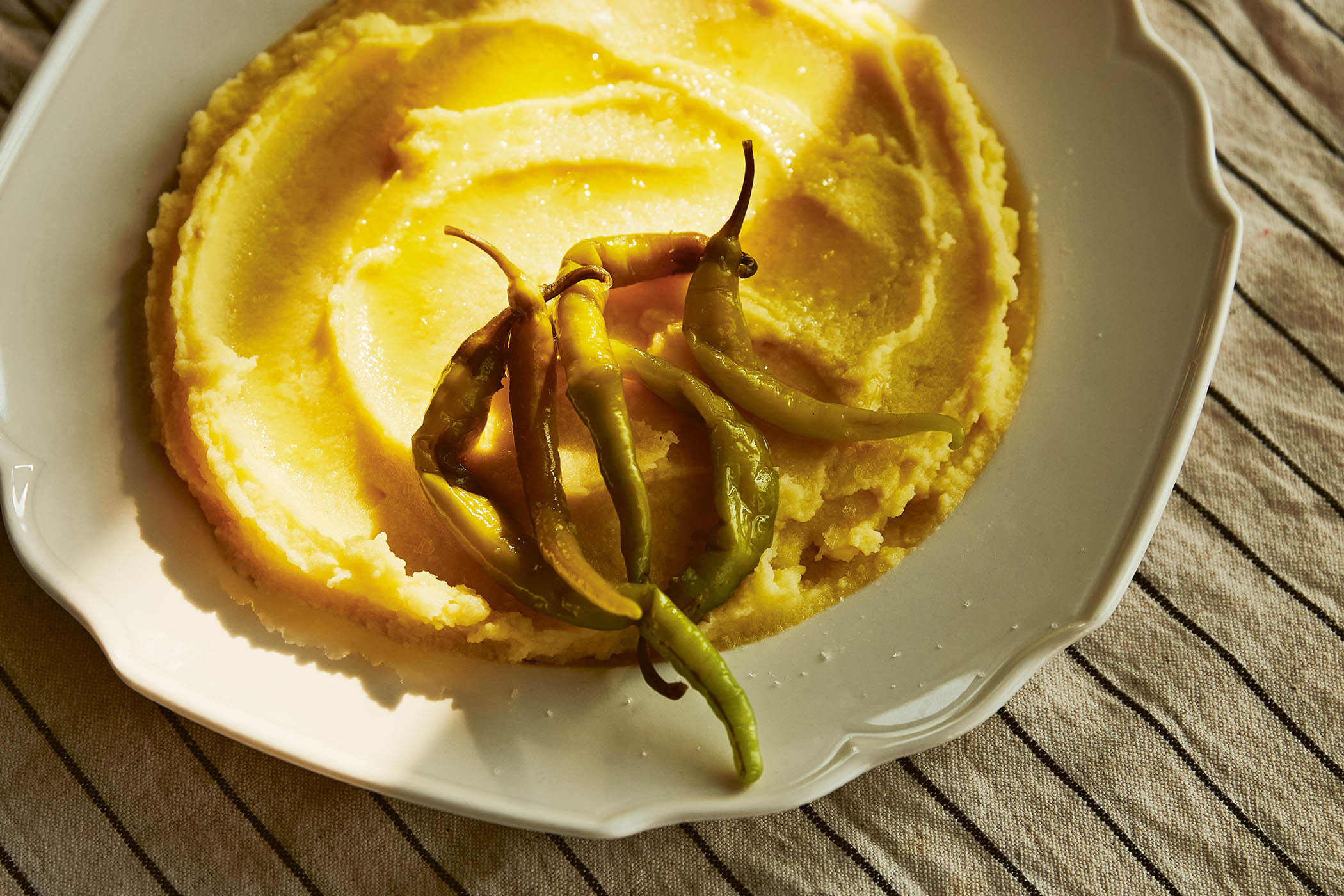
‘A heady blend of potato, garlic and olive oil’: skordalia

‘A heady blend of potato, garlic and olive oil’: skordalia

Skordalia

Makes a bowlful. Ready in 25 minutes.

My favourite place to eat as a teenager was a Greek restaurant with paper tablecloths that still sits on the fringes of Brisbane’s West End. Whenever there were more than a couple of us around the table, I would talk everyone into the big, shared feast of bits: a tower of dolmades, a little dish of tender marinated octopus, tzatziki, tarama, crudités and a side order of multiple plates heaped with my favourite dip: skordalia – a heady blend of potato, garlic and olive oil.

I’ve talked a lot about skordalia since, and it seems to be a bit of a Marmite thing. I get it. The issue is that it’s easy for potatoes, olive oil and a ton of garlic to become a gummy mess if subjected to too much processing – though a lot of recipes I’ve read suggest using a food processor, I’ve never been able to make it work in mine. But I know there’s also a chance you’ve had a great skordalia.

There’s no economy of scale here – a small amount will be just as much effort as a big bowlful – so I like making a large batch and keeping it around, alternately dipping bread into it, or serving it with the shoulder of lamb (below).

potatoes 600g, good mashing ones, peeled and cut into 21/2cm cubes
garlic 8, cloves, very finely minced
lemon juice of 1
olive oil
150ml
flaky sea salt
to taste

Put the potatoes in a saucepan with cold water, bring to a simmer and cook for 10-15 minutes, until tender enough to pierce with a fork. Drain well and return to the hot, dry saucepan to steam dry a little.

Push the hot potatoes through a ricer into a mixing bowl. A potato masher will work, too, but you’ll need to commit a little more time to get the mash really smooth. Mix the minced garlic with the lemon juice and, with a wooden spoon and a vigorous arm, beat a little into the potato, then beat in a couple of tbsp of the oil. Keep alternating between lemon juice and oil, beating vigorously, until it has all been incorporated. Taste and season with salt.

Transfer to a wide serving dish, cover, and leave to cool. Eat at room temperature.

‘It really does taste entirely new’: baked apple and baked cheese

‘It really does taste entirely new’: baked apple and baked cheese

Baked apple and baked cheese

Serves 2. Ready in 30 minutes.

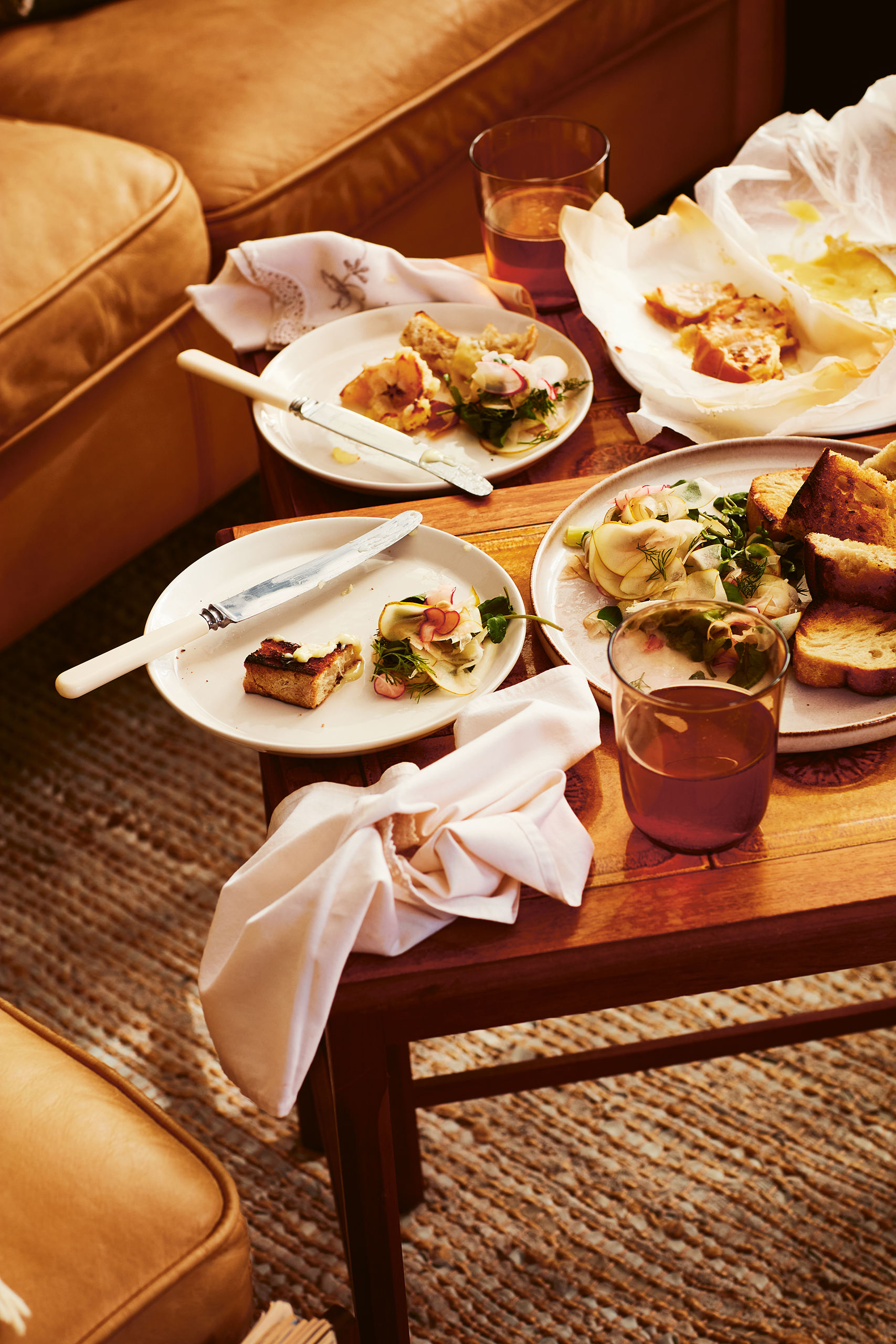
I like to have some sliced apple on a cheeseboard – the sweet-sharp sting of the fruit is always a welcome companion for rich, salty cheese, regardless of what else is on there. Baked camembert is a familiar old classic, but the baked apples and the sharp little apple salad are so special alongside it – it really does taste entirely new.

This dish has all the elements of a good cheeseboard (bread, soft cheese, something a little pickle-ish), but in a way that allows you to pass it off as a dinner for two. It’s a bit messy, and fun to share, ideal for a lazy night when you’d rather sprawl together on the sofa and linger over a meal than sit down at a table. I love this with apple cider, or a sparkling wine, and something cosy on the telly.

camembert 1, whole
apples 2, crisp and sharp
extra-virgin olive oil 1 tbsp
salt
a pinch
crusty bread lots, to serve

For the salad:
fennel ½ bulb
lemon juice of 1
salt a pinch
apple
1, crisp and sharp
radishes
10
dill sprigs
10
watercress
50g
extra-virgin olive oil
2 tbsp

Preheat the oven to 200C/gas mark 6. Wrap the whole camembert in greaseproof paper and place it on a baking tray. Trim the top and bottom off each apple, keeping them for snacking later, then slice each in half through the rounded centre (the equator of the apple). Place on the baking tray alongside the cheese. Drizzle the apples with olive oil, season with a pinch of salt, and bake for 20 minutes, until the apples are soft and jammy and the cheese is oozing inside its parcel.

Meanwhile, finely shave the fennel (a speed peeler or mandoline is useful here) and add it to a bowl with the lemon juice and salt. Massage the fennel with your fingertips, until it starts to soften. Shave the apple and radishes in the same way, and add to the bowl. Leave everything to sit while the cheese and apple finish off in the oven.

Once the cheese is ready, toss the dill and watercress through the fennel salad, and dress with the olive oil. Serve while the cheese and apple are hot, with crusty bread to spread them on, and the salad piled up alongside.

Salsa verde shoulder of lamb

Serves 6. Ready in 4-6 hours.

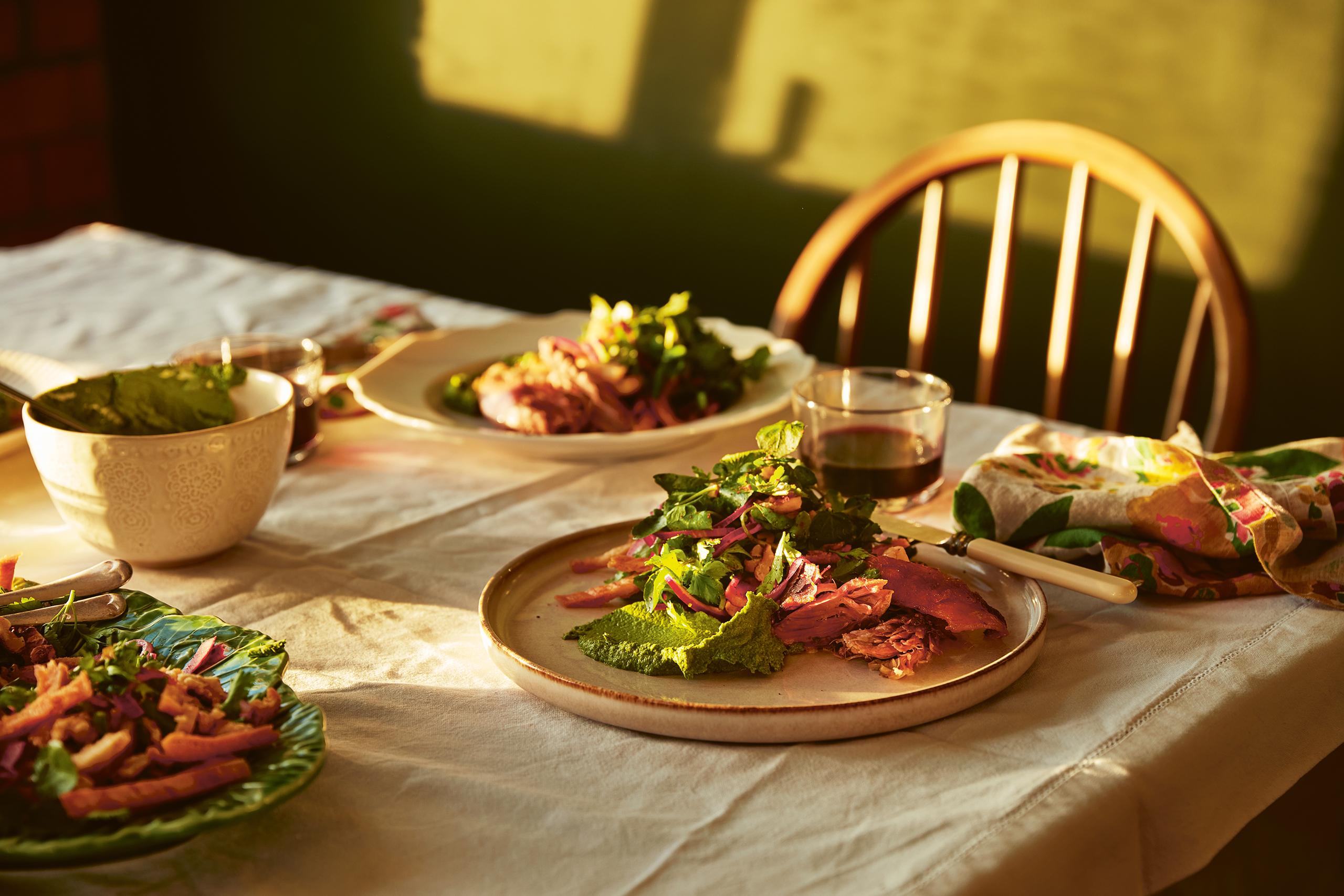
­This is a real weekend showstopper, the sort of thing you’d put down at the centre of a crowded Sunday table when there’s something to celebrate – such as a big Easter lunch. The tender lamb we were raised on always stood up to strong, heady flavours – I still think first of anchovies whenever I’m planning to cook it.

After reading James Rebanks’s The Shepherd’s Life a few years ago, I started hunting out hogget and mutton as well as my childhood lamb. They’re a little trickier to get hold of – less reliably in supermarkets – but a butcher should be able to help you out. Whether you’re working with lamb, hogget or mutton, I don’t think you can do better than a shoulder cooked low and slow, a technique that will show the meat off at its best: so melting and tender you need only a fork to pull it from the bone.

The complex sweetness of the meat is longing for big, brash flavours to accompany it – the salt and umami of anchovies, and the heat of garlic. They’re both here twice; melting into the meat as it cooks, enhancing the flavour, and then afterwards in a salsa verde, which makes the whole meal sing.

brown onions 2, sliced into half moons
shoulder of lamb 2kg
anchovies
1 x 50g tin (including their oil)
olive oil 50ml
garlic 4 cloves, finely minced

For the salsa verde:
coriander leaves 20g
parsley leaves
20g
anchovies
1 x 50g tin (and their oil)
capers 3 tbsp
garlic 3 cloves
banana shallot 1
olive oil 60ml

For the salad:
red onion 1, thinly sliced into half moons
radishes 2, very thinly sliced
lemons juice of 2
sumac 1 tsp
flaky sea salt a pinch
walnuts
a small handful, roughly chopped
pita breads 2
olive oil 75ml
watercress 100g, woody stems removed
coriander leaves 80g
parsley leaves 80g

Preheat the oven to 150C/gas mark 2, and find a roasting tray that will fit the shoulder comfortably. Place a layer of onions across the base of the tray, then lay the lamb on top, skin-side up. Mash the anchovies and their oil into the olive oil and stir the minced garlic through, then make deep cuts through the skin of the lamb, and rub the anchovy oil in. Pour 200ml of tap water into the base of the tray, then cover the whole thing loosely with foil.

Transfer to the oven and leave for 4-6 hours, until a fork can pull the meat off the bone easily. Remove the foil, increase the oven heat to 200C/gas mark 6, and give the lamb a final 30 minutes, until the fat is crisp and golden.

While the meat is roasting, you can make the salsa verde and the salad. It might be that you want to get things out of the way before people arrive, so that you need only pull the shoulder out at the last minute. Or it may be you want to put the lamb in the oven and get on with something else for a while, leaving everything until the last 30 minutes, when you turn the temperature up. It’ll be fine either way, it’s completely up to you.

For the salsa verde, roughly chop everything, then blitz to a smooth sauce with an immersion blender, small blender or food processor. You can finely chop it all by hand, if you like, which will be lovely, but the vibrant green is the product of an intense blending.

For the salad, put the red onions and radishes in a bowl, and mix through the lemon juice and sumac, along with the salt. Toast the walnuts in a dry pan for a couple of minutes until fragrant and golden on their cut edges.

Split open the pitas and slice thinly. Fry in a couple of tbsp of olive oil until crisp and golden. Drain on kitchen paper.

Combine the watercress and herbs, onions and radishes, walnuts and pita strips in a serving bowl. Whisk the rest of the olive oil with the lemon juice that will now be pink from the red onion, and (at the last minute) toss everything together.

Serve the lamb hot from the oven alongside a bowl of the salsa verde and the salad.

Recipes from Dinner at Mine?: New Inspiration for Everyday Ingredients by Kate Young (Head of Zeus, £25). Buy a copy from observershop.co.uk for £22.50.

Newsletters

Choose the newsletters you want to receive

View more

For information about how The Observer protects your data, read our Privacy Policy

Follow

The Observer
The Observer Magazine
The ObserverNew Review
The Observer Food Monthly
Copyright © 2025 Tortoise MediaPrivacy PolicyTerms & Conditions