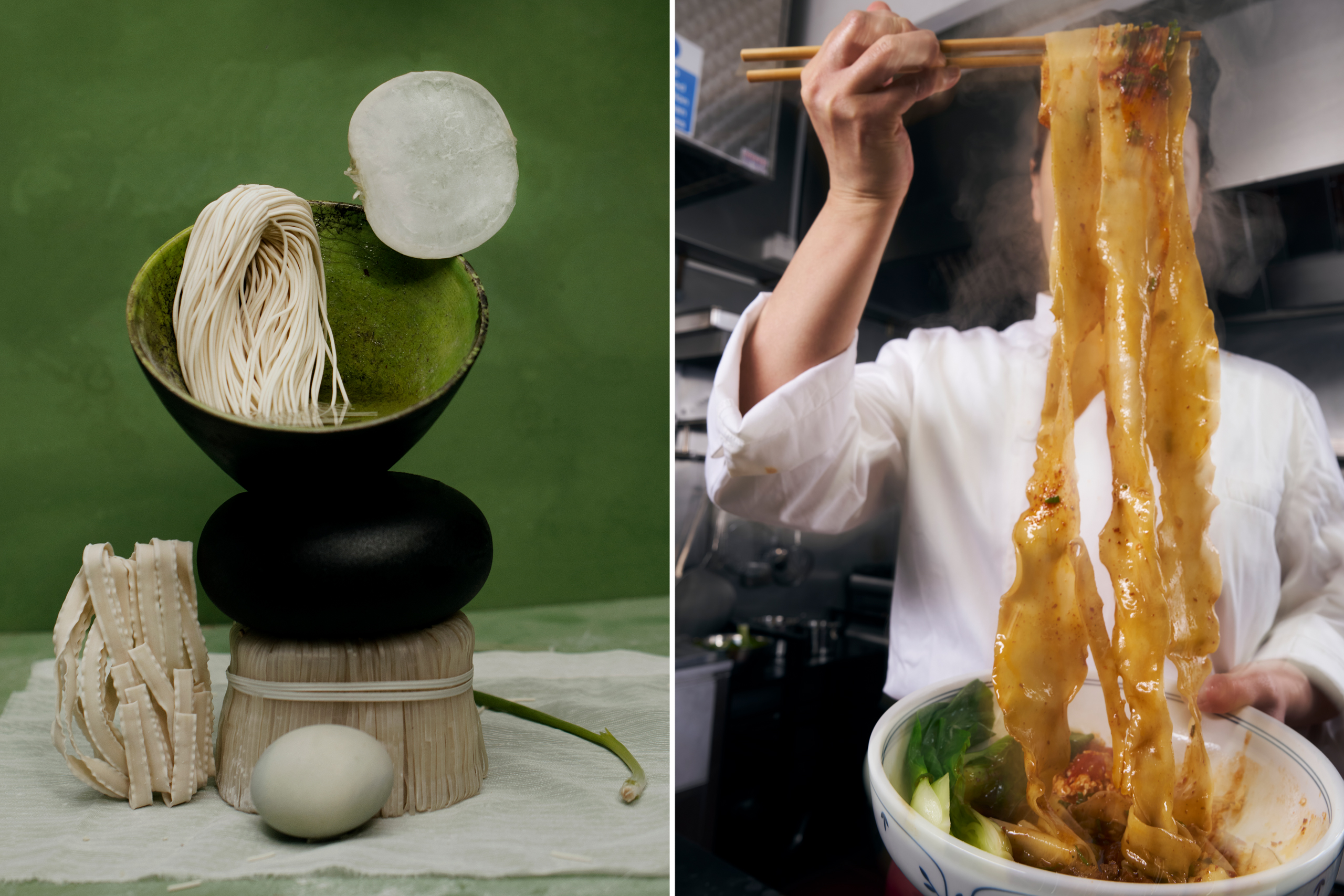



The queue forms in London’s Soho at the top of Old Compton Street at 11.30am, splitting in two as it bends past the Harmony sex shop. They stand in all kinds of weather (up to 90 minutes, at peak times) right up until 10pm. Everyone is waiting for the same thing: Noodle Inn’s version of the dish of the minute, viral Xi’an hand-pulled biang biang noodles.
“We probably go through 500 bowls a day,” says Jay Tran, their head of marketing. The most popular biang biang dish is topped with a caveman-esque braised beef rib that slides off the bone on to a bed of tangled noodles splashed with hot oil. A waiter is on hand to cut it into pieces.
Five minutes away, opposite Leicester Square station, from the street Lanzhou Lamian looks like a generic Anglo-Chinese buffet: sweet and sour chicken in warming trays, steam-fogged windows. Head inside to the back tables, though, and the menu centres on noodles. A noodle-puller in a white uniform manipulates the dough, stretching it into long strands of lamian, or carving slices of dao xiao mian straight from a block into a pot of boiling water. It’s pure theatre. Service is fast because it has to be. The room is tight, often packed, and unsympathetically lit. You might share a table with strangers on a bench or perch on plastic stools beside boxes of stock – but no one seems to mind the hectic atmosphere because everyone has their head down, slurping.
A short walk west, the newly opened Khao-Sō-i sits just off one of Britain’s busiest shopping streets. The eponymous dish pairs wheat-based egg noodles with a coconut curry broth. It arrives on a wooden tray with crisp fried noodles, chillies, extra coconut milk, aromatics such as red onion, pickles and spring onions, and a wedge of lime. Last October, before opening, the owners tested the waters with a pop-up: 400 diners waited up to two hours to try the signature northern Thai dish.
There was a time, not so long ago, when we didn’t understand noodles, we were not noodle-literate. For many people in the UK, noodles meant chow mein from a Chinese takeaway, or Pot. Few knew the difference between soba, sweet potato vermicelli and ho fun – let alone pho, char kway teow or laksa. Now we queue, we’re fluent in single-dish restaurants, and we know that a glossy, oil-slicked noodle pull will satisfy our need for social-media likes and dopamine bursts, as well as sate our physical hunger.
No one has done more to popularise noodles in the UK and to broaden tastes on a national scale than the Hong Kong-born restaurateur Alan Yau, who opened Wagamama in 1992. Its stripped-back, fast-moving canteen style introduced many British diners to ramen, teppanyaki and rice bowls for the first time. Communal tables, open kitchens and quick service made East Asian flavours accessible and modern. The model took off, growing to more than 150 sites across more than 100 cities and forging a new category of casual restaurants built around speed, simplicity and good-value bowls.
However, a full two decades before Wagamama started getting us comfortable with sharing long benches and understanding the imperative that “food comes out when it’s ready”, the restaurateur Tak Tokumine opened Japan Centre in central London, after struggling to find Japanese ingredients himself. What began as a small shop in 1972 grew into the UK’s largest Japanese food hall, and expanded to multiple sites. As interest in Japanese food grew during the 1980s economic boom, Tokumine focused on sharing the flavours he had grown up with in his home district of Hakata, in the city of Fukuoka.
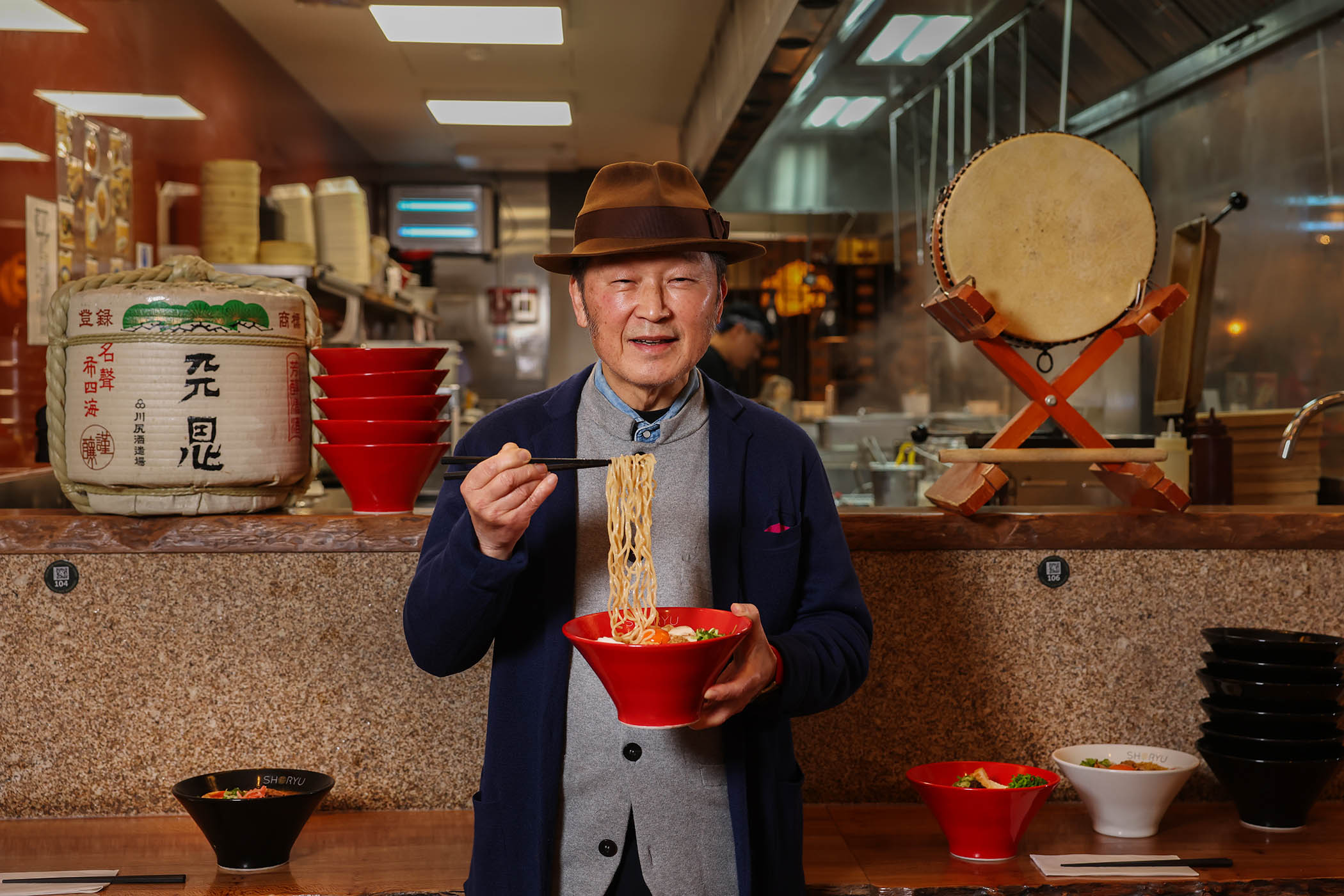
Tak Tokumine, founder of Japan Centre and Shoryu Ramen. His favourite noodle dish? ‘A simple Hakata ramen with only char siu, negi and kikurage – the basis of quality is minimalist.’
“Customers didn’t know the difference between soy sauce, sushi or ramen back then, when I first opened Japan Centre,” says Tokumine. He found noodles an easy sell. “Spaghetti is basically like Chinese lamian noodles, so people already had a sense of what noodles should taste like,” he explains. And, of course, people just really love carbs. “I pushed the manufacturers to let us stock more noodles, and from there it grew organically.” It all eventually led to the launch, in 2012, of the ramen chain Shoryu, with its iced frothy beers and instruction to choose your noodle firmness, from standard to very hard.
By the 2010s, London had reached peak ramen. Bone Daddies, from the Australian chef Ross Shonhan and his Greek co-founder, Demetri Tomazos, helped lead the wave, alongside Tonkotsu, created by the British and Japanese friends Emma Reynolds and Ken Yamada, which also opened in 2012. They were soon joined by established Japanese chains Kanada-Ya and Ippudo, with its Hakata-style ramen. These styles of ramen share a rich, milky and creamy pork broth that’s simmered for hours, paired with thin, straight alkaline wheat noodles, tender chashu (braised pork) and other customisable toppings.
Now 80, the retired Tokumine has sold the Japan Centre business and stepped back to focus on Shoryu, with his daughter, Hannah, now running the company. He credits Wagamama with changing how people in the UK see East Asian food, especially Japanese cuisine, as diners began moving away from catch-all Japanese restaurants and towards dedicated ramen shops. Tokumine believes tonkotsu’s popularity is down to the Eurocentric love of protein. “Soy sauce can divide people,” he says. “Beef, pork and lamb – these meaty broths feel familiar. It tastes like childhood comfort.”
Noodles didn’t start as neat strands but as torn pieces of dough dropped straight into broth, a style still seen in Xi’an’s paomo, a dish of torn pieces of flatbread simmered in broth with meat and glass noodles. As trade routes opened, noodles travelled and adapted into all kinds: mian pian (simple, square sheets of dough); dao xiao knife-cut noodles, shaved straight from a block; and mao er duo, or “cat’s ear” noodles, shaped like tiny orecchiette.
“Shaanxi is the birthplace of noodle culture in China. The importance of wheat there cannot be overstated,” says Guirong Wei, chef-owner of Master Wei, Dream Xi’an and the recently opened The Wei. All three focus on Xi’an hand-pulled biang biang noodles. The dough is stretched, folded and slapped against the board in quick, rhythmic motions, giving the noodles their onomatopoeic name. Visit one of Wei’s restaurants and you may be lucky enough to see her pulling dough into long, belt-like strands, waved out longer than her arm-span, before being dropped straight into boiling water. The signature style that draws the crowds is the you po mian (or oil-splash noodles) – hot oil is poured over the noodles topped with garlic, chilli, soy sauce and vinegar, releasing their aromas – and diners(especially those sharing) may have to navigate the fact that a bowl of noodles is often one long ribbon, to be stabbed and sawed and chomped through.
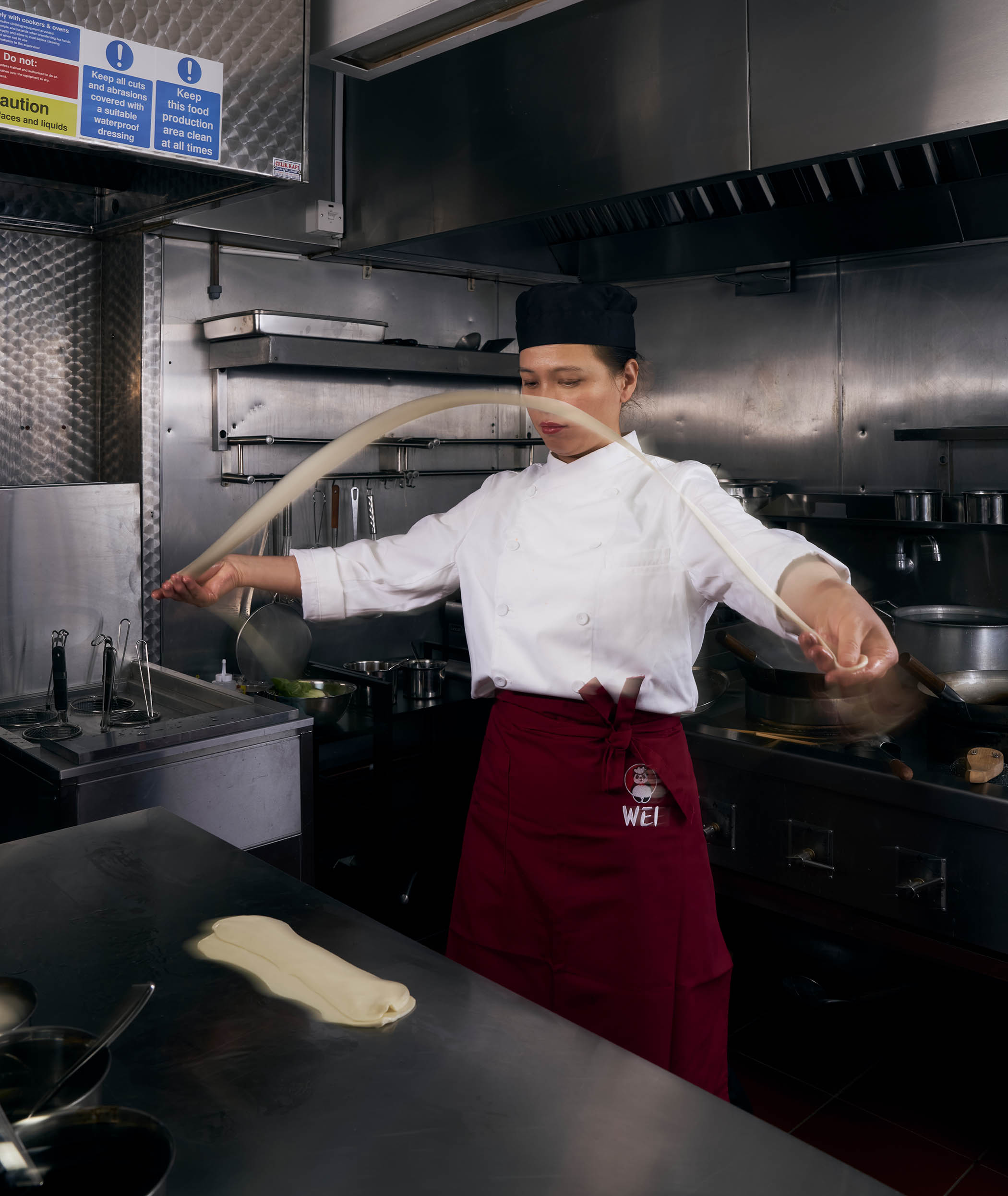
Guirong Wei, chef-founder of Master Wei / Dream Xi’an, with biang biang noodles. Above all other noodle dishes, she loves a family recipe. ‘My favourite dish is a braised noodle stew with cured pork that my grandmother makes. The cured pork is smoked using cypress branches, a traditional method passed down in our family for generations. She also adds mung beans from the hills to the stew. The noodles are cooked in the broth from simmering the cured pork and the mung beans, then knife-shaved noodle sheets are added to the stew.’
Wei has worked hard to popularise this kind of noodle in the UK, and her profile grew further with an appearance on Netflix’s Chef’s Table noodle series. People now travel across the world to try her food. “What touches me most is seeing who comes,” she says. “Elderly couples, young families, three generations sharing a table, eating noodlestogether. I want people to understand they’re not just eating noodles. They’re tasting history, heritage and the accumulated wisdom of countless generations.”
Noodles tell the story of how people ate for survival, which feeds into how we eat or want to eat today. In the era of Everything Is Awful, it’s no wonder we’re seeking comfort, convenience and affordability when it comes to eating out. Today, no longer confined to Asian grocers, they are increasingly a daily and convenient choice for British people across the country.
For ramen’s quieter sibling, udon, few businesses have been as pivotal there as Koya, a specialist udon restaurant with three London sites. According to chef-founder Shuko Oda, creativity is important, but being able to do the same thing consistently, day in and day out across 15 years, is what has made her restaurants successful. “It might not sound exciting, but it’s reality,” she says. “I see genuine strength and beauty in that.”
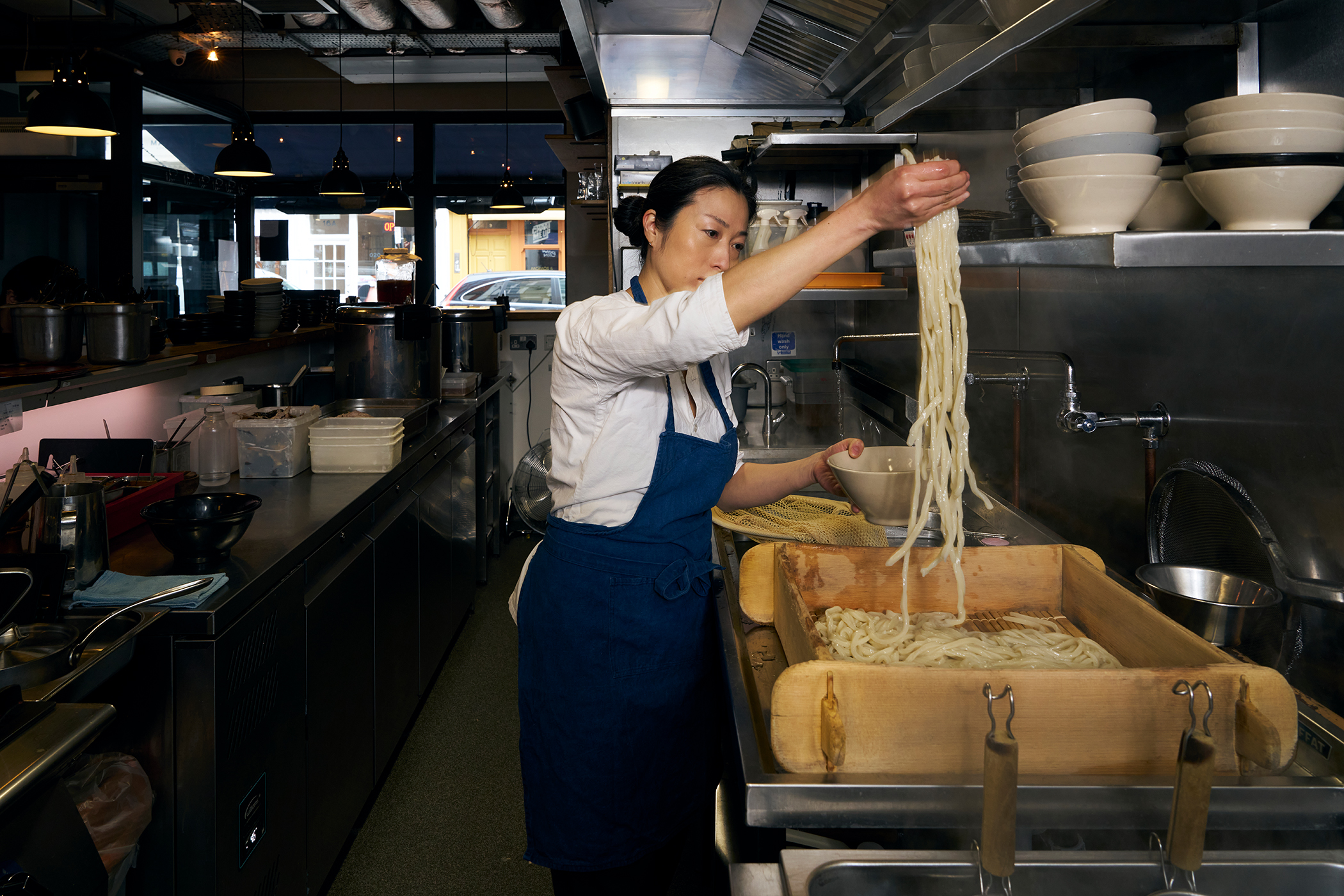
Shuko Oda, chef and co-founder of Koya, with udon noodles, ‘A clear soup noodle is always my go-to, like our dashi,' she says. 'Clean but flavourful. Fresh wakame seaweed and prawn tempura are my ultimate topping combinations. I love how the tempura batter gives the dashi a little shine, soaking up all the umami.’
The core Japanese menu at Koya has stayed the same over the years, focusing on more subtle, seaweed and fish broths of dashi rather than punchy, creamy tonkotsu stocks, and emphasising the slippery, chewy texture of handmade udon. In Soho, diners sit at a counter, all facing the giant noodle “sink” that seethes with boiling water: in the morning, the pure-white udon are dropped in to make an “English breakfast” bowl with bacon and a soft egg, passed straight from chef to customer; after midday, they might be served hot in broth, or chilled to dip in broth or sauce. “Perhaps we offer a modern way of eating and socialising,” Oda says – counter-dining means solo diners are as welcome as small groups who linger and chat, clustered round corners on small stools. “It lets you have the experience you want.”
This kind of flexibility mirrors how noodle spots have settled into everyday life. Across Asia, noodle counters sit inside shopping centres and beside train platforms, built for convenienc e as much as sustenance e. Something similar is happening here, as British tastes diversify, often led by international Chinese students yearning for the flavours they grew up with. In the 2023-24 academicyear, nearly 150,000 Chinese students were enrolled at UK universities, with applications rising each year. Lanzhou noodle shops, Sichuan hotpot restaurants, Dalian dumpling spots and Taiwanese bubble tea shops have sprung up near campuses, and are often staffed by students. Delivery apps offering Chinese-language menus, deals and promotions prop up an entire population of the hungry and homesick. You can see the effects across London and other university cities such as Manchester, Nottingham, Sheffield, Oxford and Cambridge.
Dumpling Tree was the first Yunnanese restaurant to open in Cambridge, in 2014. Their most popular item, Crossing the Bridge noodles, is a heritage dish of Kunming, the provincial capital of Yunnan. It comes as a DIY set presented with a large bowl of boiling broth and several bowls of accompaniments: silky rice noodles, with raw meats, pickles, aromatics and vegetables added at the table.
“It’s a dish with a beautiful story,” explains owner Anthony Trueman, referring to the legend that it came about from a woman’s attempts to keep her scholar husband’s lunch warm when delivering it to him. “It never fails to get a great reaction.”
Elsewhere, Zaap Thai, a family-run chain founded by chef Khun Ban in Leeds in 2015, has made its mark across the north, with sites in Manchester, York, Sheffield and Newcastle. Ban wanted to spotlight the flavours she grew up with – the kind you find in the night markets of Bangkok and Isaan, thrilling to British palates but increasingly familiar through tourism – and to combine those with various regional Thai recipes. The restaurants are laid out like night markets, colourful, packed tables, with neon signs and souvenir ephemera. “Pad thai is still our best-selling noodle dish,” notes Zaap’s Greg Callaghan.
Zaap’s sprawling menu has more than 80 dishes, including lesser known ones that are rarely seen outside Thailand, such as guay jab sa tan fah rice noodle soup with liver and guay tiew bamee gai toon boat noodles with pork blood. “These dishes are appreciated by the large Thai community in Leeds because they recognise the authenticity,” says Callaghan, adding that they’re also taken up by adventurous local diners, looking to try something different. “It keeps the menu exciting and true to Thai food culture.”
A defining characteristic of many, more recently opened, noodles bars is a compact menu. It can cut through consumers’ decision fatigue and, crucially, help restaurateurs manage costs. Diners are smarter now, preferring to spend on something simple, done well. For chefs, this often means sourcing higher-quality ingredients, understanding them fully, being transparent about their processes and limiting waste. At her new venture in Covent Garden market, Nicole Ma of Hoko Wonton Noodles sources dried flounders from her fish-trading family in Hong Kong. A keen focus on the menu, also helps chefs excel in the kitchen.
“Wonton noodles are everyday food, but they’re treated with a lot of care,” Ma says. “When the dish is translated to London, some of that often tends to get simplified.”
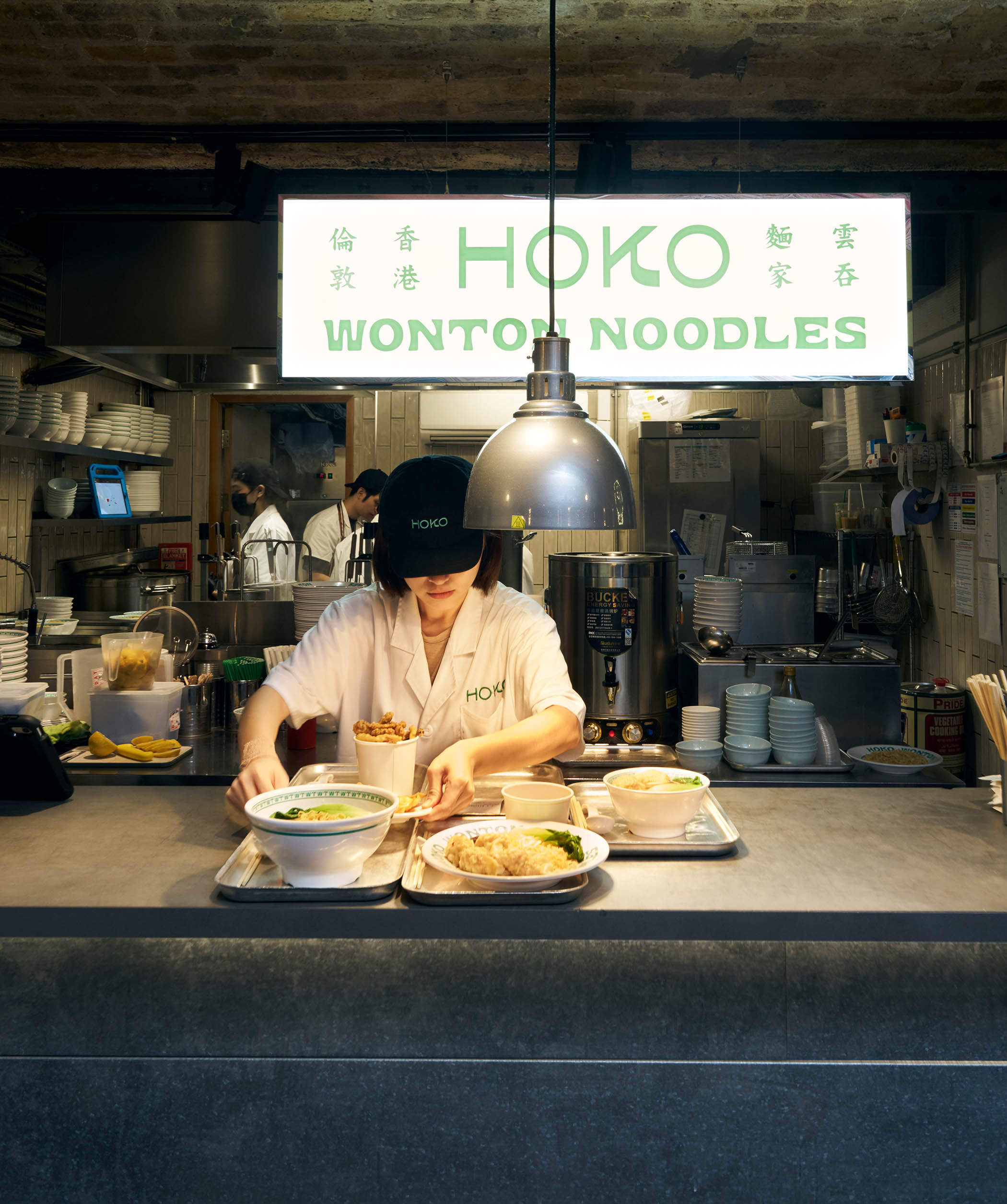
Nicole Ma, co-owner of Hoko Wonton Noodles: ‘Wonton noodles are my favourite, for sure, or a rare-beef pho. I love how a squeeze of lime juice lifts the whole bowl.’
Another common strand is open kitchens, which let diners see every step of the cooking and make the preparation part of the experience. It’s just one part of a winning formula: noodles are visually appealing, from the interactive mixing dishes to the noodle-pulling that makes for perfect social-media fodder.
There’s a misconception with noodles that affordable means cheap, that quick equates to easy. In reality, they require enormous amounts of time, skill and labour to prepare. “There are no shortcuts if you want to maintain quality,” explains Wei, who travels between her restaurants to ensure her high standards are maintained. “Finding chefs who truly understand the essence of Xi’an noodle-making is remarkably difficult in a foreign land. Training someone takes years.”
Across the UK, east and south-east Asian noodles are reshaping the food scene, bringing diversity and inventiveness to neighbourhoods everywhere. The more people taste, the more we become versed in the language of noodles, with specialists from different regions and cultures becoming part of our cities’ fabric thanks to their range and creativity. Too often, noodles are still seen as lowly, everyday fare rather than the result of craft built on technique, effort and regional knowledge. Wherever you are in the UK, it’s an exciting time to be eating noodles. There are more styles, more regions and more variety on offer than ever before. “Each region of China has its own noodle traditions, its own techniques, its own stories,” Wei says. “The diversity is extraordinary, and here we’ve only scratched the surface.”
Portrait of Tak Tokumine by Fabio De Paola. Still life: lighting tech Rachel Man; food styling Georgia Rudd
Newsletters
Choose the newsletters you want to receive
View more
For information about how The Observer protects your data, read our Privacy Policy