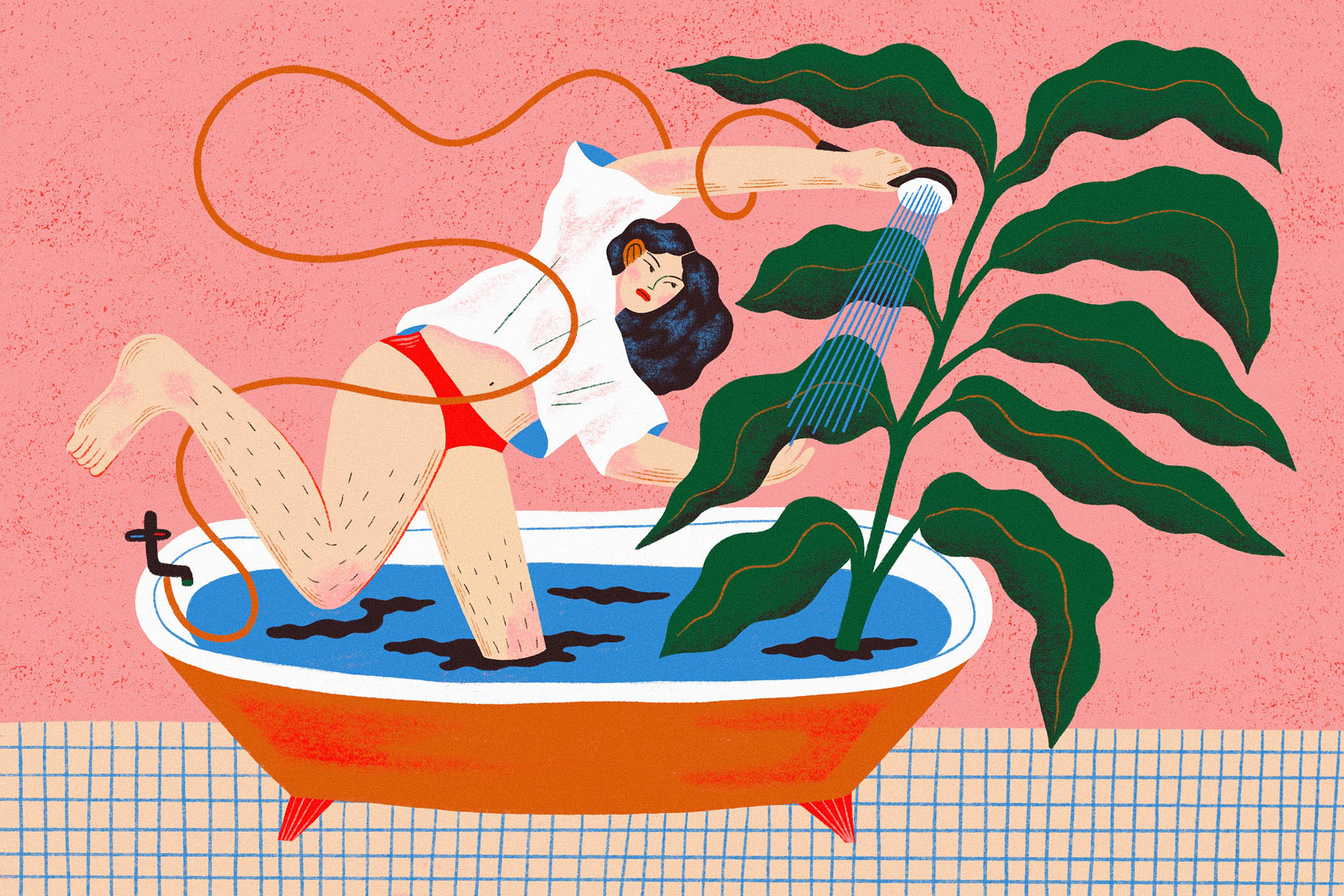




Even in daylight, the world is dark. Choking tendrils obscure my path; passersby and migrating birds are endangered. Reports of haystacks proceeding down Tottenham Court Road have mystified the press. Yes, I need to have my legs waxed.
But simple solutions, like booking an appointment, are sadly not for me. Natasha, my waxer, and I are locked in a vortex of mutual destruction and, for the good of humanity, we must remain apart. Natasha has thrips.
A naive person might think this unimportant. Thrips, while the sap-sucking bane of houseplants, are not communicable to humans. Natasha does not toll a plague-bell as she walks down the street, or face a heartbreaking early yet photogenic death. Although, in a sense, she is dead already. If all one’s houseplants are infested, what is the point of going on?
Thrips are tiny black dots, thus: “.” But this microscopic inky speck cannot convey the absolute arseishness, the violence, the spite of these malevolent creatures. There are many species, equally undeserving of your attention. All you need to know is that the instant you notice sickliness, an odd silver sheen,, dryness, mottling, indeed any hint of sorrow whatsoever, on the fishbone cactus your mother left you in her will, the coyly blushing tradescantia you bought on that date or, worst of all, your emotional-support Swiss Cheese Plant, it’s already too late.
Of course, I have thrips already. So do you. Only yesterday, gazing lovingly into the orifices of my partridge-breasted aloe, I spotted two tucked deep in the crook of leaf and stem and one even smaller excremental microdot: how charming. I crushed them with a pencil-tip, squashed the fragments against my desktop, carried them at arm’s length to flush down the toilet and had my flat demolished, just in case.
Because a thrips – they are, implausibly, plural, like sheep, or swine – are strangely difficult to destroy. This may be because of their unique asymmetrical mouth-parts, or their highly unusual clap-and-fling flying technique. I don’t care. What matters is that, once you have them, good luck. So far I’ve lost few of my offspring, I mean plants, but, as every parent knows, current calm is no guarantee of future peace. I pray that the fates will be kind but, as Natasha knows, there is no rest.
So far I’ve lost few of my offspring, I mean plants, but, as every parent knows, current calm is no guarantee of future peace
So far I’ve lost few of my offspring, I mean plants, but, as every parent knows, current calm is no guarantee of future peace
She first discovered how cruel the world can be when her chief spider-plant, an enormous cascading multi-generational matriarch like a wedding-table centrepiece, began to sicken. Other minor plants had mysteriously already carked it, but thrips are so tiny it took her a long time to work out what was wrong. No one really knows how to extinguish them completely. Quarantining is unrealistic, for the horticulturally keen. She spent over £200 on nematodes, tried neem oil, sunlight, something unpleasant with garlic. Eventually she accepted the inevitable. She put on her bikini, heaved and rolled and lugged the colossal plant into the bathroom, and turned on the shower.
Imagine trying to wash an affectionate octopus; no, a parent octopus with dozens of babies, each umbilically attached to a knotty secondary thicket. Thoroughly sluice down a leaf, both sides, then the next, then – wait. What about this one? Again, to be safe, then maybe a couple more tentacles and it’s time for a breather. Yet every time she flung a definitely cleaned miniature plant over her shoulder, it would slither back to mingle with its tiny pals.
Water everywhere. Total exhaustion.
“But it worked,” I asked. “Eventually. Didn’t it?”
Newsletters
Choose the newsletters you want to receive
View more
For information about how The Observer protects your data, read our Privacy Policy
“Put it this way,” she said. “When I move, it’s bloody not coming with me.”
And here is the problem. Natasha and I have been united for almost a decade by twin passions: a) depilation b) propagating houseplants. But for most of that time, (c), if you will, her own plants have suffered from a variable, but ineradicable, thripsian plague: d).
Algebraically: a2 +2b – c > d when b < 1- √3. It’s maths: it must be true.
If I meet her, plants will be exchanged. We can’t stop ourselves. But, although I want to help replenish her stocks, what if one of my precious offspring, the sweet golden pothos, the innocent-looking chain of hearts, is a carrier? Even worse, what if Natasha believes that her own latest wave of thrips-infestation has passed and I convince myself it’s safe to accept an infant Kalanchoe thyrsiflora? Boom! Armageddon.
We are, I believe, more than client and customer; we’re friends. We confide. But our intimacy hangs by the asymmetrical sooty mandible of a minor bug. Last time we met we were plantless. We were determined to solve our chicken-and-egg causality dilemma, our Mobius strip of reinfection, and we both thought we were safe. I hugged her goodbye. The atmosphere changed.
“If,” she said menacingly, “I come home with a thrips, we’ll know.”