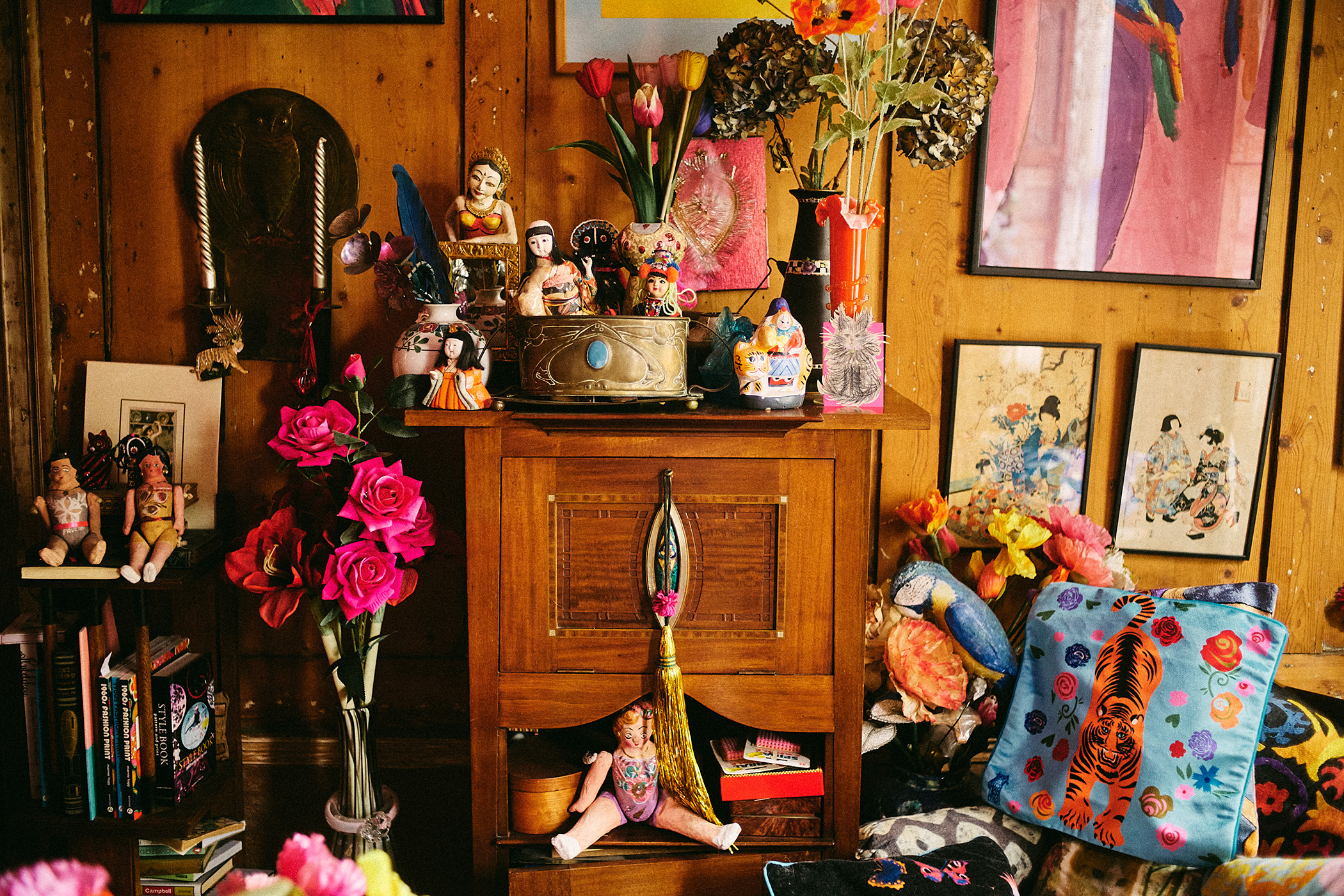



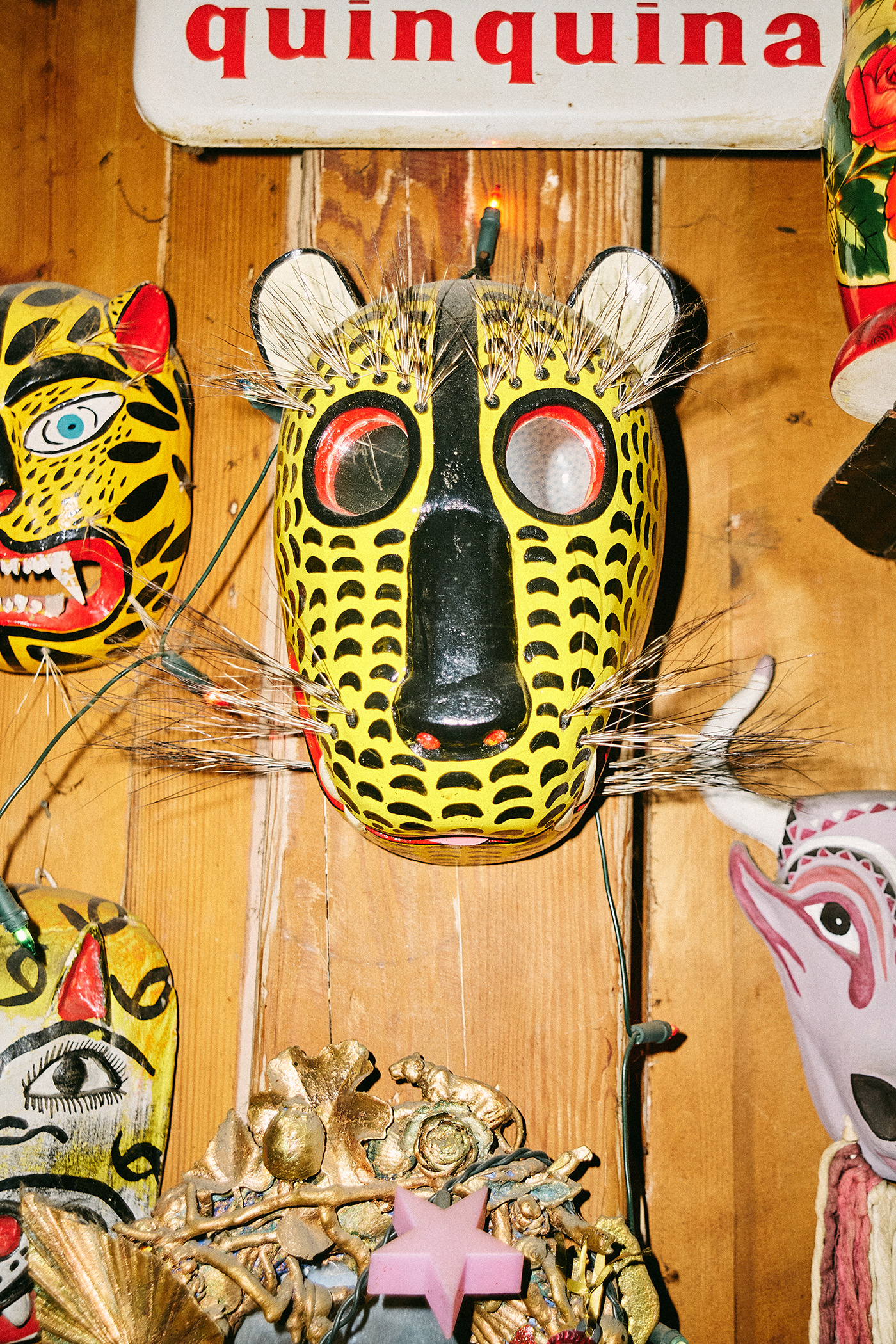
In Natalie Gibson’s kitchen there sits a vast wooden dresser festooned with Mexican carnival masks, fake peonies, hanging cups, teapots, Russian dolls, wind chimes, tassels, fairy lights and family photos. It is a magpie’s paradise, a maximalist’s horn of plenty. She found the dresser on the street and dragged it home, where its contents slowly burgeoned, thanks to junk shops, car boot sales and a fair amount of globetrotting. On the wall next to it hangs an oil painting by her husband, the artist Jon Wealleans, of the dresser, scaled down and reimagined on canvas. It’s not the only time he has turned his eye on their domestic life. He once held an entire exhibition of paintings of their home’s interiors, titled Kitchen Kitsch. “I remember my son going,” Gibson tells me. “He said: ‘Oh, wow, it all looks so much cleaner than the house.’”
It’s unsurprising to find a space filled with such rich material, given that Gibson – 87, pink-haired and unfussy but formidable – is one of the most influential figures in British fashion and textiles. A designer and printmaker of six decades’ standing who has taught at Central Saint Martins since 1964, she founded the BA fashion print course in 1981. Students passing through her print room have included Alexander McQueen, Sarah Burton, Richard Quinn and John Galliano; in 2014, she received an MBE for services to fashion. All the while, she has maintained her own kaleidoscopic practice, selling prints to Twiggy, designing collections for Terence Conran’s Habitat, and now heading up her own label, Nat the Cat.
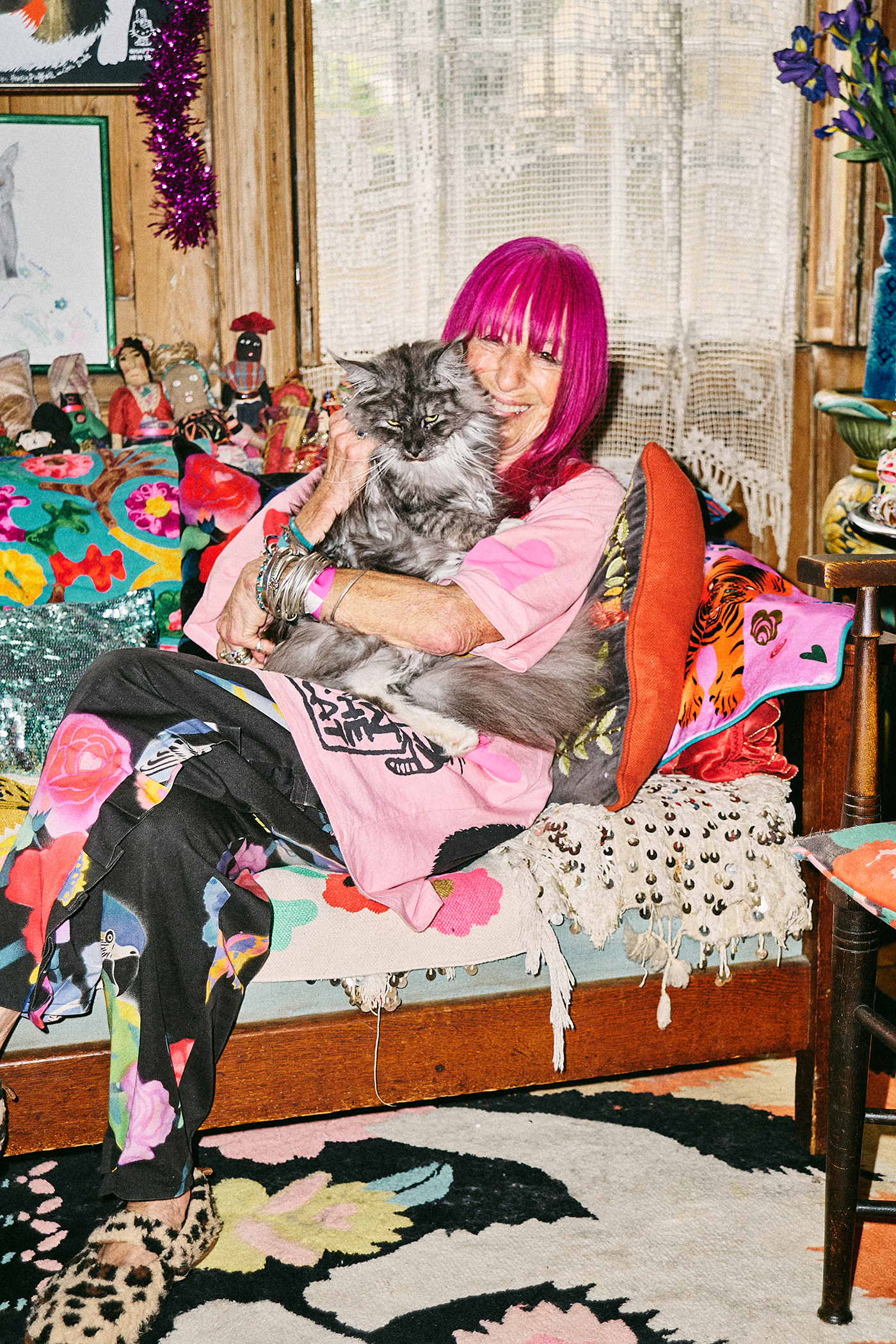
The name is apt: she owns six cats. The most she has ever had is 23, after the kittens proliferated during lockdown when she and Wealleans were in the countryside. The first of them wanders in from the garden while Gibson is making coffee. Daemon is large and coquettish, her fur long and her desire for attention clamorous. Over the next couple of hours, we’ll be introduced to Orangey (named by her grandson), Smokey Robinson (recently shaved after an unfortunate encounter with some goose grass) and Magic (sleeping regally in a pink cat palace). Many of the cats have been immortalised in her designs, which grace the rugs and cushions scattered throughout the rooms.
Gibson has lived in Bermondsey since the 1960s. When she bought the house, which dates back to the late 17th century, it sat across from a factory that produced tin boxes. “Then they brought one of those wrecking balls, knocked the factory down and had an archaeological dig for about three years,” she explains. “Old stuff from Bermondsey Abbey – gold plates and goodness knows what.” The area has retained an unusual constellation of creative neighbours. The auctioneer Kerry Taylor lives next door. Down the street there is the Fashion and Textile Museum, founded by Zandra Rhodes in 2003. Gibson is mistaken for the designer three times a day. When the two of them lunch together, they get their fair share of double-takes. “She says we’re the pink ladies of Bermondsey.”
Gibson’s career began aged 16, when she switched out A-levels for studying at Chelsea School of Art, getting in on the strength of her drawings (of cats, naturally). “You had to have a craft,” she explains. “Everyone wanted to do lithography – that was the chic thing – and etching. It was full, so I had to do textiles.” She subsequently trained at the Royal College of Art, and found her metier in printing: a “magical” process that’s at once technical and alchemical. When she first moved in here, the house also doubled as a studio. “I was printing upstairs and washing screens in the bath.”
‘If you have a sketchbook, you never run out of ideas – it makes you more perceptive’
‘If you have a sketchbook, you never run out of ideas – it makes you more perceptive’
Over the years, Gibson developed a distinctive design language: graphic and colourful, with a menagerie of motifs. The cats are frequently joined by tigers, flowers, butterflies and birds. The last pay homage to some of the house’s memorable former inhabitants: a blue-fronted parrot, called Phoebe, and Memphis the macaw. “Jon hated them because they ate all his furniture,” she says. She has since painted them on to the tiles in the kitchen, where they lurk behind the saucepans. “Alexander McQueen and Simon Ungless used to look after them when I was away,” she adds.
To walk through the rooms is to understand two things about Gibson: that she is constitutionally incapable of passing a market stall – “Jon says I have a very quick pace going to a car boot and a very slow one coming back” – and that she has spent a lifetime accumulating not just objects, but people. Works by friends and former colleagues pepper every surface. She shows me a piece by the sculptor Andrew Logan, formerly another Bermondsey resident, who gifted her a sparkling blue cat during her cancer treatment. “He made it to make me better,” she says. “It did.” There are paintings by Howard Tangye, who taught at Central Saint Martins, and her close friend Pauline Boty, the British pop artist. The bathroom features sculptures by artist Di Livey, who also made the cabinet handles. “I’ve got nice things from Grayson Perry,” Gibson adds, almost as an aside, gesturing towards a display cabinet in the living room. For 20 years her second-year print cohort were tasked with designing an outfit for Perry’s alter ego, Claire – a project that began in 2004, when Gibson and Grayson met on a bus, and Gibson said her students could make a better job of the costuming.
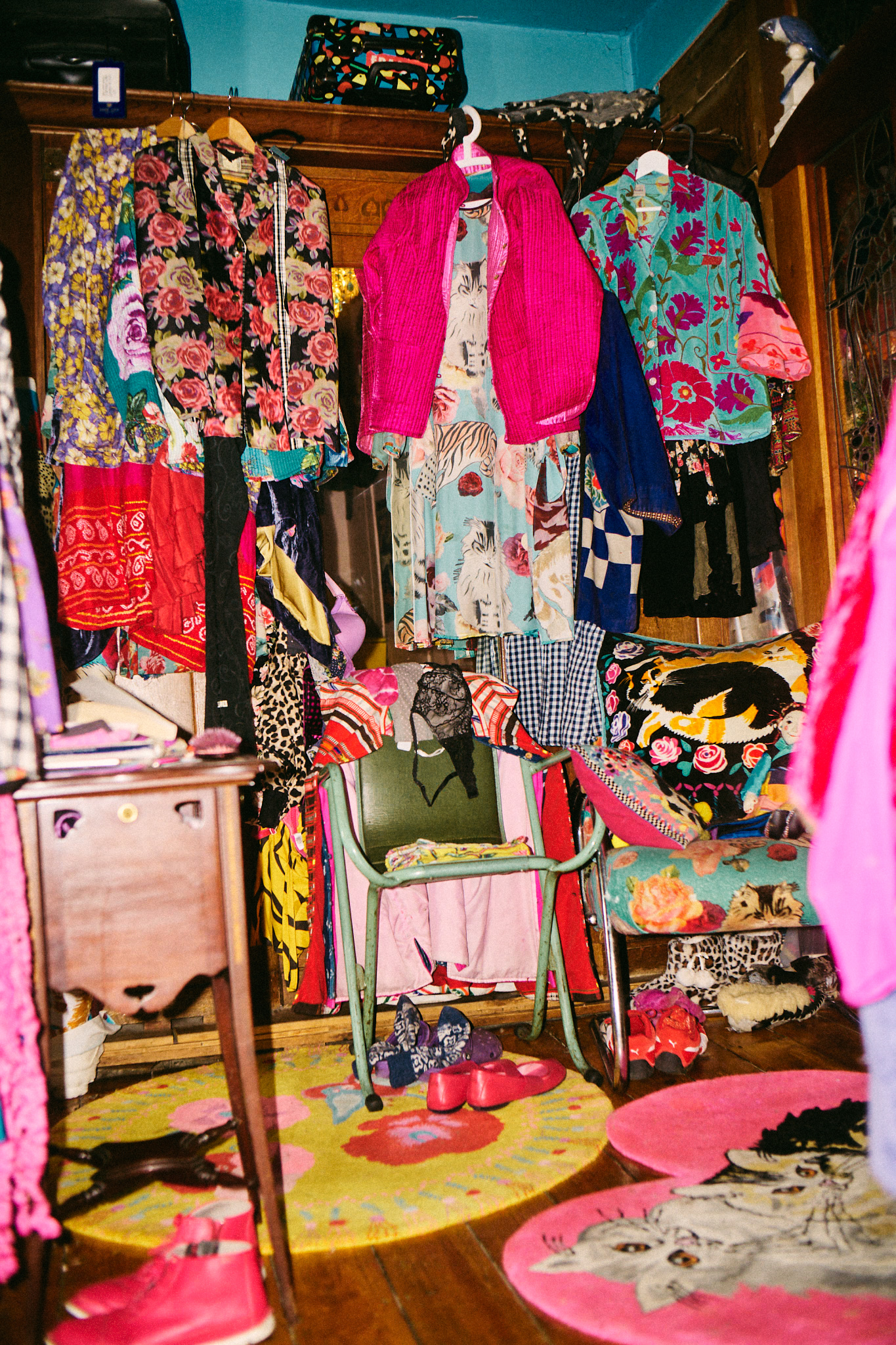
The house is a collaborative effort between Gibson and her husband. Wealleans, a former architect turned artist, made many of the doors and cupboards himself, their latticework creating unexpected glimpses between the rooms. His Art Nouveau collection sits alongside her ceramics. “My father was Russian,” Gibson says, pointing out an orange decorative plate on the dresser. “I bought it there, and the next time I went back it was in the museum.” Alongside the finds and gifts are more deliberate acquisitions: works by other contemporaries, including Peter Blake and David Hockney; a Christmas card sketched by Laura Knight, discovered secondhand; textiles and objects brought back from teaching trips to China and India. A vast antique peacock, formerly an illuminated sign at a Blackpool funfair, presides over the stairs.
That same instinct for stopping and noticing, always panning for design gold, is at the heart of her teaching philosophy. “If you have a sketchbook, you never run out of ideas,” she says. “It makes you more perceptive.” Gibson is always encouraging her students to put down their phones and pick up the pencils. “It all starts with drawing,” she says, adamantly. Technology has its advantages, though: plenty of former students get in touch via Instagram, where she is a characteristically vibrant presence.
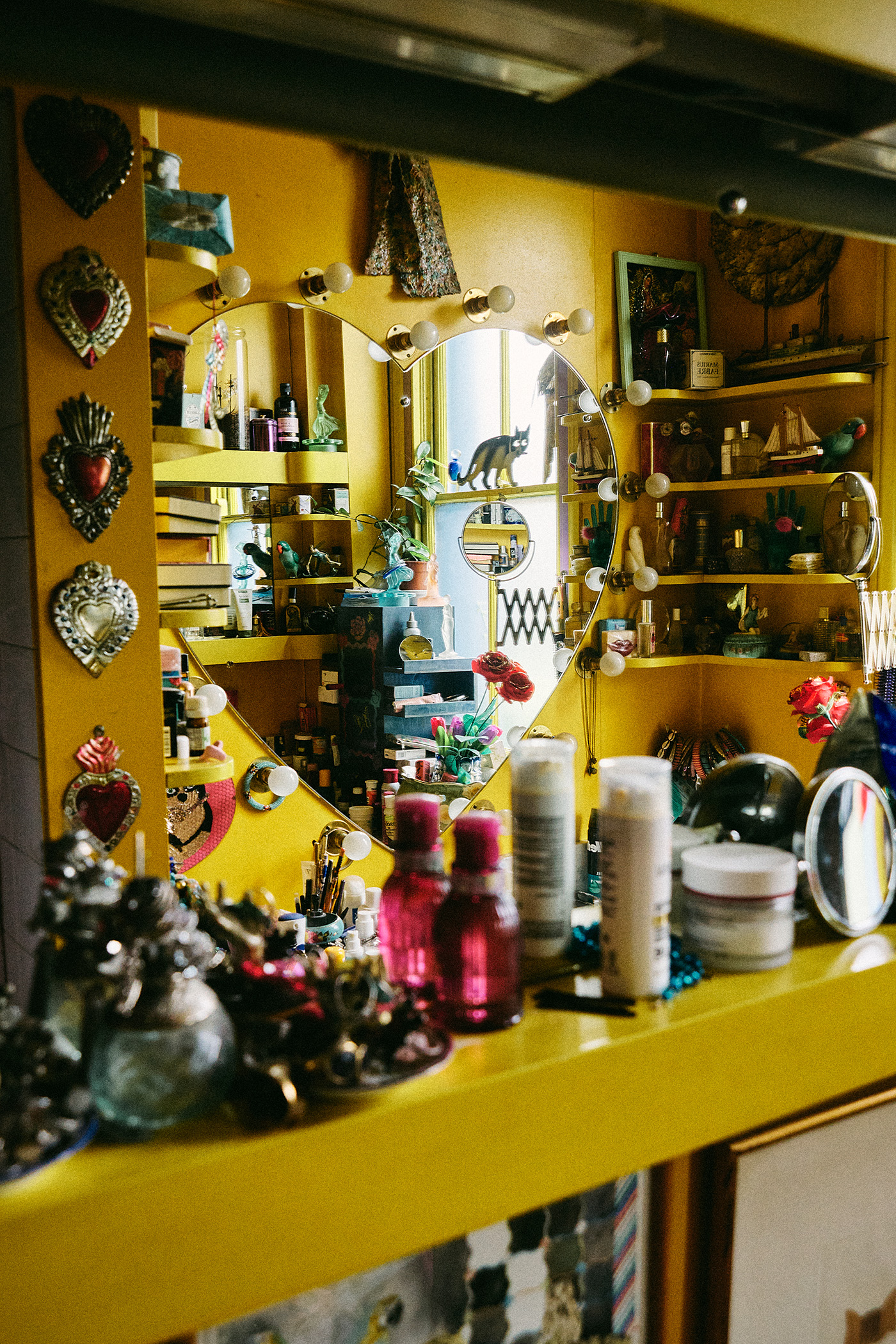
Bermondsey Abbey has played host to several archaeological digs since the 1950s. Over decades, the ground has given up silver pennies, antler combs, dress fastenings: the ephemera of distant lives. One can imagine the fun that might be had sifting through the remains of Gibson’s house, many centuries down the line: excavating Elvis memorabilia and Eric Ravilious crockery, unearthing sedimented layers of stained glass, printed fabrics and porcupine-whiskered masks. If the dishwasher survives, it will be refigured as a treasure chest. “I use it as an extra cupboard to store things,” she says.
Newsletters
Choose the newsletters you want to receive
View more
For information about how The Observer protects your data, read our Privacy Policy
Some collectors are sentimental, hoarding their pasts around them. But one gets the sense that the future is of much more interest to Gibson, an old-school bohemian who is still, always, on the lookout for more.