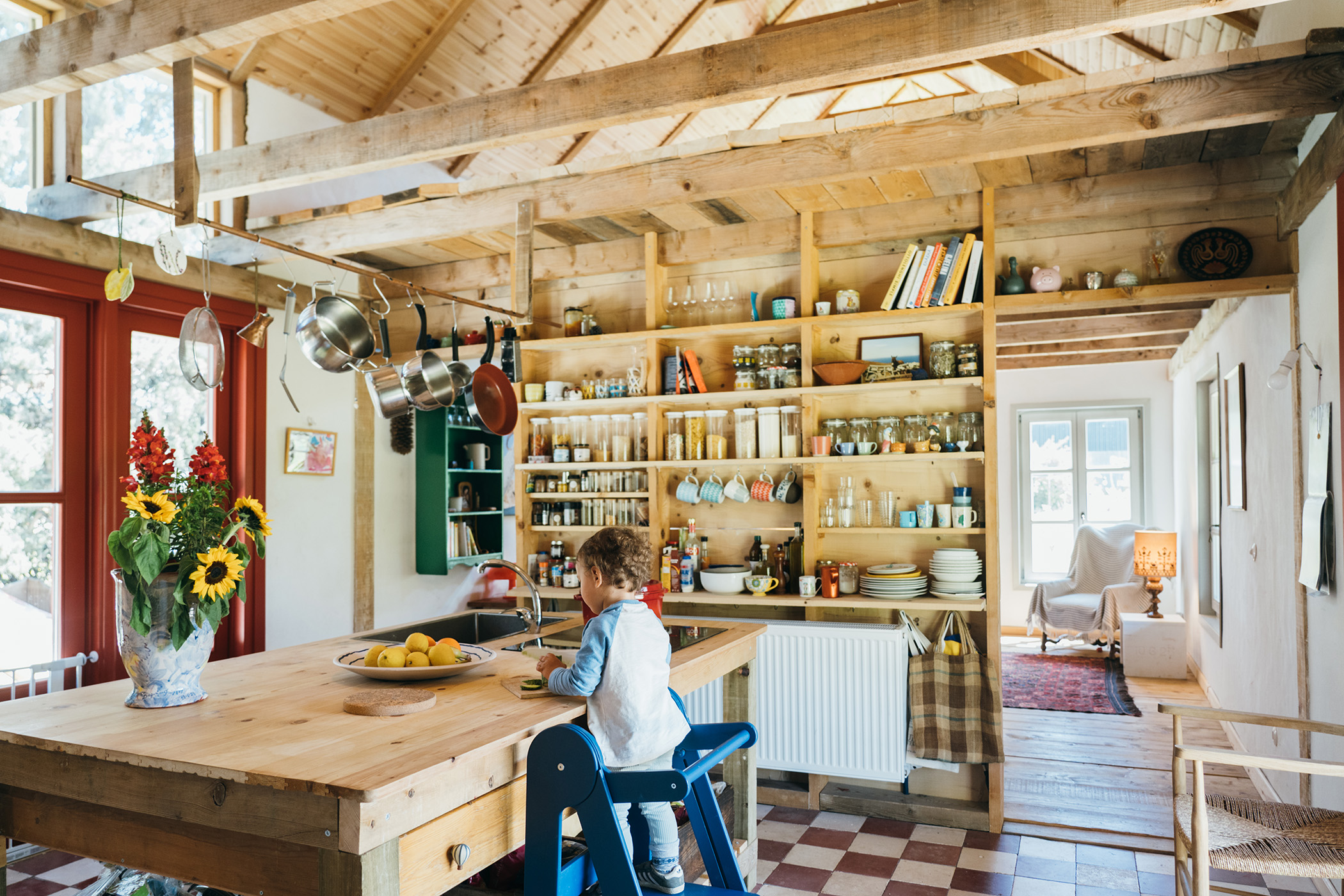



In Greek and Balkan tradition, slaughtering a rooster before building a house and laying its remains within the foundations is believed to bring good luck. But when Daphne Karnezis and George Mitzalis were building their new family home, on the outskirts of Athens, they couldn’t quite bring themselves to kill a bird. Instead they decided to draw a colourful pencil sketch of a rooster, to be buried beneath the house. The plan, after all, was never to build a traditional Greek dwelling. In a country where wooden houses are a rarity, their timber home is an outlier. The couple’s neighbours have begun referring to it as “the fairytale house”, Karnezis says. It’s not just the cabin-like timber frame that seems lifted from the pages of a children’s picture book but also the idyllic garden that surrounds it. The house sits at the heart of half an acre of orchard, filled with all manner of fruit and nut trees: fig, pistachio, almond, apple. When spring arrives, it is carpeted with a technicolour blanket of wildflowers and butterflies.
Karnezis’s grandfather bought the plot in 1969. “He planted all of this,” she says, sheltering from the midday sun on a wide wooden porch. “Before, there would have just been a few olive and pine trees, but he really loved his orchard. He was here every single day.”
It’s been less than a year since the couple traded life in a concrete apartment block in the heart of the Greek capital for the leafy northern suburbs and their new house, conceived as a tranquil idyll in which to bring up their two sons, three-year-old Markos and Foivos, 18 months.
Despite having grown up in the same Athenian neighbourhood, the couple met properly only while attending the University of Bath, where Mitzalis, who designed and built their home, was studying architecture. After graduation, he completed his Masters at Cambridge before joining Karnezis in London, where she was working as a journalist. In 2019, the couple decided to move back to Athens. Mitzalis set up a Greek outpost of his architecture firm, Rabble (his two cofounders are based in Sussex and Devon), while Karnezis founded one of the city’s first podcast production companies, the Greek Podcast Project.
As their family grew, the couple realised they needed more space. But prices had begun to rise in Athens, and a sizeable family home with a proper garden was already beyond their budget. Karnezis says, “We were, like, well, we’ve got this whole plot of land just sitting there. Why don’t we just have a go at building something ourselves?”
The plot is in an area of the city where planning regulations have only recently shifted to allow new homes to be built, with mixed results. The plot facing the couple’s home remains an olive grove. But over the past few years a string of imposing concrete-and-glass trophy homes have appeared in the neighbourhood. “There’s a slightly different sense of what a house is in Greece, and how you build one,” Mitzalis says. “People want to make their own fortress; they pour tons and tons of concrete. Here it’s a bit of a dream to make enough money to build your own home before you retire, but by that point the children have already left for university, so you’re left with this huge, empty house. We thought: let’s do it now, while the children have time to enjoy it.”
They came up with a plan to make it work using their savings, while Mitzalis took on as much of the building work as he could. Having trained with a carpenter, building oak-framed homes during his Masters, he decided a wooden build would be not only the most sustainable option but also the most feasible financially. “Communities such as the Quakers used to use this specific kind of timber-frame building method,” Mitzalis says. “Because everything is quite manageable in terms of weight and size. You can build a whole house with just a few people.”
After the foundations were laid, he built a frame using Greek pine and spruce. Walls were insulated using sheep’s wool from the Peloponnese before being coated in lime plaster. For three years the young architect spent almost every weekend working on the building, and would often bring his sons with him. (Markos began referring to the site as “bam-bam”, because he associated it strongly with the sound of his father’s hammer.) Mitzalis didn’t work entirely alone. The couple estimate some 35 friends and family members lent a hand.
The design was loosely based on the Dogtrot houses that originated in the mid-19th century in Kentucky and Tennessee: simple wooden homes with long roofs that reach out over the porch to provide shade in summer while still admitting low sunlight in winter. Moving in before the building is finished has allowed the couple to develop it organically, according to how they find themselves using the space.
The house is split over two storeys, with a double-height kitchen. It’s a characterful mix of largely secondhand furnishings, including a carved wooden sofa from Skyros, red-and-white cement floor tiles from an Athenian salvage yard and an antique chest that Mitzalis has transformed into a bathroom cabinet.
Newsletters
Choose the newsletters you want to receive
View more
For information about how The Observer protects your data, read our Privacy Policy
“A lot of people have told us that the house feels like it’s been around for longer,” Karnezis says, “that there’s a history to it, even though it’s new. And I think that’s a testament to George’s…” She takes a moment. “Slowness?” he suggests. “I was actually going to say art,” says Karnezis, laughing. “But all good things take time.”