
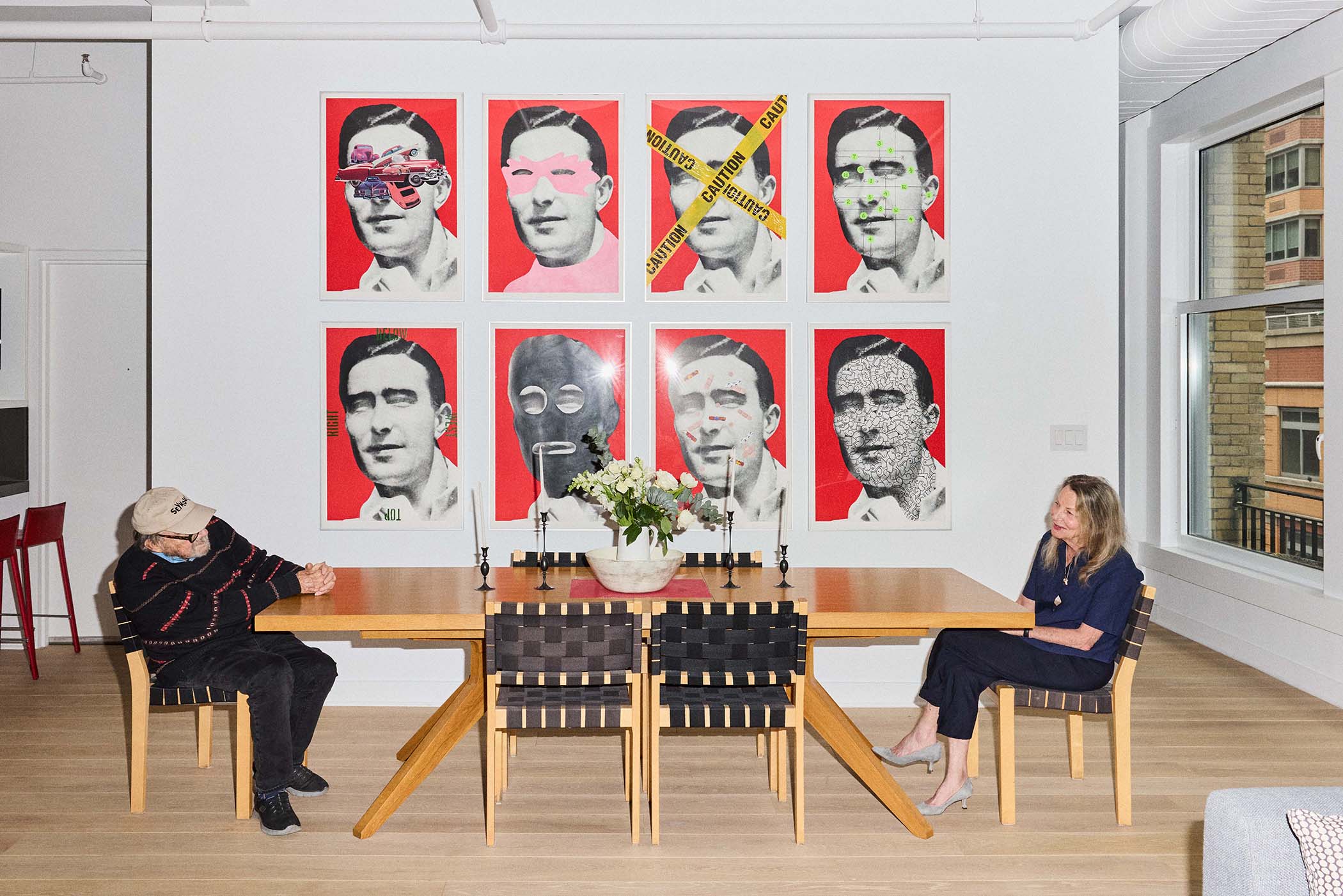
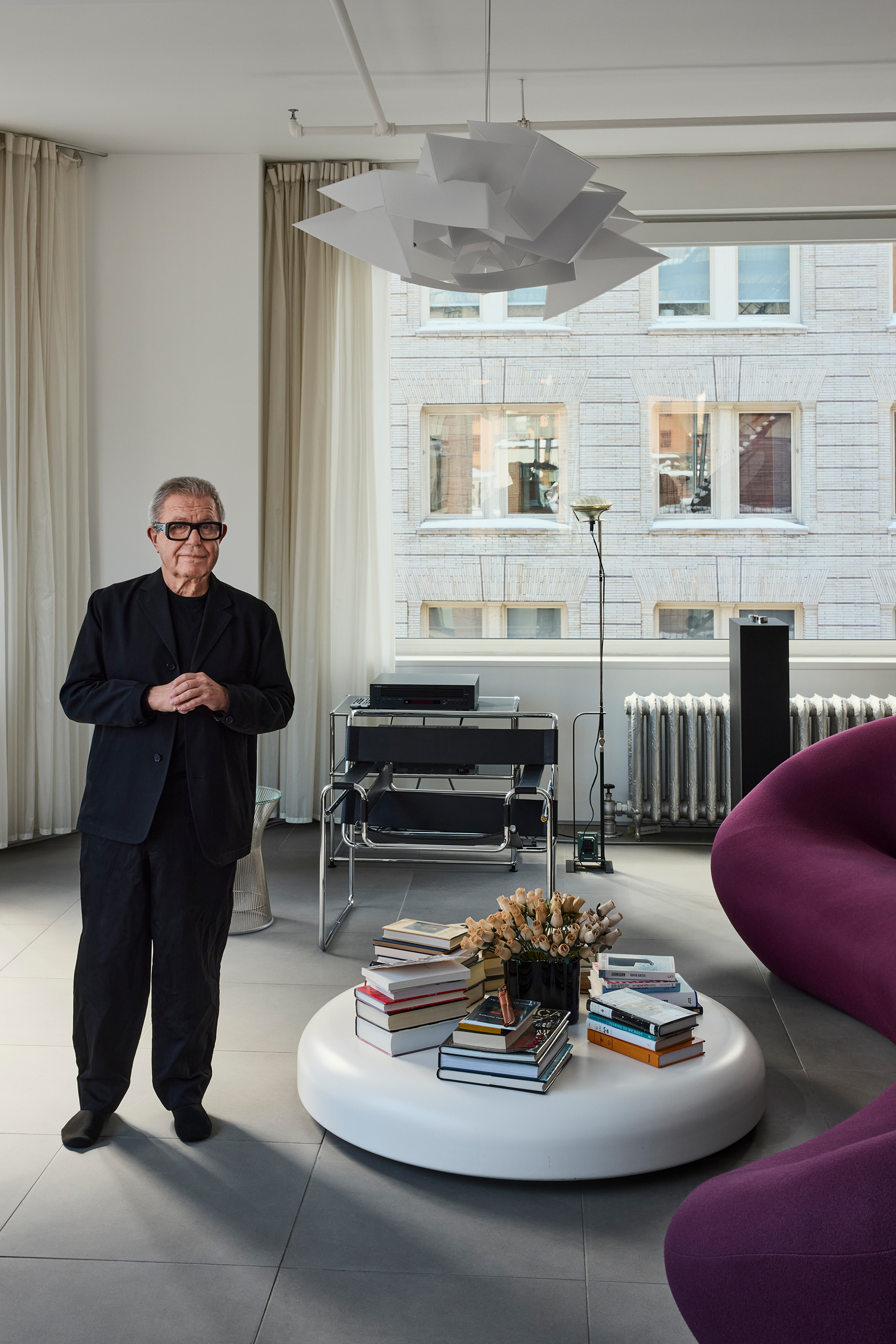
The architect Daniel Libeskind and his wife and studio manager, Nina Libeskind, are famously of a kind – accomplished, devoted, diminutive. They have their differences, though. Daniel always dresses in black and is a bit of a dreamer. Nina will pair a rainbow-striped sweater with ebony trousers and is utterly practical. It is she who does all the cooking when they are not travelling the world. Daniel can boil an egg, she says, but that’s about it.
Nina is standing in their super-functional kitchen, with its Wolf oven and marble countertops, recounting the first time she laid eyes on their home in the New York City neighbourhood of Tribeca. Daniel had been in Toronto working on his addition to the Royal Ontario Museum and had dispatched her to find a place for them to live. Nina told him about a loft whose previous occupants had been a family with six children, so that the large unit was a warren stuffed with bunk beds.
How was the light? Daniel wanted to know. Nina replied: breathtaking.
The year was 2003, and it was time for the Libeskinds to put down roots – again. The couple had led an itinerant life with their three children as Daniel took up far-flung teaching posts across the US and Europe. But they had recently spent more than a decade in Berlin bringing his first built project to fruition. Now, his Jewish Museum – an angular, haunting building with narrow windows slicing through it like scars – was an international sensation. And Daniel had just pulled off another feat, winning a competition to design the masterplan of the 16 acres in lower Manhattan that had been levelled in the terrorist attacks of 11 September 2001.
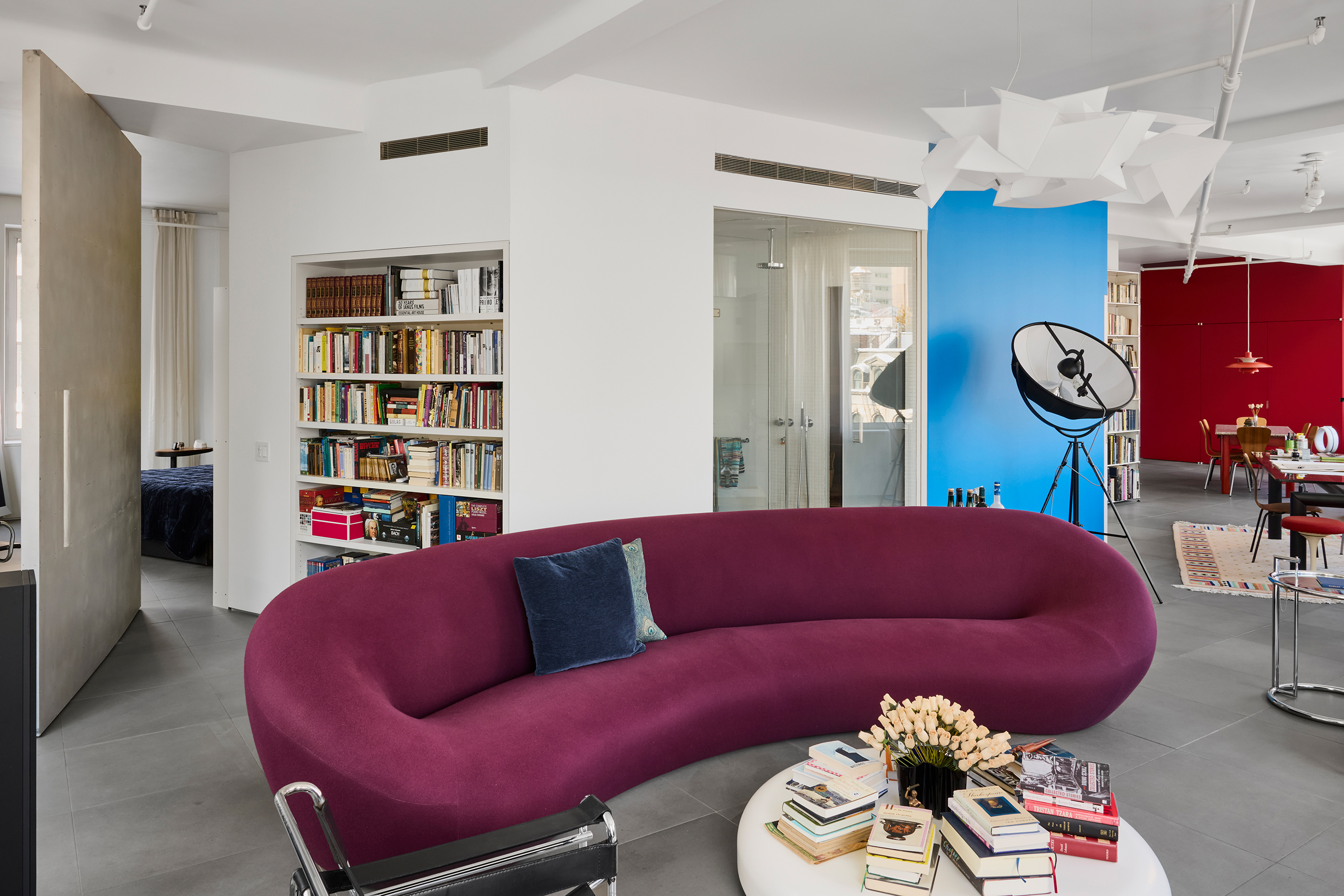
Purple reign: the huge sofa by Pierre Paulin is so big it had to be lifted through a window with a rooftop crane
He had two requirements for their new New York home: it had to be close to their studio near Ground Zero. And it had to have good light. The loft Nina visited was in an old bank building a 15-minute walk from their workplace. Because the 10-storey building sat at a point where two urban grids mashed together, it had the rare (for New York) form of a triangle. There was one unit per floor. The long, street-facing side of the seventh-floor apartment was a ribbon of windows looking east. Light poured in.
All the ingredients for an ideal home were there, but Daniel had no time to realise their potential. Not only was he orchestrating the reconstruction of Ground Zero; he was also co-designing its centrepiece, a 540m skyscraper called the Freedom Tower. “I wasn’t going to sit and figure out where the bathrooms should go,” he recalls today, his voice an inextinguishable legacy of an upbringing in Poland, Israel and the Bronx. He quickly corrects himself: “Well, I did figure it out, but I didn’t want to do the working drawings.”
Instead, in a move almost unheard of in the ego-driven world of architecture, he and Nina invited another architect, Alexander Gorlin, to renovate the space. Gorlin lived on the building’s third floor and like Daniel had graduated from Cooper Union, the prestigious New York art school. It was Gorlin who had notified the Libeskinds that the unit was available, knowing that Daniel had a particular affection for non-rectilinear angles.
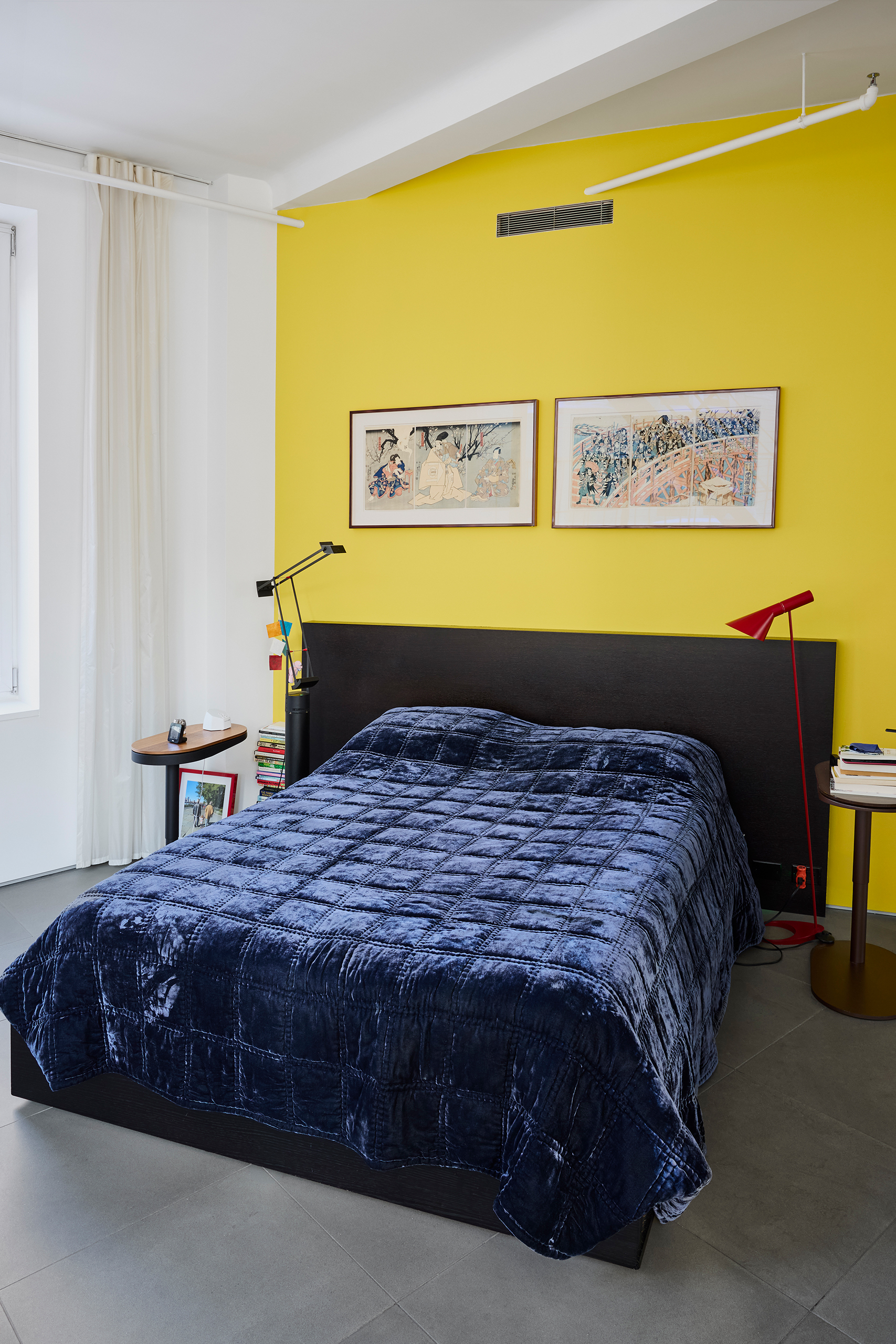
Statement colours: the apartment has 36 windows but the bedrooms are on the shadier side of the building
The two architects had no trouble agreeing that the most spectacular approach would be to tear down all the interior walls and let the light from its 36 windows wash over an uninterrupted space. That proposal was immediately rejected by the Libeskinds’ then-14-year-old daughter, Rachel. Nina wasn’t having it either. “Sometimes it’s good to be vetoed,” Daniel reflects. “My clients were not conducive to the idea.”
A new plan was drawn, with the living and dining areas sweeping continuously along the east wall of windows (larger panes were also added) and with the two bedrooms occupying the triangle’s darker side. Light and spatial connections have been maximised in all parts of the loft. Separating the primary bedroom from the living room, for example, is a large, aluminium-clad pivoting door – a compromise between an open-and-shut door and no door at all. A glass-walled shower in the en-suite bathroom (with an adjacent sauna) looks directly across the living room and out to the spectacle of lower Manhattan. If privacy is wanted, an automated screen obscures the glass. Daniel claims the technology isn’t necessary. “Nobody can see you when they look in,” he says.
“That’s what he says,” Nina adds.
When Gorlin took on the project, Daniel was intent on keeping the walls bare of bookshelves and art. Books would be stored in the studio, he said, and visual stimulation would come from the views. Today, however, the walls are lined in minimalist USM shelves filled with books and CDs. Both Libeskinds are ravenous music lovers and Daniel owns not just one copy of James Joyce’s Finnegans Wake, but three. When he couldn’t find a neat way to display chunky art books that didn’t fit on the shelves, he stacked them to create a pedestal table.
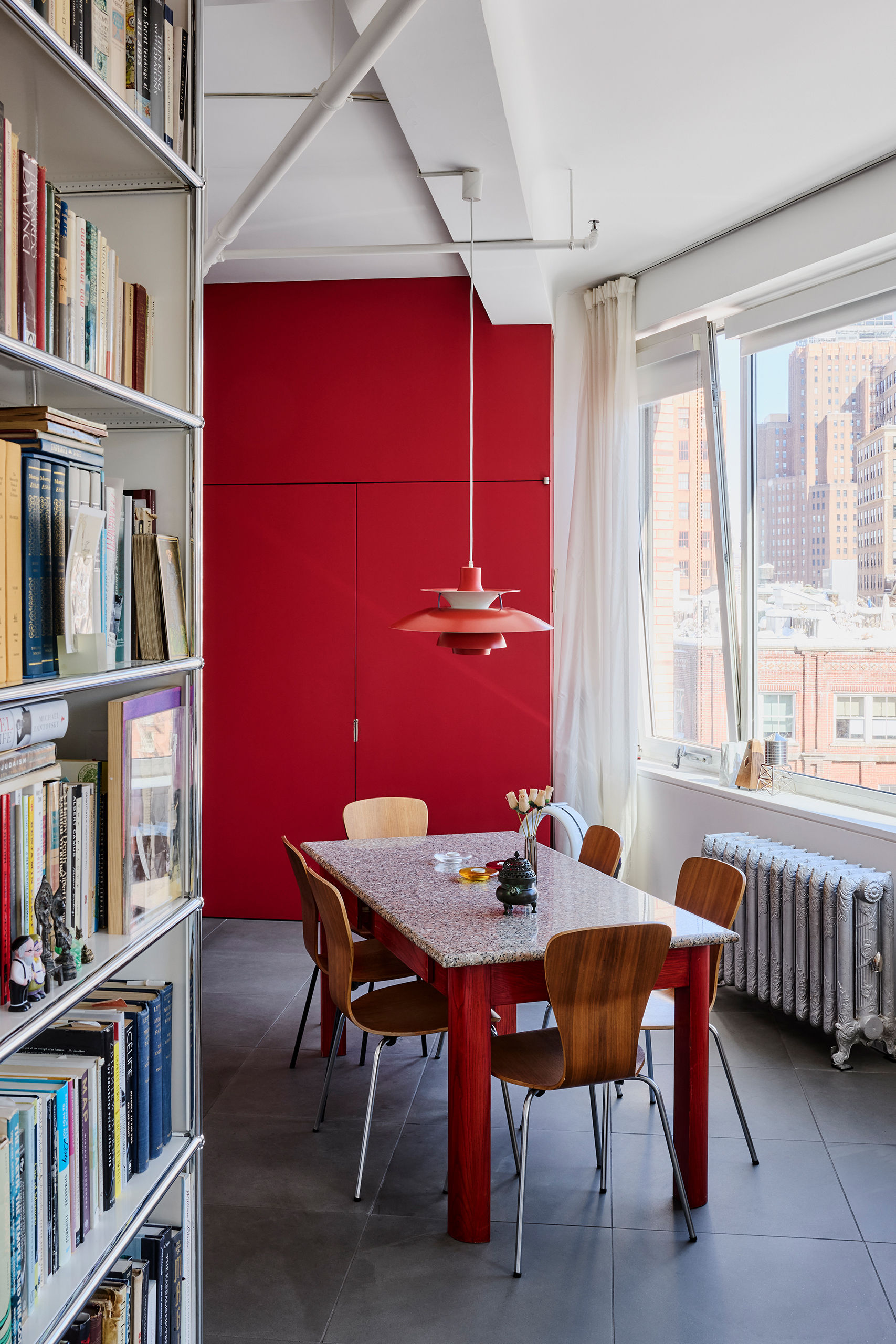
Hard top: the granite dining table was one of the first pieces designed by Daniel Libeskind
As for wall decorations, it would be difficult to banish them when your daughter is now an artist. A polychromatic sphere created by Rachel hangs near an Etruscan head that Nina bought for Daniel as a birthday gift. I pause, mouth agape, at a Rembrandt etching of the biblical David with his lyre, another present from Nina (“Not that expensive,” she says).
On the whole, the furniture consists of unimpeachable works of modernist design that the Libeskinds have owned for decades – Tapio Wirkkala dining chairs, an Eileen Gray side table, a pair of Franco Albini cantilevered tubular chairs in their bedroom, where they sit every morning listening to music as they bathe in the eastern light.
In a move almost unheard of in the ego-driven world of architecture, Daniel and Nina invited another architect, Alexander Gorlin, to renovate the space
In a move almost unheard of in the ego-driven world of architecture, Daniel and Nina invited another architect, Alexander Gorlin, to renovate the space
Breaking that mould is an enormous, curvaceous sofa that Daniel bought on a whim in Miami five years ago. A custom piece by the French furniture designer Pierre Paulin, it is very purple and so big it had to be lifted through a window with a rooftop crane. “I love this sofa because it’s not really something for a home,” Daniel says. “It was probably made for a corporate office.”
Several of his own designs are in the mix, including a Gemma armchair for Moroso and a limited-edition crystal bottle with a pear-shaped hollow partially filled with Richard Hennessy cognac. (The level has fallen alarmingly low, Daniel notes.) The first object he ever designed is here, too: a dining table made from a slab of granite resting on four wedge-shaped wooden legs. It was made to order in 1988, when the Libeskinds were living in Milan, and the couple have hauled it around with them ever since.
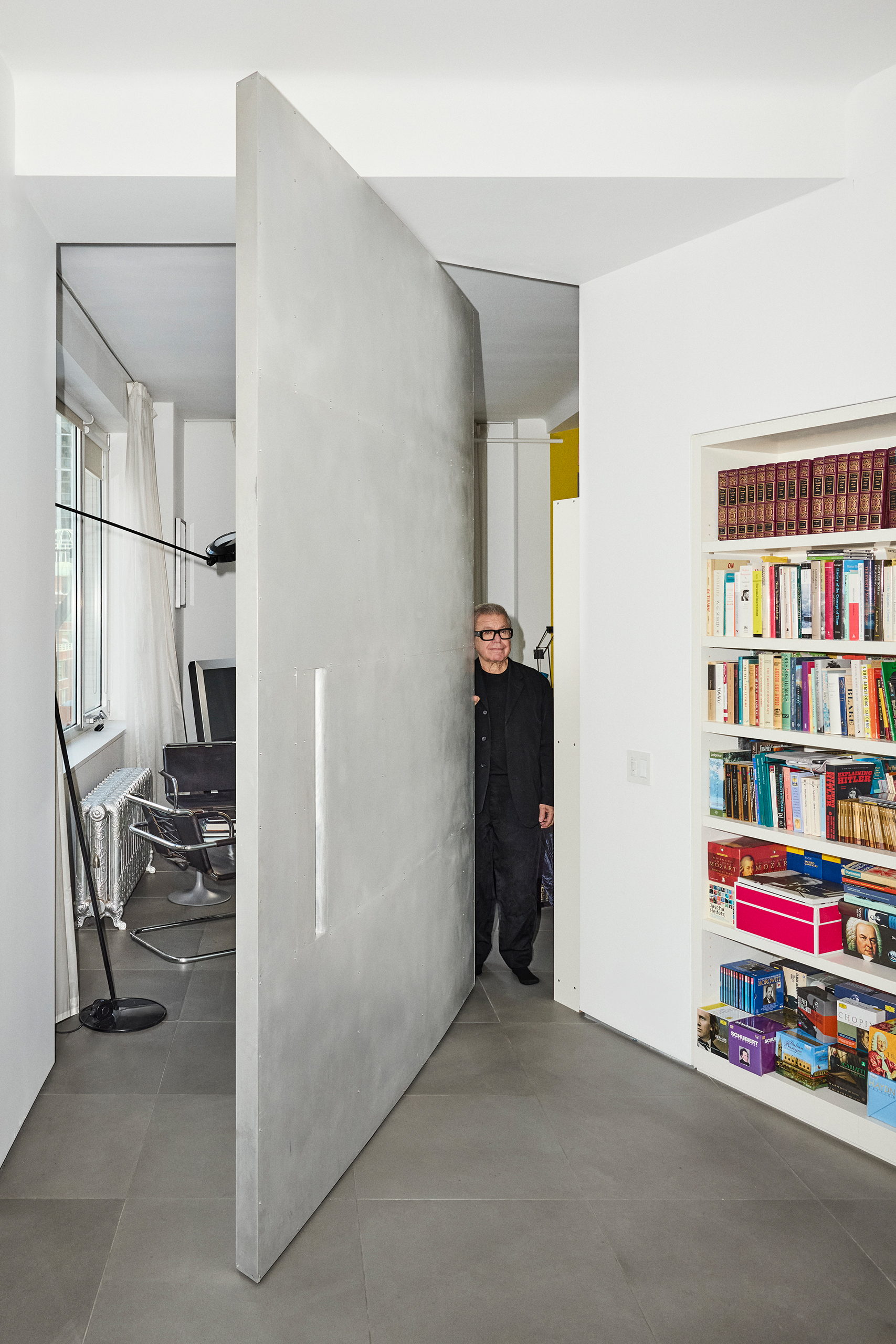
Grey matter: Daniel Libeskind peers past the aluminium-clad pivoting door
According to Gorlin, that table was the only argument he had with his client. “I just thought it was so ugly,” he tells me. But, he adds, “It’s his Rosebud,” referring to the sentimental sled in Citizen Kane. “He has to carry it around wherever he goes.”
The table will be left behind, of course, when the Libeskinds depart on their next round of travels. Current projects in Dubai, Shanghai, Paris, Prague and Pittsburgh keep them on the move. And Berlin, where they have grandchildren and another residence, remains a second home. In May, Daniel will celebrate his 80th birthday in that city, the same month the Jewish Museum turns 25.
And when they are done travelling and celebrating, they will return to a New York apartment that has aged gracefully. A few primary-coloured accent walls have been added, as has a “secret” living room closet stuffed with Daniel’s jazz CDs. But it remains a calm centre in post-9/11 lower Manhattan. As Daniel puts it, with characteristic understatement, “I think it’s stood up pretty well.”
Newsletters
Choose the newsletters you want to receive
View more
For information about how The Observer protects your data, read our Privacy Policy