
When he’s not cooking the best food you can eat in London, Seb Myers likes to share weird animal videos on Instagram. You never know quite what you’ll witness when you tap on his profile: a dog with a red basket buying vegetables at a Chinese market; a bearded man cheerfully petting a koala; an aerial view of cows in a river chomping on freshwater weeds. He posts photos of his dishes and menus too, when the mood takes him. But animal memes seem to outnumber them three to one.
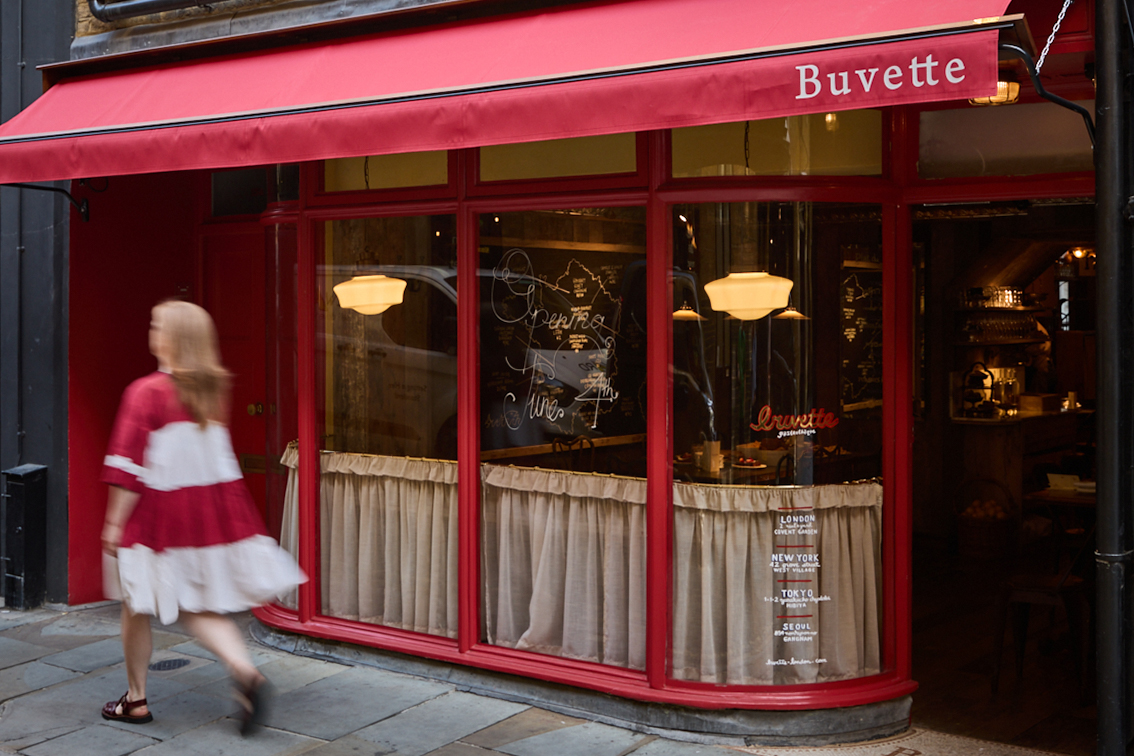
Myers is the chef and co-owner of Planque in east London, a restaurant where intense dedication to good cooking co-exists with a sense of play and a deep aversion to cheffy self-importance. It sits in an L-shaped space opposite Haggerston train station, in an arch unit under the railway lines, with a long raised counter at one end, overlooking the kitchen. If you happen to walk down the unlovely mews through the high windows you’ll see the 39-year-old Australian at the pass, head bowed in concentration over a rice dish or pithivier, affording a view of his working methods that can’t be found so readily online.
Planque opened in September 2021, but acclaim has been a slow build. Other chefs and a certain subset of London diners know Myers from his previous positions – at the cult Clapton wine bar P Franco (now known as 107), and at Viajante in Bethnal Green, where he worked having arrived from Melbourne in 2010. But to the wider public he remains an unknown entity. When Giles Coren reviewed Planque for the Times soon after it opened – finding it “very wonderful” despite the hard surfaces – he didn’t even mention Myers’s name. No other broadsheet has reviewed the restaurant since, nor has Michelin seen fit to award it a star.
When I first approached Myers about this profile, in November last year, he lamented the lack of recognition. “We just turned four years old,” he said, “and I’m not going to lie, there are times when we scratch our heads and go…” He trailed off, reckoning with his bemusement. “I mean, we don’t really do any PR or anything like that, and I quite happily work away in the background, so a lot of these problems are of my own creation. But sometimes we do feel underappreciated. We are better known in Paris and New York than in our own city.”
Planque has been recommended on the influential YouTube channel Topjaw as the most underrated restaurant in London. which perplexes him. “I’m tired of being underrated,” he told me. “I just want to be, like... fairly rated. I don’t think that’s asking too much.”
I’ve followed Myers’s career over the past decade, from his first head-chef role at Sager + Wilde, in Bethnal Green, through various pop-ups and residencies around London, and the food he turned out was always delicious and unusual, taking inspiration from China and Japan as much as France and Spain. But what he’s cooking at Planque is on another level. Over three visits in the past couple of months, I had one miraculous dish after another – an immaculately pan-fried red mullet with coco beans and a kind of nasturtium salsa verde; an unforgettable beef tartare, the coarsely chopped meat dressed with a complex warm pepper sauce, served alongisde housemade crisps – with levels of refinement and consistency unmatched elsewhere in the city.
Many of his peers agree. Nuno Mendes, his boss at Viajante, told me that Myers “has really found the format he likes” at Planque. “When I had his food earlier, you could see that he was a lot more influenced by where he’d been, but now I feel like [his cooking] is really his.” Gabriel Pryce, of Rita’s in Soho, calls Myers the best chef in London: “He has worked with some of the best chefs in the world, but he doesn’t cook their food. He doesn’t cook French food, or Italian food, or Mediterranean food. He cooks Seb Myers food, which I think is incredibly rare.”
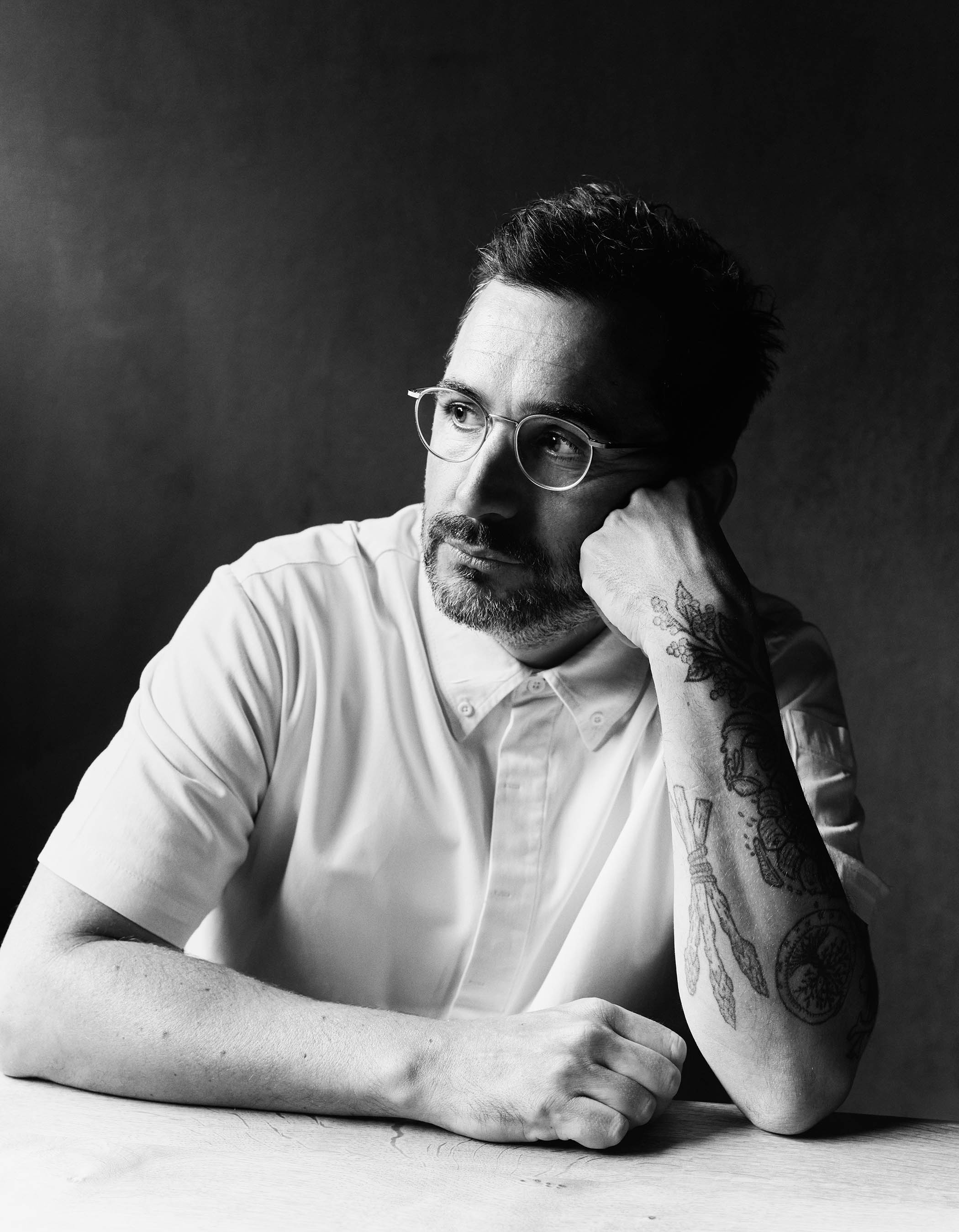
‘The great thing about cooking is there’s no finish line to what you learn. Every day I’m slightly changing things’: Seb Myers
And yet Planque flies under the radar. It shouldn’t be easy to get a seat there – it should be booked up months in advance – but on several occasions I’ve just wandered in and nabbed a prime spot at the counter overlooking the kitchen. The location, a street off a quiet stretch of Kingsland Road, which runs between the more lively Shoreditch and Dalston, doesn’t help, and the room itself takes some getting used to (I’ve heard it likened, not unkindly, to a very cool co-working space). But if you don’t do PR, and your main social media output is videos of dogs shopping for cabbages, you have to expect some trade-offs.
That said, things are beginning to change. On Topjaw, chefs have started rating Planque the best in London, not just the most underrated. The writer and Chinese food authority Fuchsia Dunlop recently paid tribute to the “extreme brilliance” of Myers’s cooking on Facebook. Then, last month, the influential food newsletter Vittles ran a list of the best 99 restaurants in London. I watched them count down from 99 over the course of a week, ticking off big-hitters like Ikoyi and the Ritz until there was just one spot left.
“Wow never even heard of it,” wrote a commenter when Planque was awarded first place.
Acouple of weeks before the Vittles result, I spent a Tuesday hanging out with Myers. We went for an early lunch at Luso, a Portuguese restaurant in Fitzrovia overseen by Leandro Carreira, one of the many talented chefs Myers worked alongside at Viajante. Over steak buns and piri-piri chicken, Myers, who has a salt-and-pepper beard and an armful of tattoos, recalled his childhood in southeastern Australia, and the early fascination with cooking that set him on his current path. We talked about the supreme importance of being organised in the kitchen – “If you take care of all the nuts and bolts, the magic happens in the 1% or 2% on top of that,” he insisted – before veering into a discussion about the impacts of AI on our respective professions.
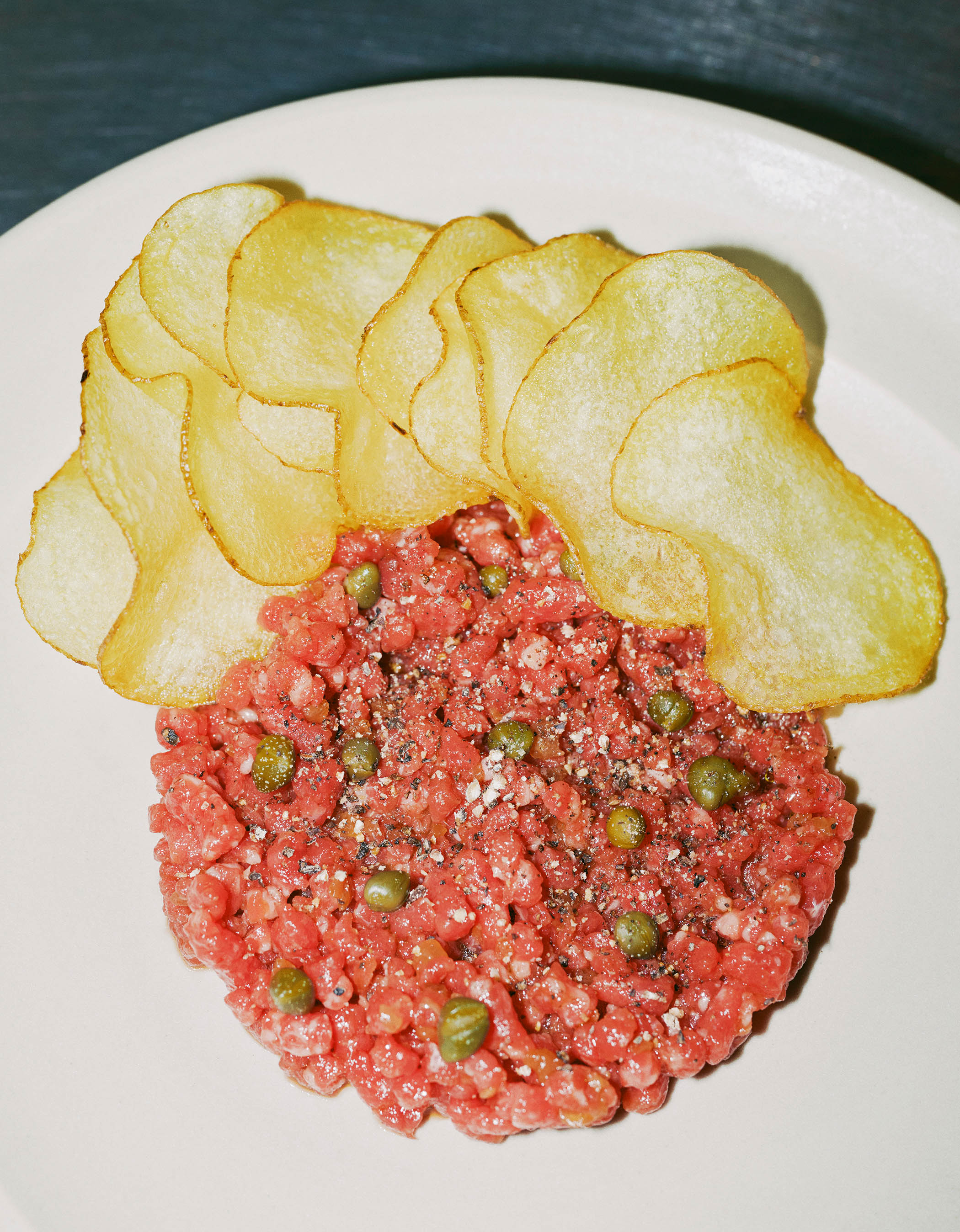
Beef tartare with pepper sauce and crisps, one of the star dishes at Planque
When forced to speak about himself, Myers fidgeted a lot and glanced about for escape routes, which became particularly noticeable when I asked about his reluctance to engage with the London food scene. “I’m quite an insular person,” he said, removing his glasses and rubbing his eyes. “I don’t go to the PR events. I’m just doing my own thing.”
He’s no less twitchy when an opportunity arises to praise his own work. At one point, when discussing house-made ingredients such as herb vinegars that help elevate his dishes, he spoke about “those little touches that are going to just change it from being something nice to something like, hopefully, a little bit, you know, sort of…” He trailed off again, unable to muster a superlative stronger than “nice”.
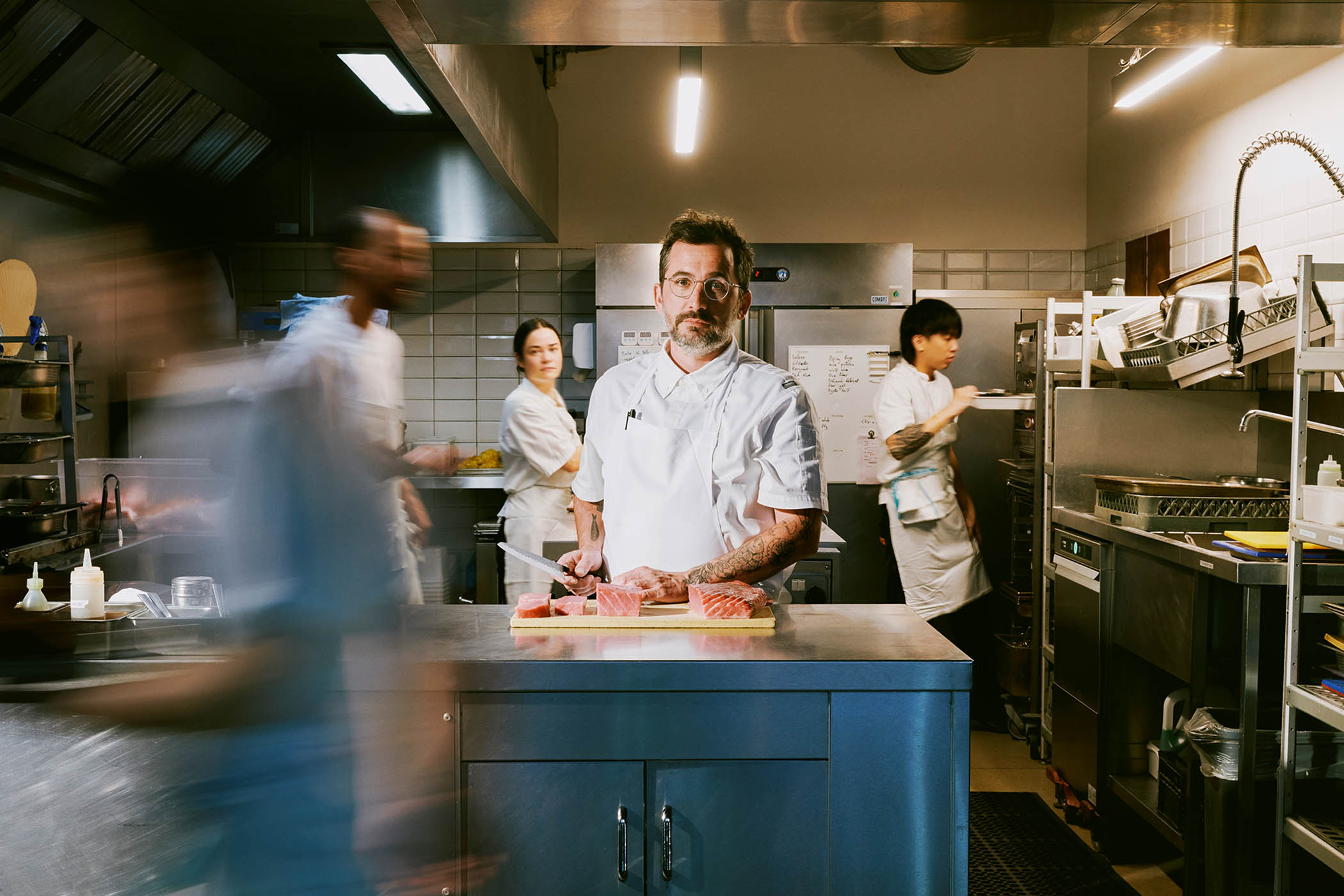
After lunch, we travelled to Haggerston station and crossed the street to Planque. As soon as we stepped through the front door, Myers’s demeanour changed. He checked in with his team, who were prepping for the evening’s dinner – cracking open crab claws, cutting out bright green discs of seaweed pastry for scallop tartelettes and stacking them like casino chips. And then, after a costume change, he started blasting through tasks at speed – grilling leeks, simmering a crab bisque, shaving chestnuts – while keeping a watchful eye on the activity around him.
That is Myers in his element. Jack Coghlan, who worked at Planque for nearly two years before opening the rotisserie restaurant Norbert’s, in East Dulwich, recalled him as “an absolute powerhouse” in the kitchen. “He would come in and chew through mise-en-place so fast,” he told me recently. “And he was just ridiculously creative. He’s always thinking, always creating. His mental flavour Rolodex is terrifying.”
Myers began filling out that Rolodex at a young age. Geelong, a port city southwest of Melbourne, wasn’t exactly a culinary utopia when he was growing up there in the 1990s, but there were points of interest close to home. An aunt who worked for NGOs around the world – Afghanistan, Cambodia, Peru – would come back laden with ingredients and inspiration. “I was three or four, and she’d be making dinner for the family,” he said, “and I was always pestering, trying to get in the kitchen.”

‘If you take care of all the nuts and bolts, the magic happens in the 1% or 2% on top of that’
His maternal grandmother had emigrated from northern Spain in the 1950s and brought food traditions with her. She would catch snails and pigeons in the yard to eat and have giant legs of jamon curing in the cellar. Myers would drop in after school to make croquetas with her, rolling the plump little ovals in flour, egg and breadcrumbs. “The tactile nature of it really interested me,” he said.
At 15, his parents bundled him off to Bangkok for a year on a youth exchange – “I’d never left the country before. Suddenly I was staying with Thai families and going to big formal dinners and eating all this crazy food” – an experience Myers describes as “eye-opening” and formative. In his last couple of years at high school, in Geelong, Myers got a job at a friend’s noodle bar. The place was nothing special, and he was the lowly potwash, but the lifestyle – drinking beers after work, hanging out with other chefs on the beach – appealed to him.
When school ended, he decided to skip university and commit to cooking. “I come from a family of academics,” he told me, so “Mum and Dad were really freaked out by it.” He blagged his way into positions at top-rated restaurants in Melbourne. “The things that I hold most important now – working with the seasons, building relationships with suppliers – were less in consideration then,” he said, but the kitchens he worked in were well-organised, giving him an appreciation for the systems that underlie good cooking.
Myers’s arrival in London, in 2010, coincided with fresh energy taking hold of the capital’s dining scene, as restaurants sought new ways of operating post-crash. The job agency he signed with kept sending him to old-school kitchens hidden away underground, but eventually, after much wheedling, he got a job at Viajante in east London, where a number of chefs he admired were working.
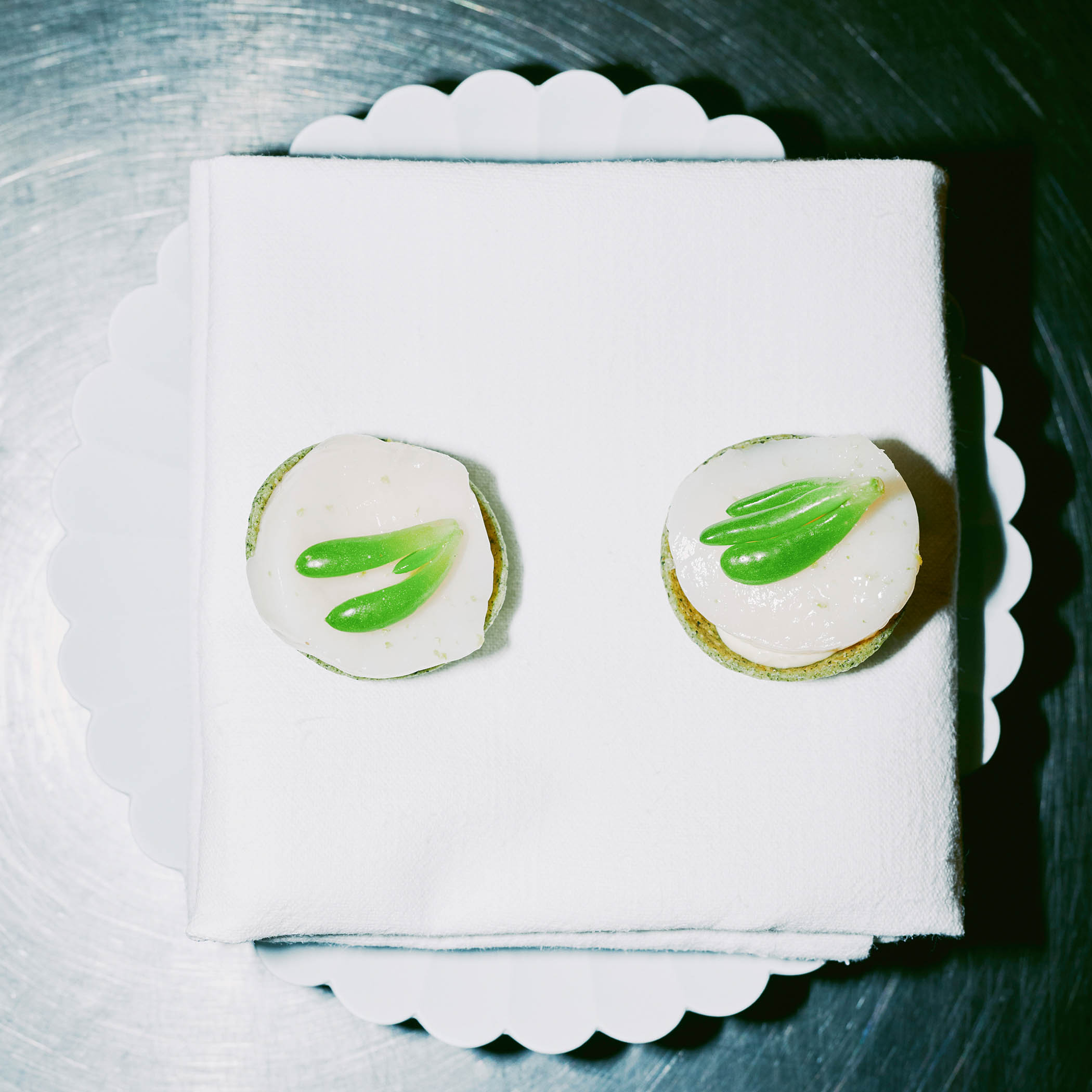
Another star: scallop and sea lettuce tartlettes
Nuno Mendes remembers the “super-focused” young Australian arriving in his kitchen with an already-broad knowledge of different cooking traditions and a hunger to learn more. “He was really passionate about food,” he told me. “He was not show-offy at all, but his technique was impressive, and he was always speaking about ideas, helping us make adjustments on dishes.”
They worked together a second time at Chiltern Firehouse, the celeb hangout Mendes was running in Marylebone, before Myers moved to Sager + Wilde in east London, where he was writing his own menus for the first time. The transition to the top had some rocky patches. Ben Hofer, who worked front of house at Viajante and who now runs XO Grill in Vienna, recalled accompanying Myers to a food festival in Lisbon in 2015. “You had really top chefs there, four chefs cooking per night. And Seb, he was so stressed and so embarrassed for his dishes. He was like, ‘Ben, I can’t do anything.’” Hofer remembered Myers standing in the kitchen holding his head in his hands. “I told him, ‘The dish is amazing'… At the end, all the chefs came and said that his was the best.” Hofer recalls Myers feeling elated. “But I think he had a massive bout of imposter syndrome.”
When I raised this with Myers, he recalled finding the festival “completely nerve-wracking,” and said it took him a while to feel properly comfortable leading a kitchen. Settling into Planque in 2021 was a step forward. Its Parisian founder, Jonathan Alphandery, set it up as a wine club as well as a restaurant. Myers, who was intending to move to New York, was only meant to be consulting on the project, the first in a series of guest chefs, but when his plans fell through in the US, Alphandery asked him to take over the kitchen, giving him carte blanche. Still now, Myers remains his own harshest critic. “I’m having one of those weeks where I hate everything I make,” he told me in November, just two days after he’d served me the best meal I’d eaten all year.
Coghlan told me, “He can be extremely hard on himself,” adding that the incredibly high standard he holds himself to also extends to his staff. “He wants you to work hard, he wants you to think hard, and if you’re not doing that, he’s going to let it be known,” though not in an old-school shouty way, Coghlan clarified. “He’ll explain why he’s frustrated and how to fix it. So it is about moving forward, ensuring the guest is getting the best thing. And because you see him working so hard, and you see that his output is so high, you’re like, ‘Fuck, I’ve got to up my game.’”
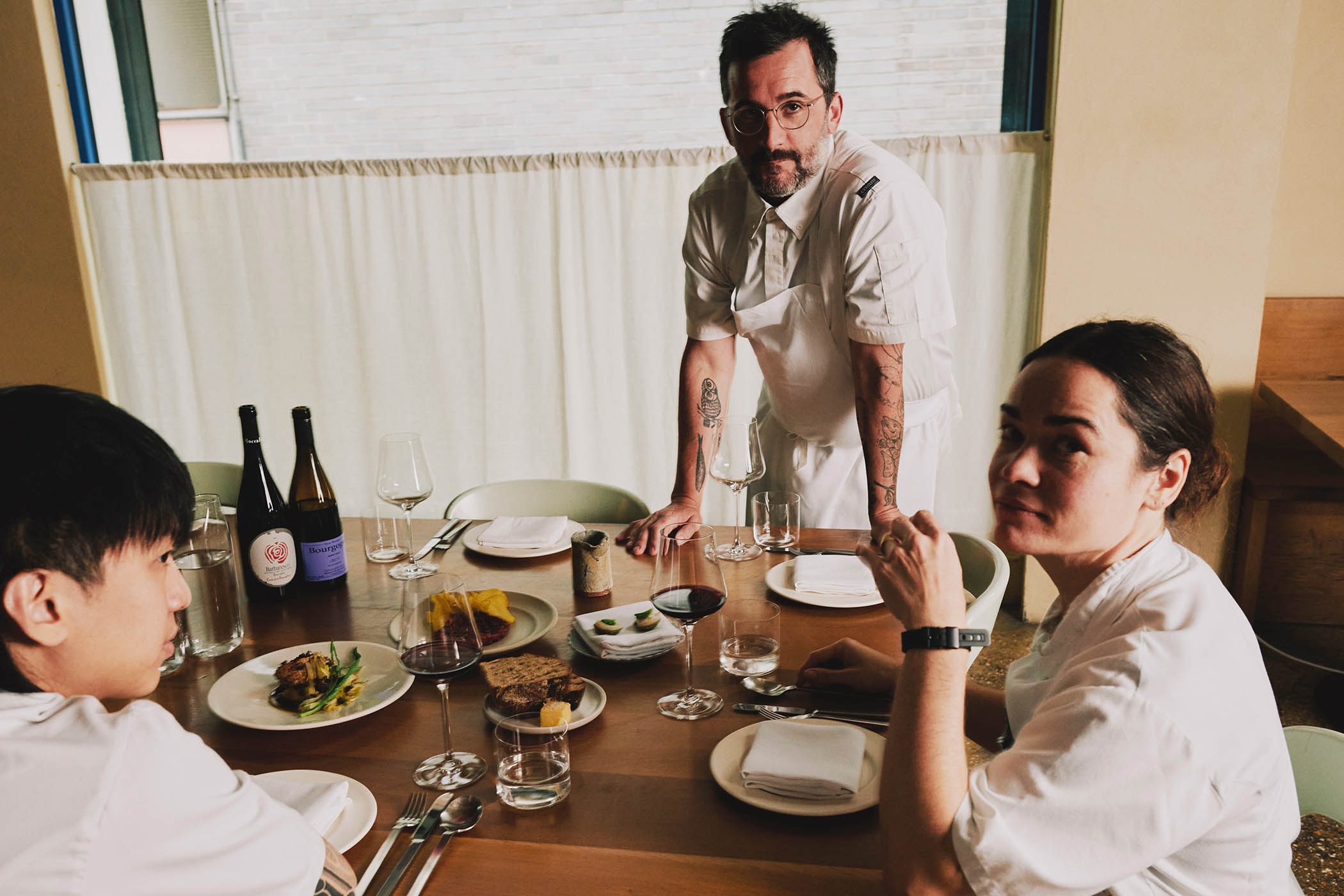
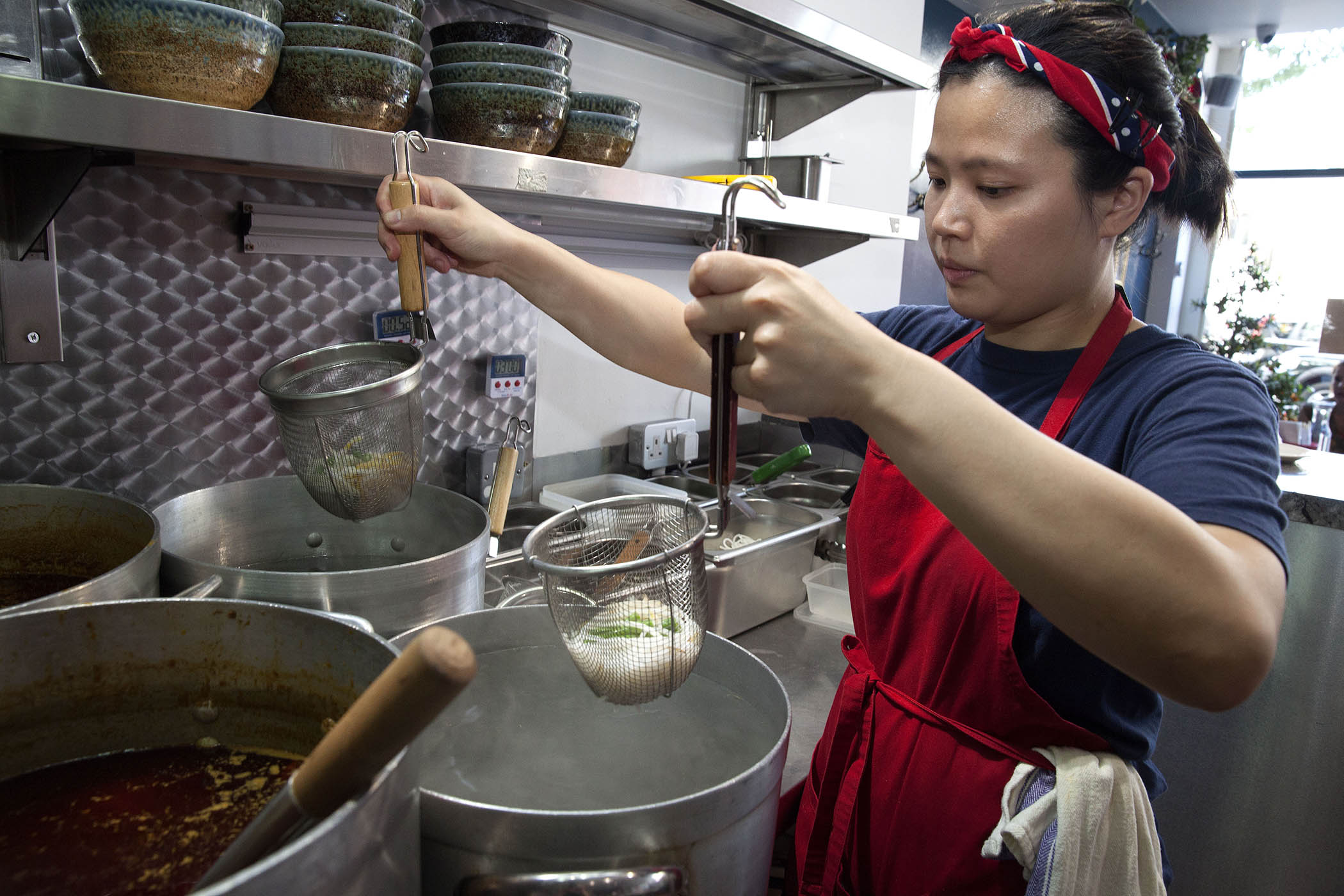
‘We are better known in Paris and New York than in our own city’: Myers with team members Lynus Lim and Ellie Wilding (along with Marcelo Rodrigues in main image)
Some of Myers’s ideas come from trawling YouTube, or flicking through an extensive cookbook collection. Others are gathered on the road. During his first few years in London, Myers interned at some of Europe’s great restaurants, including Fäviken in Sweden, where he learned the value of building up a larder of house-made ingredients: flavoured vinegars and oils, preserved tomatoes and berries. More recently, inspired by eating at a mangal restaurant in Turkey, he changed the way he cooked sweetbreads, brining and letting them dry out before grilling them, instead of peeling and poaching them, French-style.
“The great thing about cooking is there’s no finish line to what you learn,” Myers said, suggesting that the pleasures of improving his work, tweak by tweak, motivates him more than external accolades. “Every day I’m slightly changing things.” It’s also about learning what you don’t put on a plate, he added. “That editing process is really important. Years ago, I would have been trying to put more and more things on. Now I’m trying to pull things away. Do less.”
Even by chef standards, Myers is a grafter. For many years he partied hard, too. As he approaches 40, he’s making an effort to take better care of himself, before the lifestyle catches up with him. “I get outdoors when I can,” he told me. “Go for a walk in Epping Forest, play basketball with friends – it’s a form of therapy as much as anything else.” But disengaging from work completely is out of the question. Some evenings, instead of zoning out in front of the TV, or getting an early night, he finds himself sitting up in bed, cookbook in hand, thinking about menus.
One of the recurring things people told me about Myers’s cooking is how light and gentle it is. “It’s got this sort of softness to it,” Coghlan said. “It’s just, like, complete care. The thing I always joke about with him is that he’s got the manliest hands I know, his hands are big and lovely and manly. But his cooking is just so beautiful.”
‘I’m having one of those weeks where I hate everything I make,’ he told me, two days after he’d served me the best meal I’d eaten all year
‘I’m having one of those weeks where I hate everything I make,’ he told me, two days after he’d served me the best meal I’d eaten all year
During my day at Planque, I witnessed those manly hands creating something extraordinarily lovely. First, he minced scallop trimmings with guanciale and spooned them into a blue piping bag. It was to make dumplings, he explained, but instead of using conventional dumpling wrappers, he took out a tray of frilly cauliflower mushrooms and piped the mixture into the mushrooms’ folds. He wrapped this in guanciale so thinly sliced as to be transparent, then blowtorched it until the meat had tightened around the mushroom, creating a seal.
Like many of his ideas, this one has various roots. At Perilla, in nearby Newington Green, he took note of a cacio e pepe dish that the chef Ben Marks had made using cauliflower mushrooms instead of pasta. He also drew from Chinese dumplings and the classic French chou farci, relishing the chance to use up scallop trimmings from the tartelettes elsewhere on the menu. “As I’ve grown older, I’m able to cook without having to think so much,” he told me, “because when you’ve got a lot of experience, it does circumvent that to a certain degree.”
Myers served me a dumpling in an aromatic Cornish bluefin tuna broth, and I carried the ceramic bowl across the room with sacramental care. When I returned, wowed by the dish’s ingenuity, I found Myers and his head chef Cavan Power O’Keeffe shaking their heads – the seasoning wasn’t quite there, they said. More tweaking needed.
That level of consideration was what struck Fuchsia Dunlop about his food. “It has just the right degree of elaboration,” she told me. “It’s not complicated, but it’s interesting, and it plays with influences from different places.” The first time she visited Planque, “I went with some uber foodies from Hong Kong who travel all over the world eating at all the best places. Planque was the best meal of their trip. We had the lobster rice and a fish dish, and my friends thought that the seafood was cooked so perfectly that there must be someone Cantonese in the kitchen.”
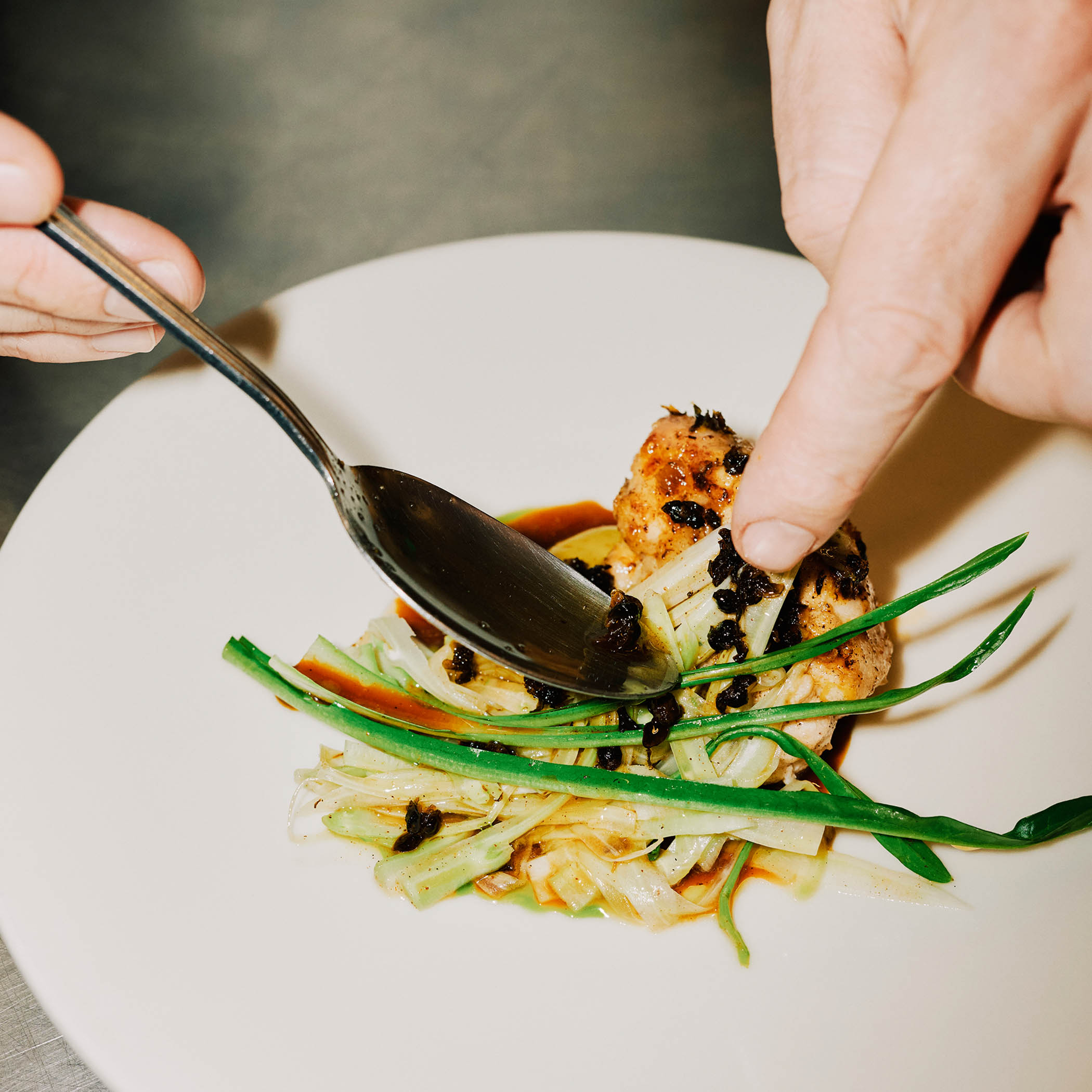
Veal sweetbreads with puntarelle and pistachio
All of Myers’s wide-ranging knowledge and questing for perfection must have factored into Vittles’s decision to name Planque the best restaurant in London. When I spoke to Myers after the announcement, I found him pleased by the acknowledgment, but unable to resist playing it down. “Obviously, it’s a great honour,” he said, but then he started picking apart the decision, as though awarding Planque first place was the result of a box-ticking exercise, and not because it’s a fantastic restaurant. “It’s a nice recognition,” he finally allowed, “and it’s really good for the team. It’s a nice reminder of the progress we’ve made over the past few years.”
Gabriel Pryce told me he was delighted to see Myers getting some overdue recognition. “It is incredibly admirable to watch someone not play the game for a very, very long time and get the notice and the respect that he deserves.”
It might help Myers go a bit easier on himself, though I was already beginning to see small signs that he was cutting himself some slack. After my day observing prep at the restaurant, I returned for dinner and, noticing the scallop and cauliflower mushroom dish on the menu, I couldn’t resist trying it again. There were two dumplings in the tuna broth this time, and my dining companion and I took one each, before falling into a long silence. The seasoning levels had shifted infinitesimally, but somehow Myers and Power O’Keeffe had managed to propel the dish from merely delicious to stratospherically good.
When he checked in on us, I gave Myers a blissed-out smile and he nodded slightly in return. I imagined that he was about to deflect the forthcoming words of praise with some amusingly offbeat remark, but instead he allowed himself a rare moment of self-congratulation. “Yeah,” he murmured. “I think we nailed it.”
Newsletters
Choose the newsletters you want to receive
View more
For information about how The Observer protects your data, read our Privacy Policy