
Related articles:

List eight animals whose names are also verbs. You have 60 seconds.
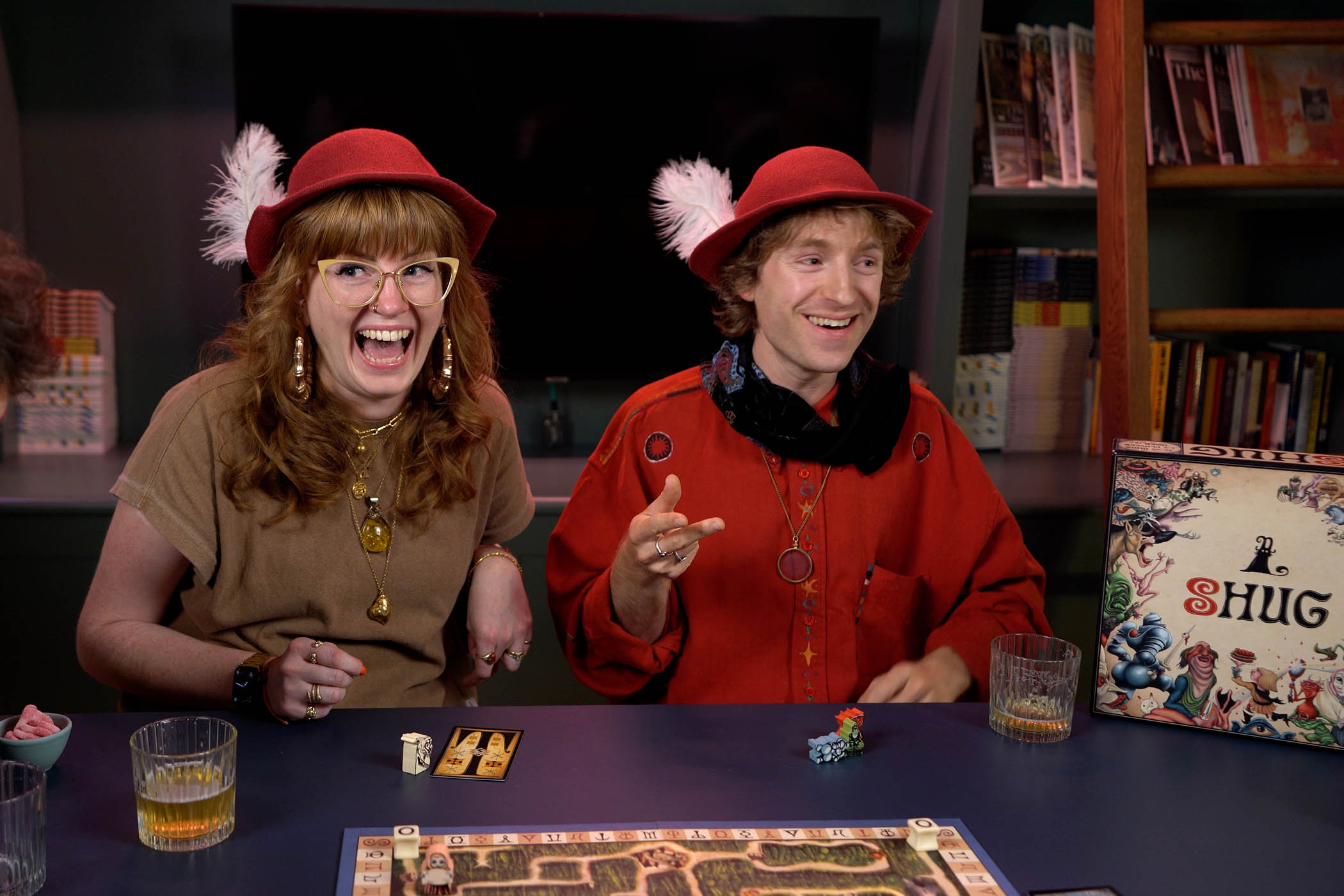
It is Chris and Blythe’s challenge, not mine, but I am watching their faces and can feel it happening; the moment, at around 40 seconds, when the brain stops producing words. I am holding myself back, wanting to help, to mouth “bat”, “ape” and “badger” across the table at them. But they’re on a competing side, and this is just the opening challenge.
They lose.
We are playing Shug. I have convened the (unofficial) Observer puzzles team after hours in the newsroom basement, to play a board game I have only just heard about, designed by two brothers I have never met, on a board the pair first drew when they were seven and 10 years old.
By the end of the evening, I will have tap-danced, participated in a duel, and convinced another team that their silica gel packet was really salt. (Don’t worry, nobody ingested it.)
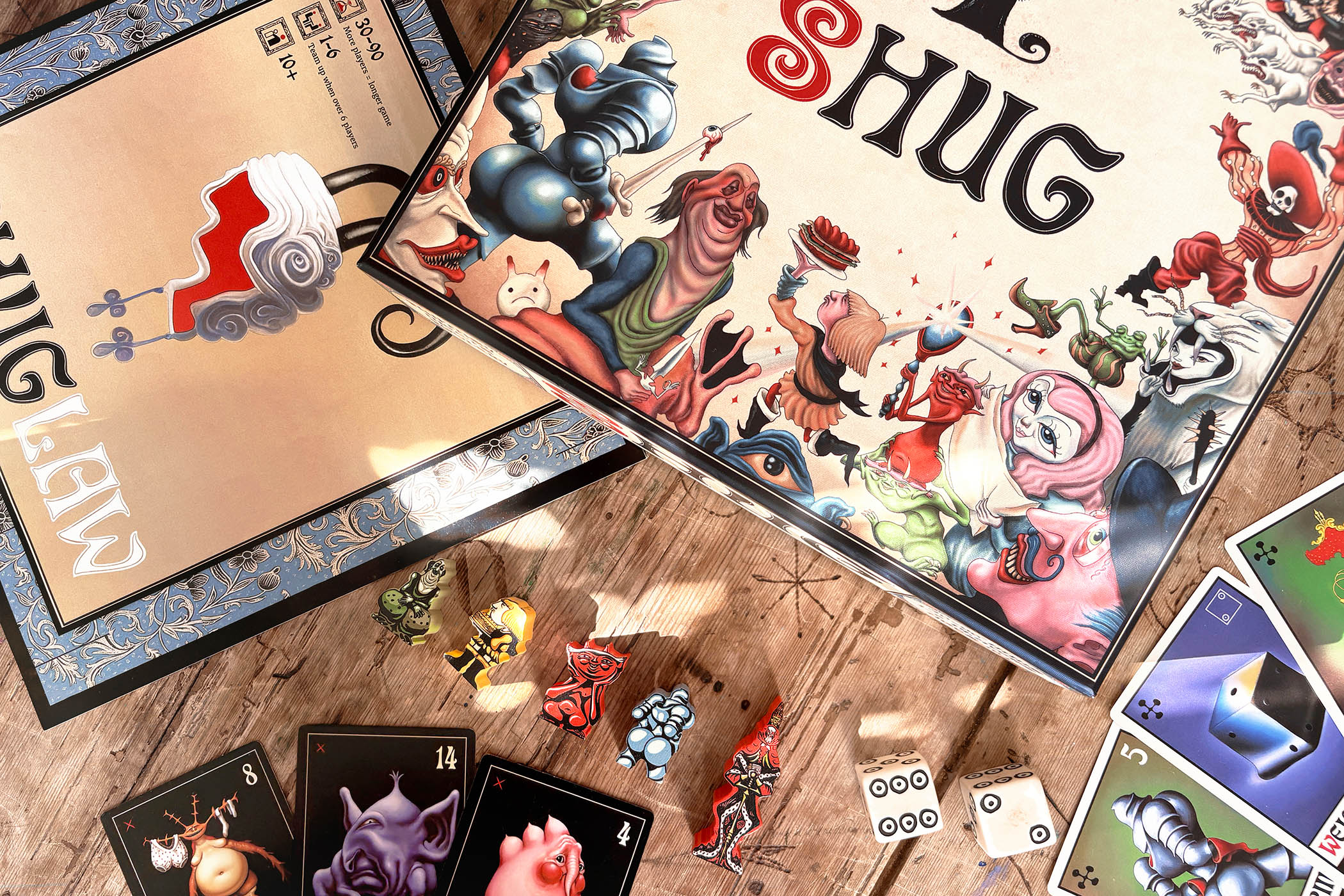
Shug is a board game, yes. But what brought me to the basement that evening was the puzzles. Miles, my colleague whose childhood friend Luke invented the game, had told me it was strewn with them. A chaotic blend of board game, puzzle and adventure quest, Shug is its own thing. You roll the dice and move across the board, searching for Shug himself – the furry, friendly creature from British folklore after whom the whole thing is named. Find him, and the next job is to get him safely to the pub. Thanks to a deck full of monsters, chaos and treasure cards, play stops being something that happens on a table and asks you to do something physical. Identify an object you cannot see. Spot a lie. Count 30 seconds in your head with your eyes closed. The fourth wall breaks repeatedly, by design.
The people taking part in this evening’s tournament spend their professional lives making puzzles for other people to solve. We had never sat down to play something together, however – so when Miles told me about Shug, I saw a chance to turn the tables; the people who set the tests on the receiving end for a change.
Shug’s challenges are not Taskmaster bits. Taskmaster pulls you back into the room; the whole pleasure lies in watching, in the slightly mortifying gap between you and your performance. Shug does the opposite. The challenges are not invitations to be observed. They are invitations to step somewhere else. My daughter is six. She wants to play imaginary games with me every day, and every day I find myself half in, half out, thinking about the newsletter I need to write, the washing I need to put on, and dinner. Shug brought me all the way back in. It pulled me through a door I keep trying to walk through and let me stay there for the evening.
Related articles:
And, crucially, the challenges are still puzzles. They are puzzles of constraint, memory, lateral thinking and social deduction – just in disguise, wearing a felt hat and a ruff.
Luke Dye-Montefiore was seven when he started drawing the original board with his brother Rufus, who was 10. Now in their 30s, they run an animation studio together. They have, between them, redrawn every card in the deck by hand, sometimes more than once. Their friend Dil, whom Luke met when he was four, is the game’s third designer. He has been part of Shug for 20 years and is credited in the rulebook as its lawyer, the person you ring when there’s a dispute over the rules.
Newsletters
Choose the newsletters you want to receive
View more
For information about how The Observer protects your data, read our Privacy Policy
“Our parents would bribe us to go outside,” Rufus tells me of their childhood. “We were just completely hooked [on designing the game].” Two and a half decades on, they have built an animation studio because they “couldn’t really escape fantasy”.
You can feel it in the deck. The creatures you meet – the Catawampus, the Salmon of Knowledge, the changeling king who rules the land – are drawn from real British folklore. Luke and Rufus have been steeped in these stories for 25 years, and every card carries a depth most games never reach.
The version they made as children was crueller than the one we played. There were cards called Sorries that punished you for losing. There were challenges that made you stand in the rain. “It used to be quite cut-throat,” Rufus says of his brother. “But Luke’s always wanted to take this space where everyone comes away from it feeling really happy and really together.” For them, the work of adulthood was not to make Shug more sophisticated. It was to take the punishment out. More room to be silly without any consequences.
Earlier on the day we played, Shug had been given the award for best party game at the upcoming UK Games Expo (UKGE), only to have it taken away within an hour – disqualified on a technicality because the game was not yet in shops. Eighteen days later, after launching on Kickstarter with a £9,000 goal, they’d surpassed £285,764.* Quite how Dil scales his rulebook lawyering to that many players, I do not know.
Something is shifting in how people choose to spend time together. Board game cafes are full again. Pub quizzes are back. The reach is for the room, not the rectangle. Shug arrives in the middle of that, but it is doing something more particular. It is opening a door most adults thought had closed.
As you read this, I am at UKGE, looking for more games like Shug. People know me as the crossword lady in the crossword dress, but I have always been about games and puzzles in the wider sense. So many puzzles cross the boundary into games, and so many games are really puzzles. There is a vast world beyond cryptics and sudokus that I have not yet explored. Shug is the start.
In the meantime, the Catawampus wants eight verb-animals. Chris and Blythe could only think of five. Can you do any better?
Did you enjoy this article? Are you good at games, keen on crosswords, sold on Sudoku? Subscribe to our Puzzle Edit newsletter, your weekly dispatch from the world of puzzles – trends, community, and the stories behind every solve
*Correct at time of publication