Two men in hard hats and harnesses with scaffold hooks are about to climb up to the pitched roof of an abandoned former postal sorting office to experiment with blocking off the skylights. Around us, in what was until a day or two ago a huge space, empty except for detritus and pigeons, carpenters are crafting wooden plinths and raising partition walls. In the distance, a slight form is guiding a large packing case through a gap that is, at best, 2cm wider. This is sculptor Sean Henry.
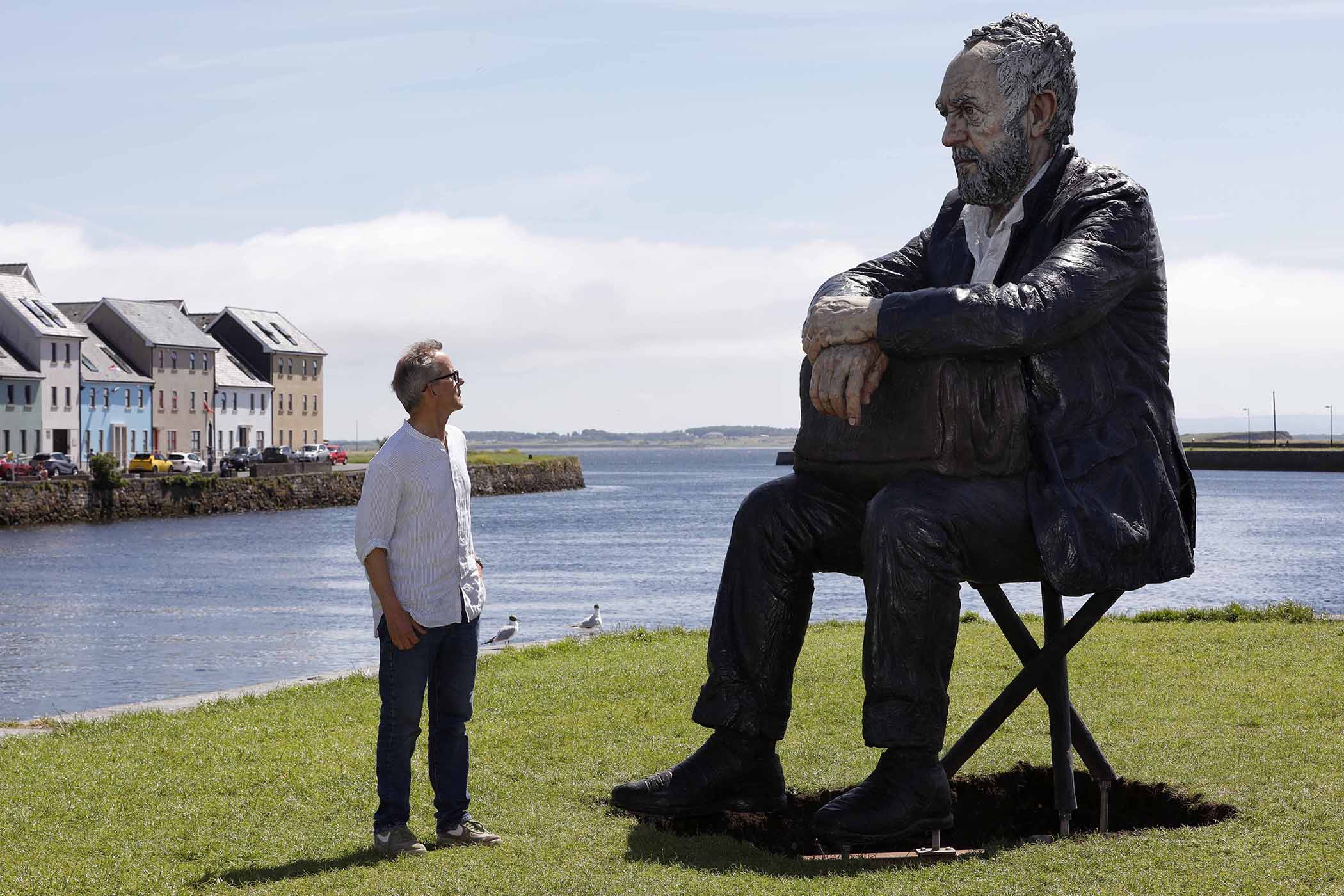
Henry is helping the team set up the main exhibition for the 49th Galway International Arts Festival (GIAF). Some of the 22 works are already in position, others are waiting for a plinth. His painted figures (some bronze, others ceramic) suggest characters caught in mid-action, mid-thought: their textured skins and rumpled everyday clothes have a portrait-like quality (the National Portrait Gallery in London commissioned a statue from Henry to mark Sir Tim Berners-Lee’s 60th birthday). The arresting realism is given poignancy by unexpected alterations of scale – from monumental (Seated Figure, three metres tall, installed, for the duration of the festival, outdoors, on Galway’s Claddagh Basin) to minimal (Hedda – inspired by Ibsen’s anti-heroine, just 15cm high).
In a corner by the entrance, a still figure hunched over a laptop comes to life, wrapping his fingers around a cup of milky tea. Paul Fahy, the festival’s artistic director, is on hand to coordinate. “One advantage of Galway being a relatively small city, without a huge cultural infrastructure,” he says, “is that we have to be creative. We work with artists to adapt spaces, or we create new ones.”
The Heineken Big Top has become a festival landmark, covering Fisheries Field, a short walk from the gallery, over the River Corrib. With a capacity for 3,800, it can easily accommodate audiences for this year’s acts, including the Patti Smith Quartet, the Saw Doctors or Manchester Legends, James. Further along the river, where it meets Galway Bay, regular visitors from Wales, the circus-spectacle troupe NoFit State, pitch their own big top for their new show Carnation.
‘One advantage of Galway being a relatively small city, without a huge cultural infrastructure,’ Fahy says, ‘is that we have to be creative’
‘One advantage of Galway being a relatively small city, without a huge cultural infrastructure,’ Fahy says, ‘is that we have to be creative’
“I love the way the festival shapes the place,” says Fahy, who grew up just outside Galway and worked at the festival as a young volunteer, familiarising himself with all its facets: music, dance, theatre, events, exhibitions, talks. “It opens up possibilities to reshape people’s thoughts.”
Galway’s central Eyre Square becomes the Festival Garden, transformed into a bustling village and performance site. “People can enjoy experiences as high art, or they can experience them for two minutes on their way to the shops,” says Fahy. “John [Crumlish, chief executive] and I work hard to welcome everybody.” This year, Compagnie PPP presents a promenade production based on Moby Dick, with giant structures, hydraulics and – be warned – water.
Fahy became director in 2005 and, in 2014, a participant, entering an artistic collaboration with the playwright Enda Walsh on Rooms. Half a dozen audience members enter a white 5x5m cube. Inside, they are immersed in a meticulously realised installation (designed by Fahy) where they listen for 15 minutes to a recording that draws them into the interior world of the unseen speaker. This year’s Room (a changing space for an under-13s Gaelic football team), features the voice of Irish actor John Olohan as a 70-year-old man whose life is unexpectedly disrupted.
Galway’s internationally acclaimed Druid Theatre Company, founded in 1975, has been associated with the festival since it began in 1978, a connection the Druid’s artistic director Garry Hynes describes as “enormously rewarding”. Fahy speaks of the company’s great qualities: nurturing not only writers, actors and designers, but also theatre technicians through its workshops and other initiatives. This year, Druid will stage a new production of The Shaughraun, the 1874 melodrama by Irish-American playwright Dion Boucicault, intended to be “illustrative of Irish life and character”.
The eponymous Shaughraun is a quicksilver figure, said to be “the soul of every fair, the life of every funeral, the first fiddle at all weddings” – a description that might be said to capture the spirit of the ever-changing, ever-evolving GIAF.
The Galway International Arts Festival runs from 1326 July
Newsletters
Choose the newsletters you want to receive
View more
For information about how The Observer protects your data, read our Privacy Policy
Photograph by Mark Steadman