

Curator’s remorse is a hidden affliction. No matter how embarrassing, it can never be acknowledged. For who can admit that when they commissioned an artist to create work for a new show, they expected something quite different than whatever emerged from the studio years later – bafflingly divergent, depressingly similar, weak pastiche, mad departure? The curator saves face by keeping loyally silent.
Not one but two artists of international repute are on show at the Hayward Gallery: Chiharu Shiota, born in Japan in 1972, and Yin Xiuzhen, born in China in 1963. In each case, the new commissions disappoint. The shortfall would hardly be so visible, however, were it not for the fact that these works are shown alongside the past art that originally made these reputations.
Xiuzhen is a recycler of ill-considered trifles. She cannot bear to see the world’s clothes thrown away. The mass-produced garments she wore growing up in Beijing are stitched into small flat miniatures of themselves that can be framed, like pictures, on a wall. Sunk into chests full of soil, they become buried treasures. Laid flat on the ground, they make tombstones. These elegiac works, some from the 1990s, are accompanied by an equally moving video titled Washing River (1995), in which the artist froze polluted water from the Funan River in Chengdu, in the Sichuan province, into blocks of filthy ice. Local people, invited to wash the blocks, try to make the river pure again as it melts away. This performance, reprised in Tasmania in 2014 and Indonesia in 2017, could alas go on for ever.
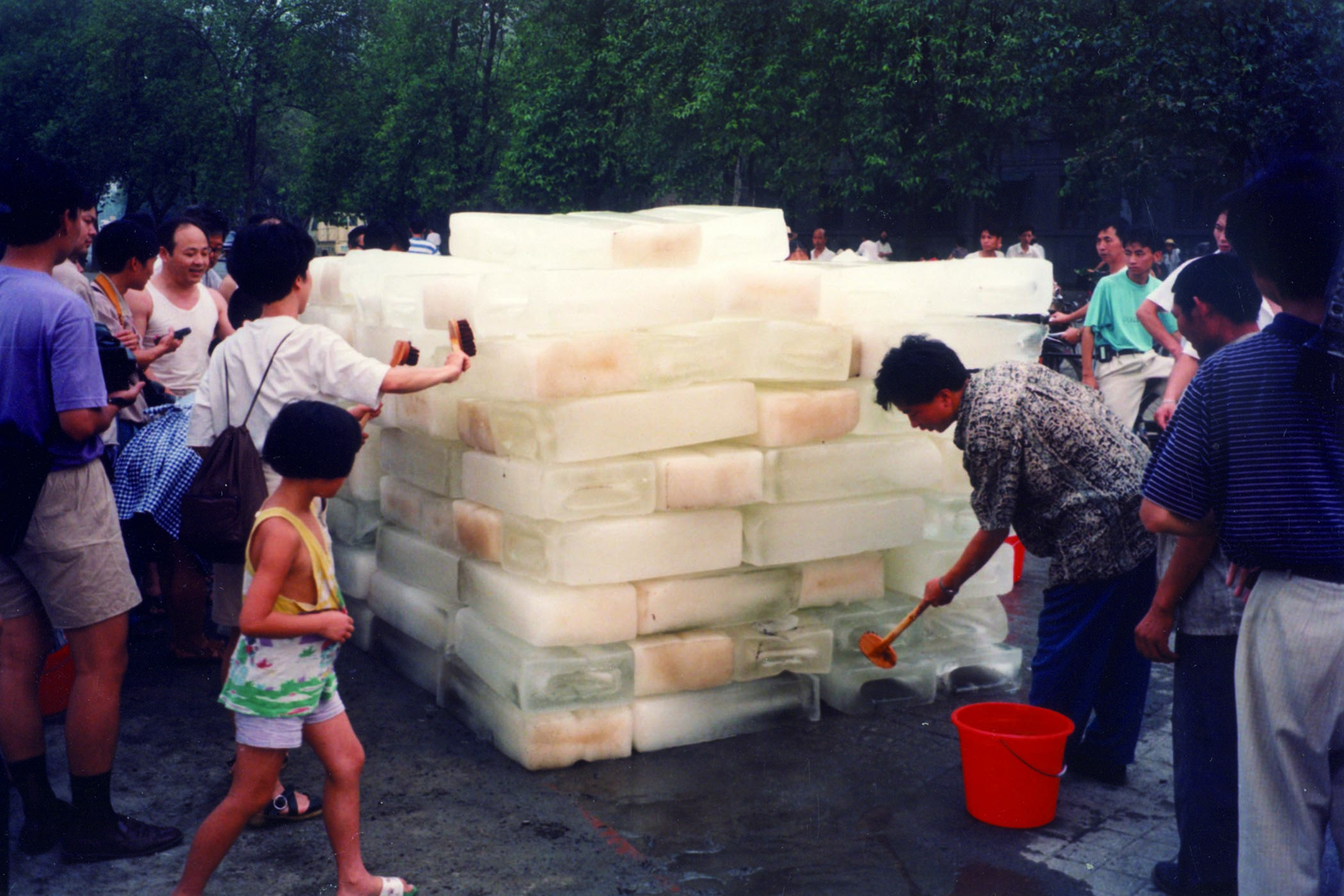
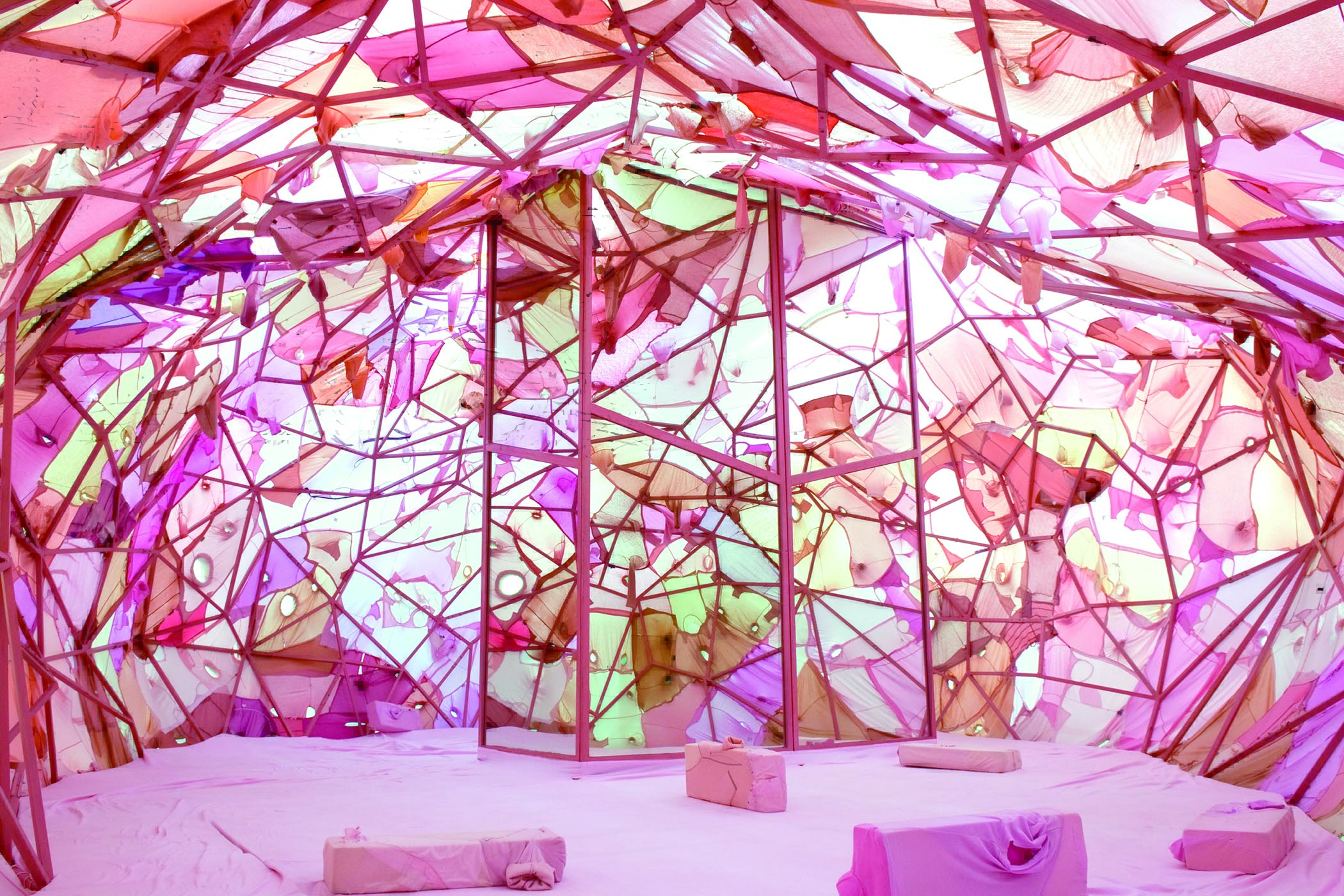
A still from Xiuzhen’s ‘moving video’ Washing River, 1995. Main image: visitors can enter her structure clothed with pink garments
There is a beautiful metaphor in this show, too, in the narrow ribbons of clothing wound tight into silver canisters that might make reels of speaking voices or films of human lives. And Xiuzhen turns clothes into a library of books. On one side of the shelves are the cloth-bound spines: rows of untitled hardbacks waiting to be taken down and read. But go round the back and you see the rest of the garments hanging loose; unexamined lives, anonymous writers and readers.
For the Hayward, Xiuzhen has made London in miniature, small enough to be packed into the suitcase that lies open before you on entry. The House of Commons is deftly stitched out of mustard jersey, with grey flannel towers. An old Beatles T-shirt stands in for the Thames. It is touching and ingenious in its stuffed and stitched softness. But then comes a baggage reclaim of New York, Melbourne, Brussels, Seoul and more. Xiuzhen has been making these so-called Portable Cities for the past 20 years.
It may be that the Hayward hoped for something more than the central piece – at least according to size – in this show. This is a vast structure clothed with garments in shades of red and pink that visitors can enter, presumably for the novelty, or the Instagram post. Nothing, bar the caption on the wall, could tell you that this is meant to be a heart. And though the Hayward has chosen to double its supposed effect in a colossal mirror, this empty idea is already an exact repeat of several installations the artist made earlier, and depressingly long ago.
Shiota, meanwhile, recycles more than clothes upstairs. She was the sensation of the 2015 Venice Biennale with thousands of keys showering from the ceiling on scarlet threads, some slipping through nets into boats straight out of Hokusai. Here they are again, this time cascading down to a door standing open on its wooden threshold. People were already snapping each other going in and out when I was there. Surely a closed door would have been more tantalising: which key would fit in that fairytale lock?
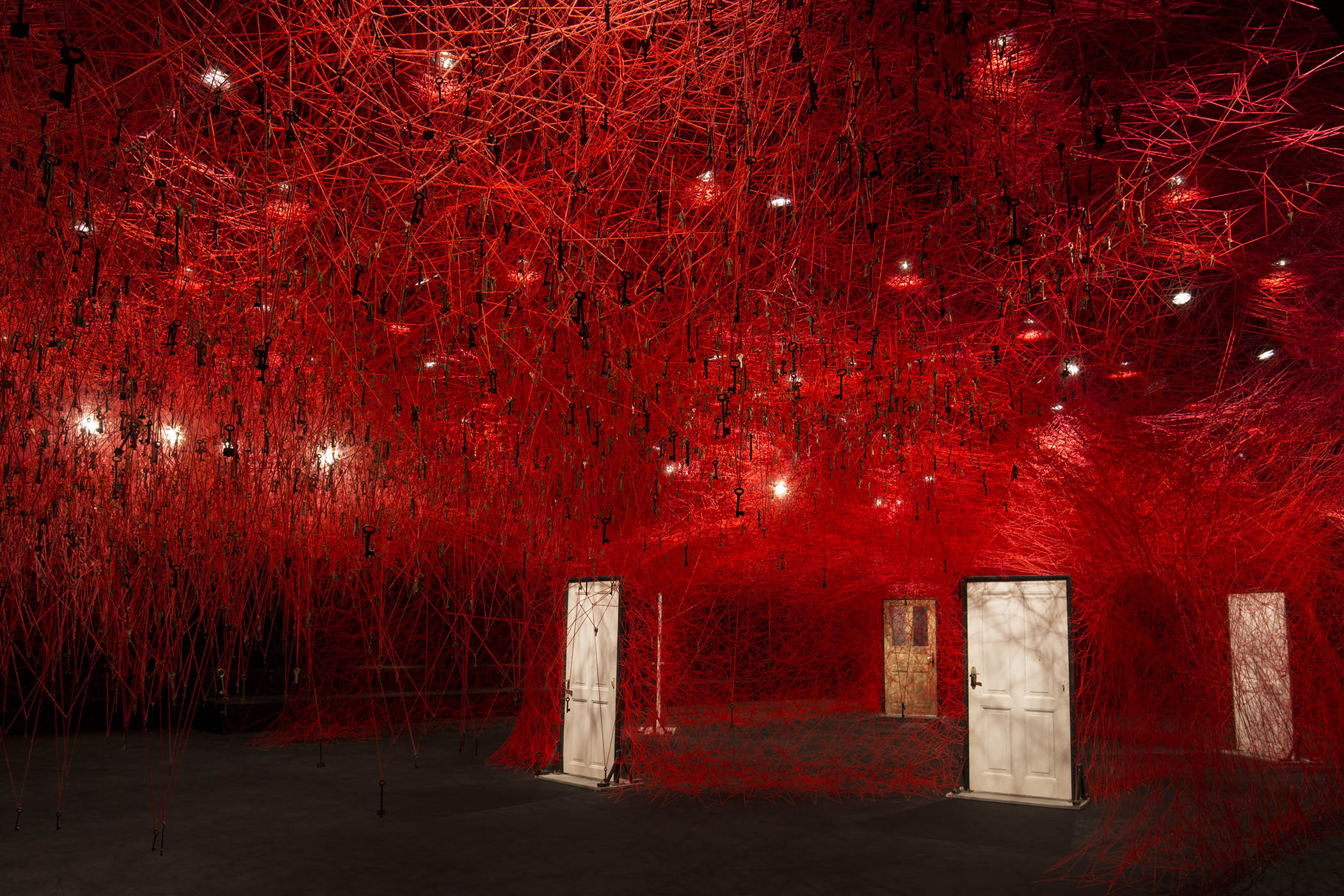
Chiharu Shiota’s ‘dreamlike’ installation The Locked Room, 2016
For Shiota’s works can feel dreamlike, theatrical. Her tornado of black threads swirling up from a grand piano can set a gallery on fire with silent smoke. Her wedding dress caught in a misty white web conjures spectres in the right place. Unfortunately the same dress, entangled in black threads, has no such presence at the Hayward.
And though the letters of gratitude that flutter through a hanging garden of scarlet threads are deeply moving – daughters to mothers and vice versa, or from the dying to those they loved – they seem to form an incidental pathway to the final immersive installation. This is a thicket of black threads surrounding a succession of hospital beds. Anyone who has ever spent time on a ward, or visiting the sick, may feel that this is far too basic a metaphor.
These are the last two shows under the Hayward Gallery’s revered director Ralph Rugoff. For 20 years, he has managed to fill the inhospitable canyons of this brutalist building with a succession of tremendous exhibitions. Who can forget the solo shows of Bridget Riley, Louise Bourgeois, Hiroshi Sugimoto, Andreas Gursky? Or the brilliant anthologies of sculpture and painting Rugoff put together – When Forms Come Alive, Mixing It Up, In the Black Fantastic? This was where one saw contemporary art from all over the world, where exhilaration met visual power and philosophical depth.
Newsletters
Choose the newsletters you want to receive
View more
For information about how The Observer protects your data, read our Privacy Policy
Very rarely did Rugoff descend to fairground spectacle or stave off the void with gigantic video screens. He has a gift for mise en scene, for choreographing visions in space, and my sense is that he is not responsible for the inflated and dismaying repetitions in these shows. An incomparable writer as well as curator, his exhibitions very often exceeded those of towering Tate Modern down the river in drama, intelligence and originality. The Hayward may not see his like again.
Yin Xiuzhen: Heart to Heart; Chiharu Shiota: Threads of Life are both at the Hayward Gallery, London, until 3 May
Photographs courtesy of the artists/Beijing Commune/UCCA/Masanobu Nishino