
A fun idea for this column. Why not listen to Prince William and Prince Harry’s recent appearances on popular podcasts and do a compare and contrast? Which of them has the wildest sense of humour? Who gets on best with the host? Who thinks quickest, confides enough, keeps the chat a-bubblin’? And thus, who can be crowned the “prince of podcasts”?
William, based in the UK, is on the US pod New Heights. Harry, based in the US, is on the UK show Joe Marler Will See You Now. In terms of spreading the brand internationally, the royal lads have done well. You note they’ve both picked a bro show. New Heights is presented by American football’s Kelce siblings: Travis, who plays for Kansas City Chiefs, and his older brother, Jason, who retired from Philadelphia Eagles in 2024. (Travis is now more famous as the new husband of the world’s biggest pop star, Taylor Swift, but – shush – that’s not important now.) Marler is an ex-rugby union player (for Harlequins) made famous by The Celebrity Traitors.
Like many straight men with repressed childhoods, William and Harry are happiest when it comes to sport; whether that’s playing, watching or doing that weird macho teasing that passes for humour among sportsmen. Harry plays polo and co-founded the Invictus Games; William is an Aston Villa fan and patron of the FA.
It was William, on New Heights to talk about the World Cup, who had the easier ride. The madly enthusiastic Kelce brothers are labradors in human form, barking loudly and amiably, asking for nothing much other than a rib-tickle and to be told they’re good boys. William kindly offered more: fluency in professional fouls and VAR controversies. “My weekend goes from being either the best weekend in the world when we win,” he said about Aston Villa. “Or I don’t want to see anyone on Monday morning because I’m really down. That lasts for quite a few days.”
Such emotional incontinence is the mark of a true football fan, as was his confessed enjoyment when Villa were relegated to the Championship from the Premier League. “I really enjoyed the battle [to get back up],” he said. “I got into that.” Travis, confused, referred to “relegation” as “regulation”, and kept calling William “prince”.
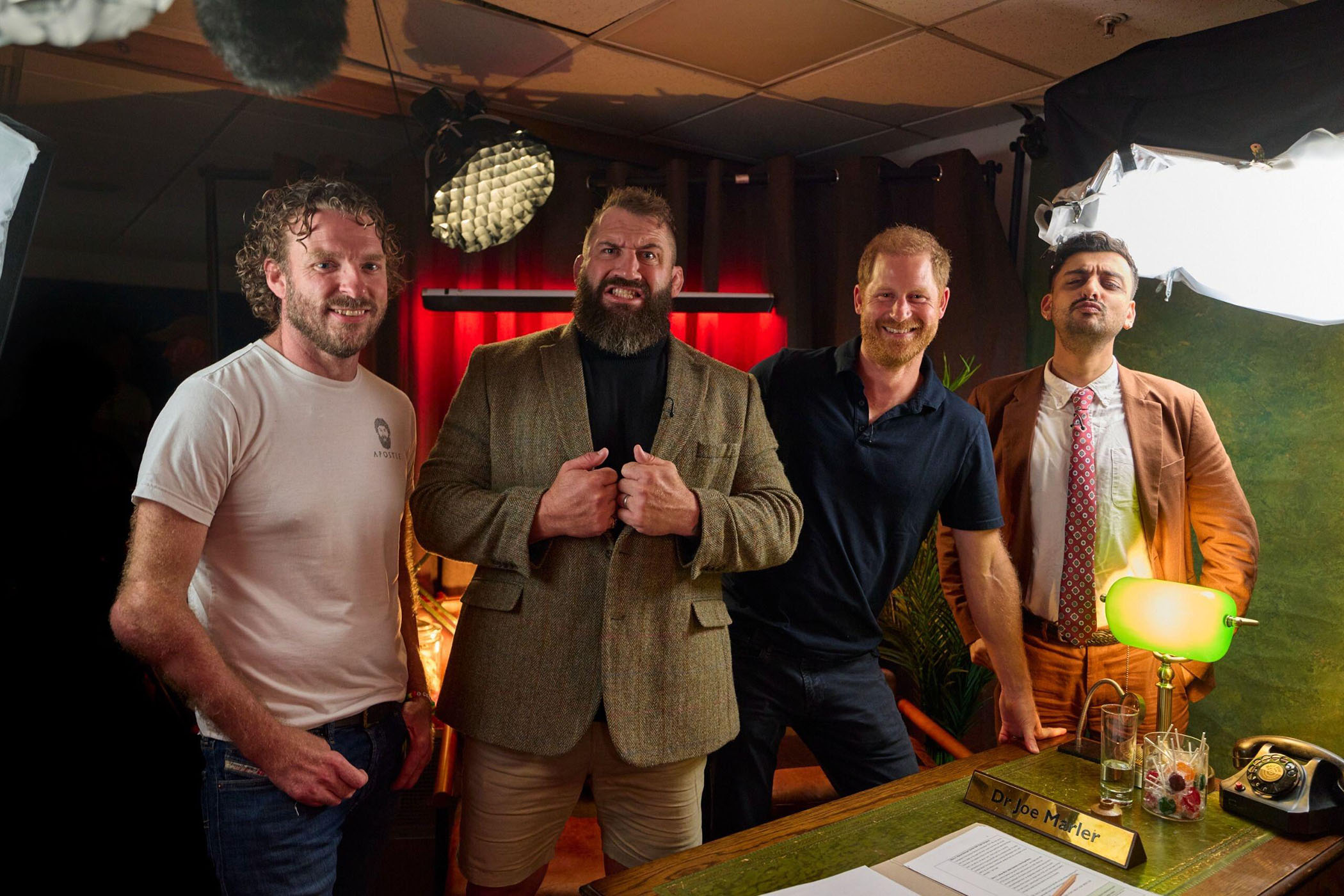
Harry’s airtime was more up and down. Though the show is under Marler’s name, it’s the comedian Jake Bhardwaj who does the heavy lifting in terms of atmosphere and jokes, despite not even sitting at the same table as the host and his guest. Harry – Marler called him “duke” – pointed out this strange situation immediately. “Why are you so far away from the desk?” he asked Bhardwaj. “So this isn’t a one-on-one?” he asked Marler.
In the end, prince and duke were better guests than either pod deserved. Perhaps they could present their own two-host show, The Podcast Princes?
In the end, prince and duke were better guests than either pod deserved. Perhaps they could present their own two-host show, The Podcast Princes?
Actually, Harry’s ability to flip straight into rugby-bloke ribbing seemed to flummox Marler. The former England rugby player is lovely but, despite all the efforts of this podcast, which has been going since last November, he is still not a great presenter. He boggles for too long, gets the wrong end of the stick and his ripostes are seconds too late. And when the pod turned into its supposed therapy session, his first question to Harry was so bad it made me switch off for a moment.
“You’ve grown up in a world that has been both incredibly public and really unusual,” said Marler. “You’ve had to face stuff arguably no one else has had to face in their life. And then you’ve had to try and navigate your way through it all publicly, not just alone, like we are privately. Later, we’re going to be joined by your friend from the Invictus Games, JJ Chalmers. What I want to find out from both of you is how you deal with trauma and find a way to move forward from it.” To which the only answer is: um, OK.
In the end, prince and duke were better guests than either pod deserved. Perhaps they could present their own two-host show, The Podcast Princes? Perhaps not. Though podcast presenter is a job I wouldn’t put past “full-time-dad-British-army-veteran-Prince-of-England-duke”-whatever Harry.
After all that, you thank God for truly interesting people such as the dancer Michael Clark, the subject of last week’s Artworks on Radio 4. “He created a new cultural language,” said presenter Nick Grimshaw, correctly. In the 1980s, Royal Ballet-trained Clark used punk fashion, club culture and contemporary rock music in his dance work to conjure an entirely new form. He created his own company, choreographed his own pieces, collaborated with Leigh Bowery and the Fall. Grimshaw, the right combination of curious and informed, spoke to dance critic Debra Craine, fellow dancer Les Child and also to Clark himself.
Newsletters
Choose the newsletters you want to receive
View more
For information about how The Observer protects your data, read our Privacy Policy
Clark, 64, spoke rapidly, banging through his life’s delights and traumas in the same even tone. About his dad, he said: “He was a fascinating, exciting, unpredictable father, but the truth was, he was drinking a bottle of vodka before he drove us to school.” About sex in his choreography: “Your body is a tool when you’re a dancer or choreographer: it’s meaningful in the context of art, but meaningless because you have to do [sexual things] without being turned on by it.”
About the critics who disliked his dances: “They’d speak about everything except the dance itself … My first review described the piece as a wanky disaster and I had that made into a T-shirt.” About addiction: “When you’ve got Sarah Lucas and Damien Hirst telling you you need to go into rehab, you listen.”
Clark now lives in Aberdeenshire. He retains his allure. Some people are interesting no matter how far they flee the spotlight.
What are your thoughts on this? Send us a letter to letters@observer.co.uk
Photograph by PA Images via Getty Images