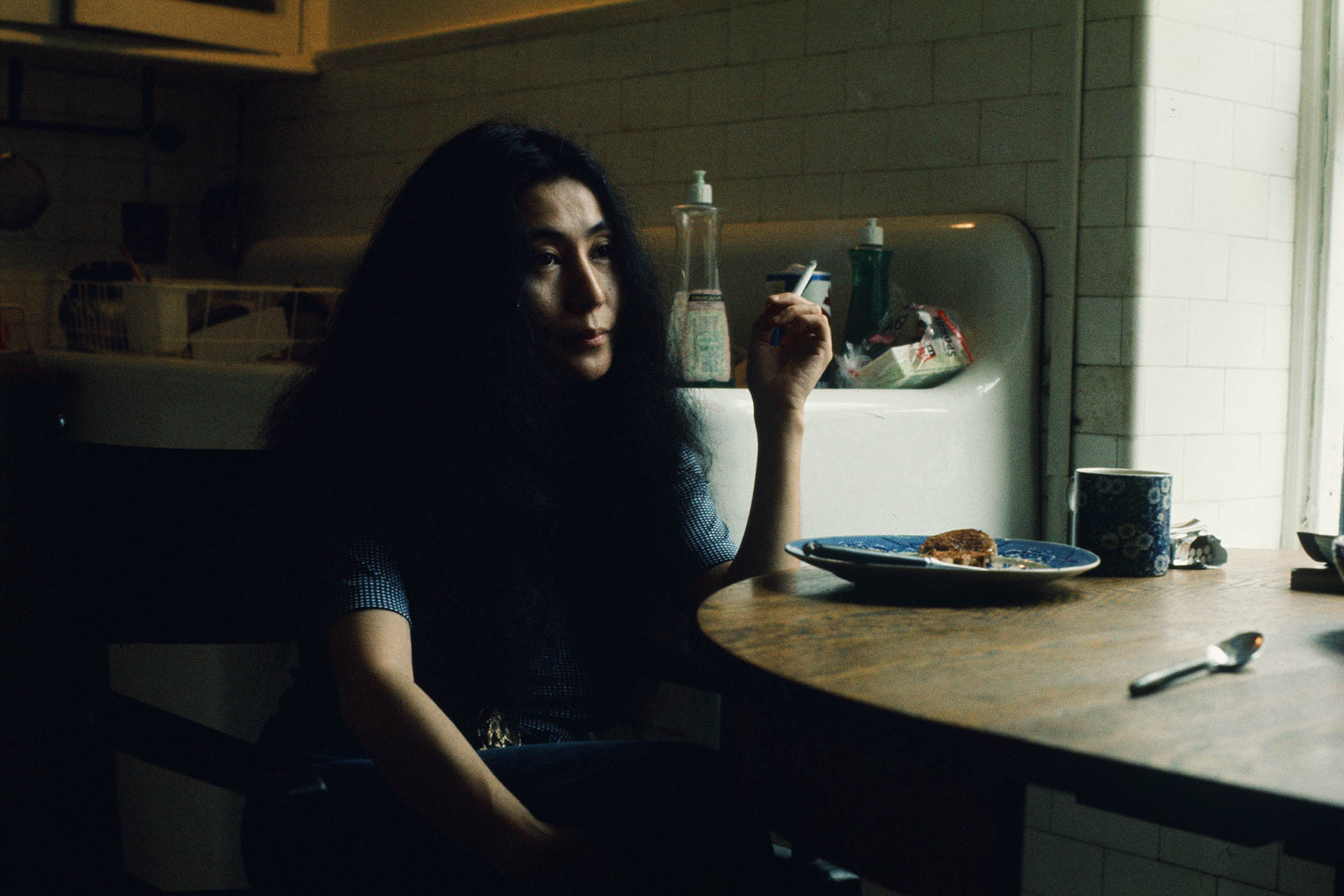


There is a particular contentment that comes at the end of a long biography – the sense that a life has been pinned down, catalogued, perhaps even solved. Yet after more than 400 pages of the celebrated music journalist Paul Morley’s new biography of Yoko Ono, I found myself unsatisfied. She remained, in Morley’s words, “at the back of the class photo, stuck behind tall, mostly male conspirators and plotters, out of focus”.
Ono’s life – when Morley does write about it – is glaringly interesting. Born in Tokyo in 1933 to a well-off mother and a banker father, she grew up for ever scarred by the devastating American fire-bombing of 1945, waking one night to what she described as “a world on fire”. From then, Morley writes that she was always trying to “take back control of reality” and “hold on to hope”. Her art is an extraordinary expression of the power of the imagination and the will to find meaning. Her father disregarded her dreams of becoming a composer when she couldn’t name a single woman who had found success in the field, but she rebelled at school by wearing trousers and playing music anyway. In 1952 – the same year allied forces ended their occupation of Japan – Ono became the first woman to study philosophy at Gakushūin University in Tokyo.
She eventually moved to America, spending three “slow, nourishing years” at Sarah Lawrence College. There, she dated a boyfriend of Sylvia Plath who, he felt, seemed cheerier than Ono. Before long she dropped out, pulled by the artistic magnetism of New York, where she formed the experimental Fluxus art scene with George Maciunas and John Cage. It was an art movement, they insisted, that wanted to remake the world.
Ono’s work is best taken on its own terms. “As with God, you had to believe it was art for it to exist as art,” Morley puts it. Her Touch Poems, which simply asked people to “touch each another”, were magic whether she staged them as “a nervous, giggly few minutes” at a nightclub or an overnight performance in a Zen temple in Japan under “noiseless stars”. Bag Piece asked participants to crawl inside a bag, in which you “become something different, identity is erased”. It seemed, Morley writes, “like the X-ray of a soul”.
The emotional centre of the book is Cut Piece, which Morley revisits through the filming of Ono’s epochal 1965 performance at Carnegie Hall. The work involved her sitting on stage, motionless, and inviting the audience to cut away her clothing with a pair of scissors. “Cut,” she said at the beginning, nothing more. Morley understands why Cut Piece was so transcendent: “Without being itself aggressive, in fact at times it was weirdly peaceful, [it] was immersion in aggression and destructive desire.” When a man cuts off her bra, “some of the men, adrenalised and charged up by their proximity to a woman losing her clothes, get back into the queue […] for another go”. The artist Carolee Schneemann slapped one of them. “She could have been stabbed,” Schneemann would later remember.
Her art is an extraordinary expression of the power of the imagination and the will to find meaning
Her art is an extraordinary expression of the power of the imagination and the will to find meaning
Here is the apex of Ono’s artistic risk, her Fluxus philosophy at its intimate extreme. But instead of acknowledging this, Morley writes with operatic flourish of how “the violence hung in the air” and would make its presence felt again when John Lennon was shot 15 years later around the corner from Carnegie Hall outside Central Park. There is no better example of Morley’s desire to digress from Ono. After her own artistic transformation, he wastes no time reframing her through Lennon’s later martyrdom.
Morley’s stated aim is to prise Ono out from under the men who have obscured her, namely Lennon (“John Lennon will not be mentioned,” begins Morley, in one of his many broken promises), and to restore her as an artist in her own right. But in attempting to situate her within the long, masculine history of the avant garde, noble though his goal may be, Morley has built yet another edifice around Ono, an architecture of reference that blocks out her light. In his telling, she must be viewed not only through Lennon, but through the histories of dadaism, futurism, Bauhaus, surrealism and conceptualism, as if her art was merely a vehicle for the ideas of others. Morley’s habit of cataloguing movements and influences means he spends less time on the harder work of grappling with the strange and unresolved nature of the art itself.
Before people turned their misogynist spite on her for supposedly stealing away Lennon, they struggled with Ono’s art too. In a late chapter, Morley tells us of the time Ono spent in a Tokyo psychiatric hospital where the avant garde scribbles she drew on the walls led them to drug her so heavily it was “dulling her senses”. Back in New York, a jazz musician named Tony Cox heard of Ono’s genius and plight, and decided to fly out to meet her. Rather fabulously, Morley reveals, he then “contrived to help her get out the facility by claiming he was a journalist and threatening the hospital director with exposure and scandal over how a famous New York artist was being held against her will”. Soon after, Ono left her first husband, the Japanese composer Toshi Ichiyanagi, for her “saviour” Cox. He became the “house-husband” who looked after their child and even encouraged her to have an affair with Lennon, letting her live out her artistic dreams. In Morley’s tome of a book, this feature film-worthy story is contained in one short paragraph.
But Morley is walking well-trodden territory: David Sheff’s adoring biography Yoko was published only last year. And besides, biography tries to fix what Ono spent a lifetime unfixing. Her art suggested that identity is always in flux, changing, unstable. In Shadow Piece, she instructed: “Put your shadows together until they become one.” Morley has certainly assembled a vast theatre of shadows here: those of Lennon, Cage, the avant garde, his own, our own. But they threaten to overwhelm Ono’s work, which does not need historical justification. Yoko Ono hoped for her art to exist outside the linear and rational. She wanted us to imagine something new and radical – to stop explaining her, and just join in.
Love Magic Power Danger Bliss: Yoko Ono and the Avant-Garde Diaspora by Paul Morley is published by Faber (£25). Order a copy from The Observer Shop for £21.25. Delivery charges may apply
Newsletters
Choose the newsletters you want to receive
View more
For information about how The Observer protects your data, read our Privacy Policy
Photograph by Koh Hasebe/Shinko Music/Getty Images