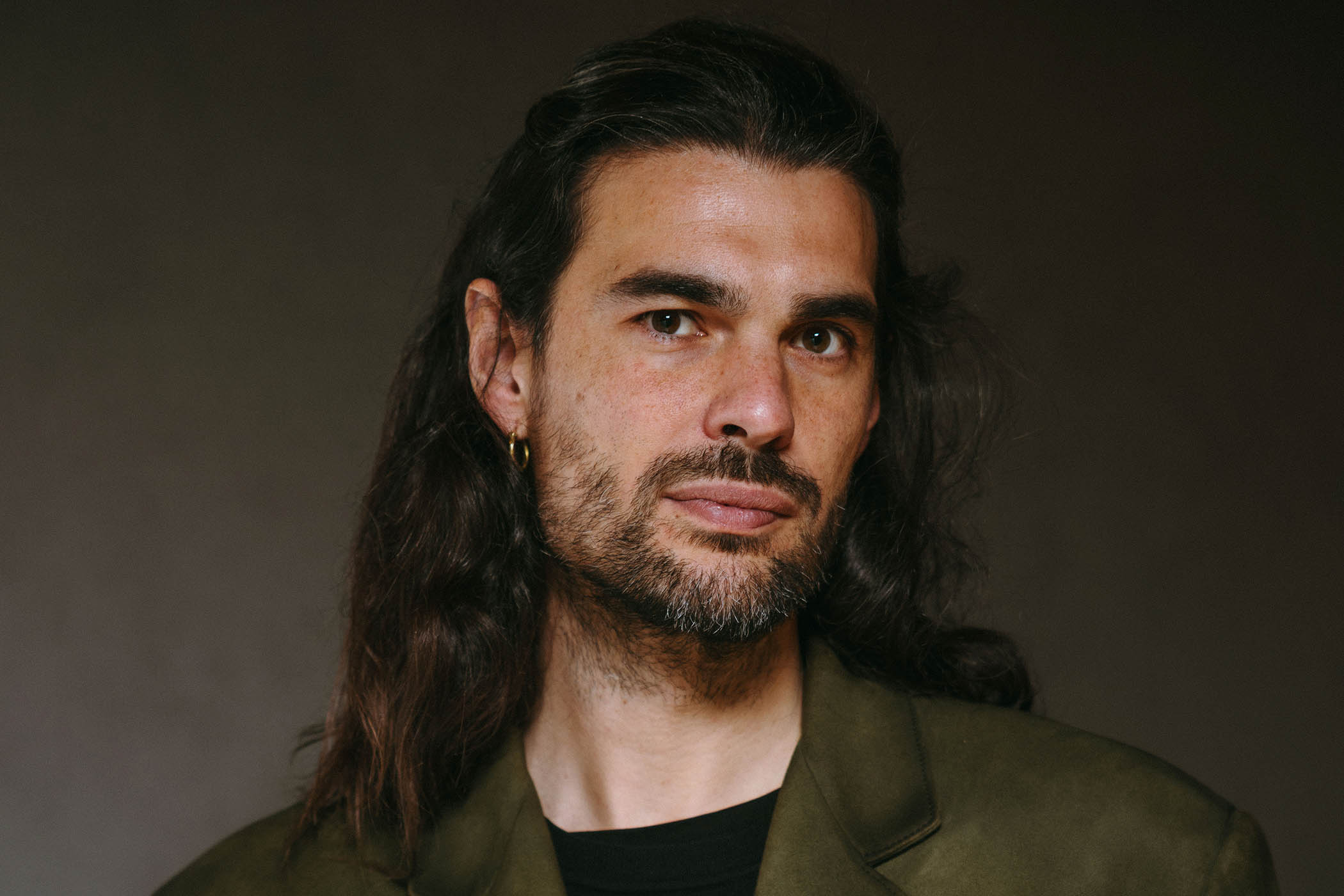

Óliver Laxe, 43, was born in Paris to Galician parents in 1982 and grew up in France and Spain. In his 20s he moved to Morocco, where he worked with disadvantaged children and shot his first two films, You All Are Captains (2010) and Mimosas (2016). His third, Fire Will Come (2019), was shot in Galicia, where Laxe now lives. His latest film, Sirāt, follows a man (Sergi López) who falls in with a group of ravers while searching for his daughter in the Moroccan desert with his young son in tow. Beguiling and devastating, it won the Jury prize at Cannes last year, topped year-end lists in the New Yorker and other publications, and is now up for two Oscars.
Sirāt has had amazing responses since it premiered at Cannes. What’s that been like for you?
The way I make films is really extreme, really going through my limits, so having these responses, it’s like life is telling me: “You have to make films.” It also shows how tired audiences are of watching the same films all the time.
Could you say more about that?
Series and franchises have too much influence on cinema today, and the result is that we have a lot of films that [don’t care about] images. So it’s the same if you watch the film in a theatre or on a plane, it doesn’t change. But people really need catharsis through art, and the cinema is a place where you can transform yourself. I see Sirāt as shock therapy. We wanted people to die watching the film. But it is a healthy death. It is the best way we found to take care of the spectators.
W hen you say you wanted people to die watching the film, w hat do you mean?
This film is a mirror [through which] you are confronted with your own death. It’s something that humans have been doing for thousands of years, in every culture: we had ceremonies where we were experimenting with death, where we were dying before dying. Now we are living in a really thanatophobic society; we are escaping from death. But when you travel a little bit and go to other countries – I was living in Africa for 12 years – you see how, when you meditate on death, you develop a level of acceptance. You are more free. So this film was made with this intention.
How did the film come about? What was the spark?
The images came first. I was living in Tangier and I had these images of trucks crossing the desert. At the same time, about 15 years ago, I started to go to raves, and that for me was really therapeutic. This is a film about the wound, so it was also a process of connecting myself with my wound.
What was your wound?
When I was child, I had [issues around] abandonment. I had a lot of love, but suddenly this love was taken away. Also, my being is really sensitive; I’m fragile. For me, just having a cut on my finger is really a trauma. So as an artist, I look for love with my films. I’m saying: “Look what I’m doing, love me.” It’s like I need to rebuild this love that I had.
This is not the first film you’ve made in Morocco. What draws you back?
I feel at home there. I’m the son of peasants, we come from rural areas [in Galicia], and the values are the same in Morocco. I feel love, light and blessings in that land, and I really like the mountains, the desert – these are therapeutic places. You feel small there. It reminds your ego that you are nothing.
The non-professional actors in Sirāt are very convincing as hardened ravers. Where did you find them?
We did a casting through raves, and we were looking for truth, for fragile people. I’m touched by ravers, because in most of society, we hide our wounds, but they show [theirs]. It’s mature.
And yet a lot of society looks down on them.
There is this idea of them as lazy drug addicts. But this is not the reality. They have strong values. They are caring. They know about plants, about medicine, about how to build things. They show their fragility. They don’t have this mask that we have in society.
How did they cope with shooting in the desert?
First they came to my home [in Galicia] for two months for rehearsals. We were building a family, building confidence, and so they were extremely committed. But the way I shoot is extreme. And sometimes during the shooting of Sirāt I was not the best version of myself.
In what way?
Making a film, you have fears. You are looking for many meanings. I’m kidnapped by the film, and the film is in my body. I’m not going to the office to make a film. No, the film is alive inside me. It’s intense.
Was this challenging for the actors?
Yeah, it was really challenging for them. But I like this fragility. It’s part of the film. It’s difficult to catch the fragility of an actor because he has a lot of tools. He knows how to build a mask. Sergi López, who is a professional actor, is good at doing this. In this case, he had to take off the mask.
Has making this film made you more comfortable with the idea of death?
I was on a plane the other day and there was a lot of turbulence, and even the people who worked on the plane were afraid. I was like, “Oh my god, I’m going to die.” But then, somehow, I heard a voice telling me, “Come on, you’re the maker of Sirāt, you shouldn’t be afraid.” And it worked. I started to breathe and to tell myself, “OK, if I have to die, I have to die.” Then the turbulence stopped.
Are you excited about the Oscar nominations [for best international film and best sound]?
I’m really excited. It’s good that a film that doesn’t take prisoners, like Sirāt, [is getting recognised]. I’ve already won just by being there. Also, it is the first time that a team of three women [sound designers Amanda Villavieja, Laia Casanovas and Yasmina Praderas] have been nominated for a best sound Oscar.
Which film-makers working today do you most respect?
I really like Sean Baker. I think he truly loves the people he’s shooting. Same with Alice Rohrwacher. Pedro Pinho had a film in Cannes called I Only Rest in the Storm, which I think is a masterpiece.
If Hollywood came to you with a big budget, would you take the money?
If I like the project, yes. And if I have freedom. And there is a red line: I only will make films that go to theatres. It’s radically important for me. Good producers from Hollywood are approaching me, and actors too. And when I meet them, I tell them that if they want to work with me, they will have to jump to the abyss with me. I want to die making my next film. Do you want to die with me? If you want to, you’re welcome. If you don’t, no problem.
Sirāt is in cinemas from 27 February
Photograph by Sebastian Reuter/Getty Images