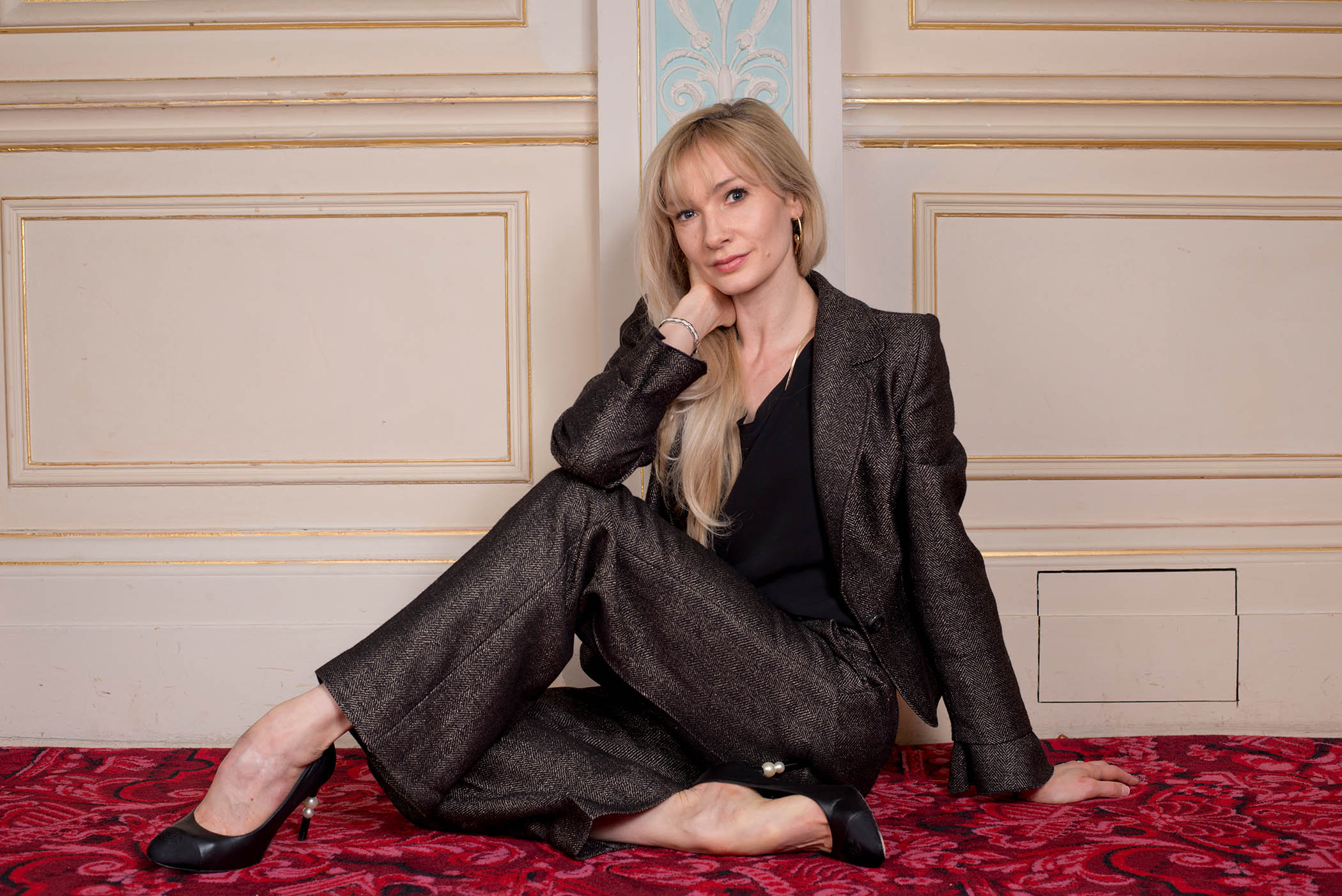

Portrait by Sophia Evans
Melissa Hamilton, 36, was born in Belfast and grew up in Dromore, County Down. She started dancing aged four, but only began professional training aged 16, which meant she struggled to fulfil her dream of becoming a ballerina. Against the odds, s She joined the Royal Ballet Company in 2007 and worked her way slowly through the ranks, making her reputation particularly in works created by Wayne McGregor and other choreographers. After two years dancing with the Semperoper Ballett in Dresden, she returned in 2017 and was finally made principal in 2024, becoming one of the oldest dancers appointed to the role. This month, she performs in Mayerling and a new work by McGregor. Principal Ballerina, a documentary about her life, is available on BBC iPlayer.
How did the BBC film come about?
The producer Tina Campbell made a film of me taking up my place at the Elmhurst Ballet School when I was 16. She started to make this film in August 2024, and when I was promoted to principal, it just took off. There’s a wonderful moment when I entered my dressing room, and my fellow dancers were there to celebrate my promotion. It was just overwhelming. In that moment I realised how much support I’d had for so many years without anyone saying anything. It was a real statement, that even when it seems like a ship has completely sailed, you can achieve something if you stick at it.
How did you feel when you were made principal?
Absolute disbelief. As a 36-year-old woman in this industry, you feel maybe it’s time to start thinking about different things. Promotion was a complete curve ball. It didn’t really alter my repertory, but for me and how I feel about myself, it’s made a huge difference. I’ve achieved my dream.
You started dancing as a young child. What made you fall in love with it?
Until I was 13, I didn’t even know it existed as a career. It was fantastical and I think it was that. The whole idea of it and the difference from what I had ever thought was possible just became a hook. It was like this magical world that no one knew about and that I had the opportunity to jump into.
You started professional training late and were always catching up. What made you stick with it?
Stubbornness. I had never encountered something that I found as difficult as ballet. Academically I was gifted and my parents thought I was set for a high-flying city job, but that didn’t challenge me. Ballet gave me a feeling of having to work to get that sense of achievement. In this career, you’re constantly aiming for something better and there’s no end point.
You say in the film that if you’d known how difficult it was you might not have pursued it…
It’s like any dream. As a young person, whenever you see a footballer or a movie star, you always see the end product and never consider the hours that go into the work, the choices you have to make to get to where you want to be. Those are the things that aren’t celebrated. Whenever people come to see us on stage, they don’t want to know how many dancers are in pain, or ill, or have blood in their pointe shoes. They’re paying to be distracted from their own troubles. But the glory moments are too many to count. They’re what you get back in moments on stage of pure adrenaline, excitement, transcendence. It’s indescribable and it’s why we’re stage junkies.
Dancing Mary Vetsera, who enters a suicide pact with Prince Rudolf in Mayerling, must be an exciting role…
I danced the role in my second season in 2008, so it’s grown with me. That’s the incredible thing with [Kenneth] MacMillan’s work. You can bring your own experiences into what you’re doing on stage, which gives it more depth every time you come back to it.
Do you think attitudes in ballet to older women are changing?
The way we train now allows us to dance for much longer. There’s also a desire to continue longer. Because of streaming, because of the internet, because of Instagram, you’re able to reach a much broader audience. Ballet feels bigger and it travels farther than it used to.
Why did you start your own production company with your husband, Michael?
I wanted to steer my pursuits into something that I felt was progression and development. I am in a full-time job with the Royal Ballet Company, so at the moment it’s small; I am concentrating on producing galas. We did our first in Singapore in 2024, then went to the Grand Opera House in Belfast. There will be one in Dublin in May then another at Grange Park Opera in summer, before we return to Belfast in October.
What did you think about Timothée Chalamet’s comments about ballet?
I’m never going to complain if ballet and opera is put into the limelight but it was quite disrespectful. If he has got himself to his position in film, he should respect different fields and appreciate how difficult it is to achieve anything in the creative industries. People should check themselves before they make flippant comments.
Dancers are sometimes accused of not engaging in the world…
When I got together with my husband, who runs a property development company, I realised how much of a little bubble I was in. Having someone beside me who has a real-world job and is affected directly by the climate of the world and the economy, I now understand a lot more of what’s happening.
There’s a lovely picture on your Instagram of you and Harry Styles. How did that happen?
I was on an absolute high from the gala that I’d produced in Singapore, and completely jet-lagged when suddenly Harry Styles was outside the studio at the opera house. I felt invincible and I just went and asked him for a photograph. I wasn’t working with him. I was just like, “Hey mate, can I get a photo? Big fan.” It was a total fangirl moment.
Mayerling runs from 30 March to 18 May