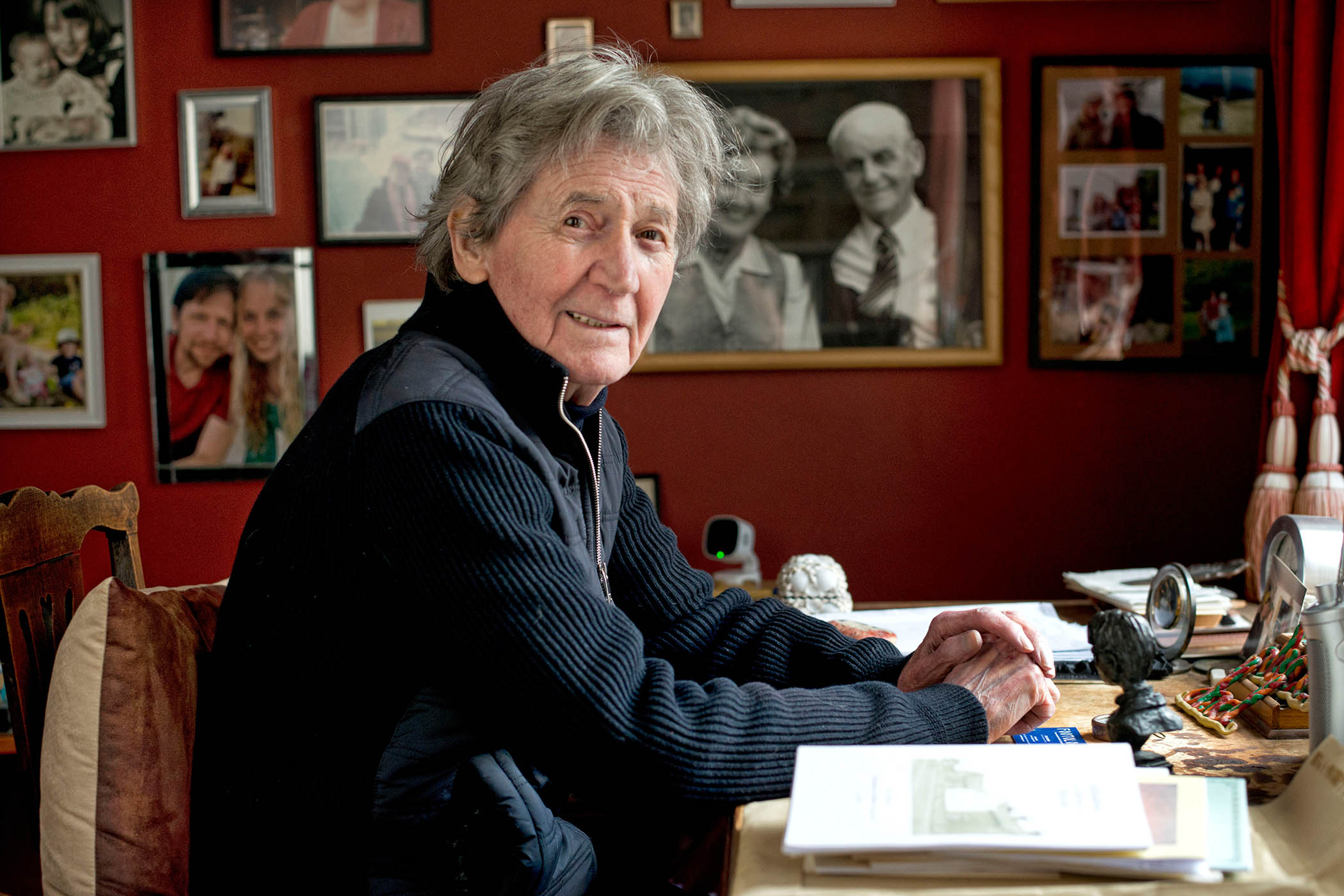

Portrait by Sophia Evans
Melvyn Bragg, 86, is a broadcaster, novelist and author or editor of 42 books who revolutionised TV arts coverage with his long-running The South Bank Show and brought academic experts to popular audiences with In Our Time, the Radio 4 show from which he recently retired after 27 years. His new memoir Another World, about his time as an undergraduate at Oxford, is a follow up to Back in the Day. He is about to begin writing the third part of the autobiographical trilogy.
The events of Another World take place between 65 and 68 years ago. Were you able to make use of diaries or other people’s memories?
Not really. I’ve got a good memory for the past, so I knew what I was trying to say, and I made jottings along the way, but there wasn’t any constructive game plan before I started to write. There was artistic licence with the dialogue, of course, although quite a bit of it was accurate. When you think very hard about things, a lot of it comes back. So I would say the conversations I recall were erring on the side of truth.
There is a dreaming spires nostalgia about Oxford that is associated with memoirs about student life there. Were you conscious of that trap?
I didn’t consider it. You can’t go to Oxford and wander around without being struck by what a beautiful, extraordinary place it is. I would challenge anybody not to think that, especially the better you get to know it – the back alleys, the shortcuts, the domes, the college greens and so on. It’s a wonderful place, one of the greatest in the world.
The woman who haunts these pages is ‘Sarah’ or Joan Martos as she became, your girlfriend from Cumbria while you were at Oxford. There is a powerful sense of love lost and the road not taken. Was that emotion you had to try to recall or did it live on in you?
That lived on in me. Joan came to Oxford two or three times and was well liked by all of my friends, but she didn’t want to go down that road, the dinner parties and long dresses and all that sort of thing. And so she moved away, which is a great shame for me. I missed her a lot. Had she stayed I think [our relationship] would have had a good life. We both thought so later when we talked about it. We kept in touch and talked every week until her death.
You write about the rich legacy of the industrial revolution in working class communities, lamenting that it was ‘allowed to wither away – unused oil, untouched coal’. Are you a critic of net zero policies?
I have very strong reservations about them. I feel that we are wasting some of our greatest assets. The coal in the north-west of England is anthracite, the purest, best coal you can get hold of. And some of the mines are still open, but they’re not used. The local council says we can’t use them because of the one milligram of pollution compared to the millions of milligrams in China. On the other side of the country, in the North Sea, there’s gallons and gallons of oil just waiting. Sooner or later, somebody like Norway will dig deep for it and we will all say, oh, dear, we should have done that.
Do you think the working class have been ill-served in literary culture?
Yes I do, it’s one of the reasons I write. They’re the most powerful and driving class in the country, and they’ve been more or less totally neglected in any attempt to get the truth of what they’re like. The variety of thinking and achievement was and is enormous and I think it’s distressing the way they’re dismissed as uncouth and racist.
You retired from In Our Time last year after 27 years of presenting. Was that a difficult decision?
Yes it was but there comes a time when you just think, I better go before I’m pushed. It coincided with one or two other things in my life, and I think it was accelerated by the fact that a year or two before, I had a severe throat infection, which meant that, however many Strepsils I swallowed, my voice still sounded thin and I was fed up with that. So I thought, it’s a signal. It’s about time to move on.
You started work at the BBC 65 years ago. Can you see the institution lasting another 65?
Well it’s not doing badly, and in some areas it’s very good. How it will fare in the future, God only knows. There’s too many people against it now. It’s a very big fat beast, and people want slices of it. They see the BBC as getting in their way and making a very successful job of the broadcasting they do. And as long as the BBC holds its integrity, that will be the case. One doesn’t know how long it will hold its integrity but they’ve got some very good people and some excellent programmes.
There’s a great anecdote in the book about you phoning Ingmar Bergman late at night to give him an idea for a film. How much was that call a reflection of the brilliance of the idea or the amount of alcohol you’d consumed?
About 50/50, I’d say. I was walking uphill for three miles in the middle of the night in the middle of north Cumbria burning to talk to Mr Bergman. I’d spent time with him in Munich for an episode of The South Bank Show and I think his work as a film director, writer and a gatherer of people is unparalleled.
You talk in the book about Bergman giving his life to his work. You seem to have packed a lot in yourself. Has work dominated your life?
Oh yes, and happily so. I worked hard at school and at university. It’s always been there. Some people say that by doing broadcasting, it lessened the effect of my writing, but you just have to put up with that and get on with what you want to do. Obviously the things that matter most to me are my wife and children.
Another World by Melvyn Bragg is published by Sceptre