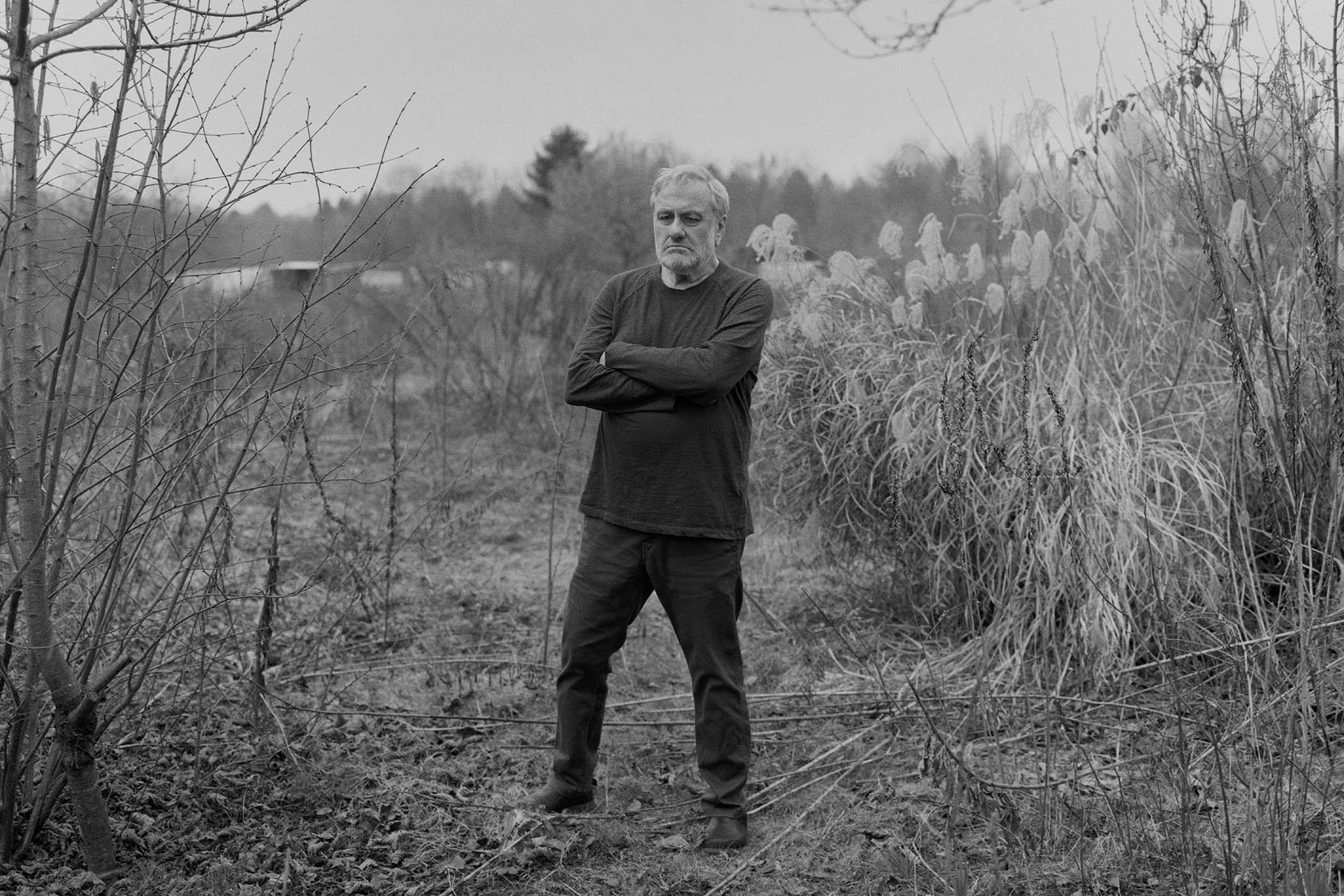
Portrait by Klemen Ilovar
Slavoj Žižek dreams of bureaucratic complications. It usually goes something like this. There’ll be an appointment with a friend, but the friend isn’t there. Žižek phones them up, but there’s been some misunderstanding, he’s got the wrong address. He gets a cab, arrives, but the friend is back where they started. Perhaps he has to fill out a form, though he won’t know why. It goes on, the anxiety mounting, until, at last, having threatened to retreat for ever, the day finally breaks. Žižek dreams a lot; he increasingly needs his sleep; he’s 77.
You should never wish Žižek a happy birthday, a mark on the calendar he attempts to eradicate with Stalinist determination. But the Slovenian philosopher has led a storied life. For better or worse, Žižek is among the world’s best known public intellectuals, and has remained so for decades. He’s written dozens of books, ran for public office, married a model three decades younger than him, divorced a model three decades younger than him, served in the army, delivered countless speeches and seminars, looked in hope towards a post-Soviet world, looked back at Soviet history for traces of the hope that didn’t come, met Jacques Lacan, fallen-out with Lacan’s disciples, failed to become a film-maker, starred in multiple films, become a meme.
We’ve arranged to meet outside Žižek’s apartment complex in Ljubljana. He’s impressed by my punctuality and cheerily repeats an old Lacanian joke. “My fiancee is never late for an appointment, because the moment she is late, she’s no longer my fiancee.” Žižek has had the same physical tic since adolescence. Every few seconds he sniffs, wipes his nose and flaps his T-shirt to air out his midriff.
Unexpectedly, I’m invited in. His wife, the academic Jela Krečič, has instituted a ban on journalists entering the flat, but today he seems happy to make an exception. Žižek used to delight in showing reporters his shabby home, proudly opening cutlery draws to reveal folded underpants and complimentary airline socks. Previous visitors have described the otherwise bare walls redeemed only by a picture of Stalin and a poster for the 2010 first-person shooter Call of Duty: Black Ops. But Žižek moved roughly 10 years ago and I’m oddly disappointed to find that his new flat is actually rather nice. The light is blossoming through the windows and everything is pleasant and well balanced. Then, after a brief tour, we arrive at Žižek’s “fetish room”.
I am afraid of knowing too many well-known people, because then you have obligations
I am afraid of knowing too many well-known people, because then you have obligations
“This is inaccessible to everyone,” he says at the door, beckoning me into a space packed, top-to-bottom, with his own work. He’s kept every publication that’s ever carried his name, and stored them here in mint condition, in all their multitudinous translations. “This is one of my nasty, narcissistic dreams,” he says, proudly. Žižek once told a documentary team that he’d rather be ignored than accepted, though he’s never been either.
Settling in the living room we get started on a discussion about the breakdown of the liberal order and the soft-fascism now sweeping the globe. But first, a brief detour about anal sex with people’s mothers. “Dear mother,” Žižek recalls writing for someone who requested a lewd autograph, “I screw you up the ass in a dirty toilet full of urine.” Inexplicably, the recipient felt he’d gone too far.
Žižek’s stubborn crassness is fundamental. Whether it’s an adopted trait is hard to say, but it’s always there, it may even be involuntary. His obscenities can be affectionate. Before he goes to sleep with his wife, for instance, he confirms his love by whispering “Drop dead bitch, drown in your own shit”. Once he was low on energy and opted for a more traditional, “Goodnight my love”. His wife panicked and asked if he was considering divorce.
Žižek has been working on a new book. He works a lot. Once a “German idiot” asked him his favourite motto and Žižek answered “Arbeit macht frei”. “It’s true…” he explains, “it’s the Nazis who brutally misused it.”
His new book is called Liberal Fascisms, and argues that the postwar liberal consensus has collapsed, and that the catastrophe of Trump’s second term constitutes a “total rupture” where “normal standards are suspended and all categories and expectations will have to be thoroughly remade”. So what comes next? It takes me three consecutive tries to get a more-or-less straight answer.
Newsletters
Choose the newsletters you want to receive
View more
For information about how The Observer protects your data, read our Privacy Policy
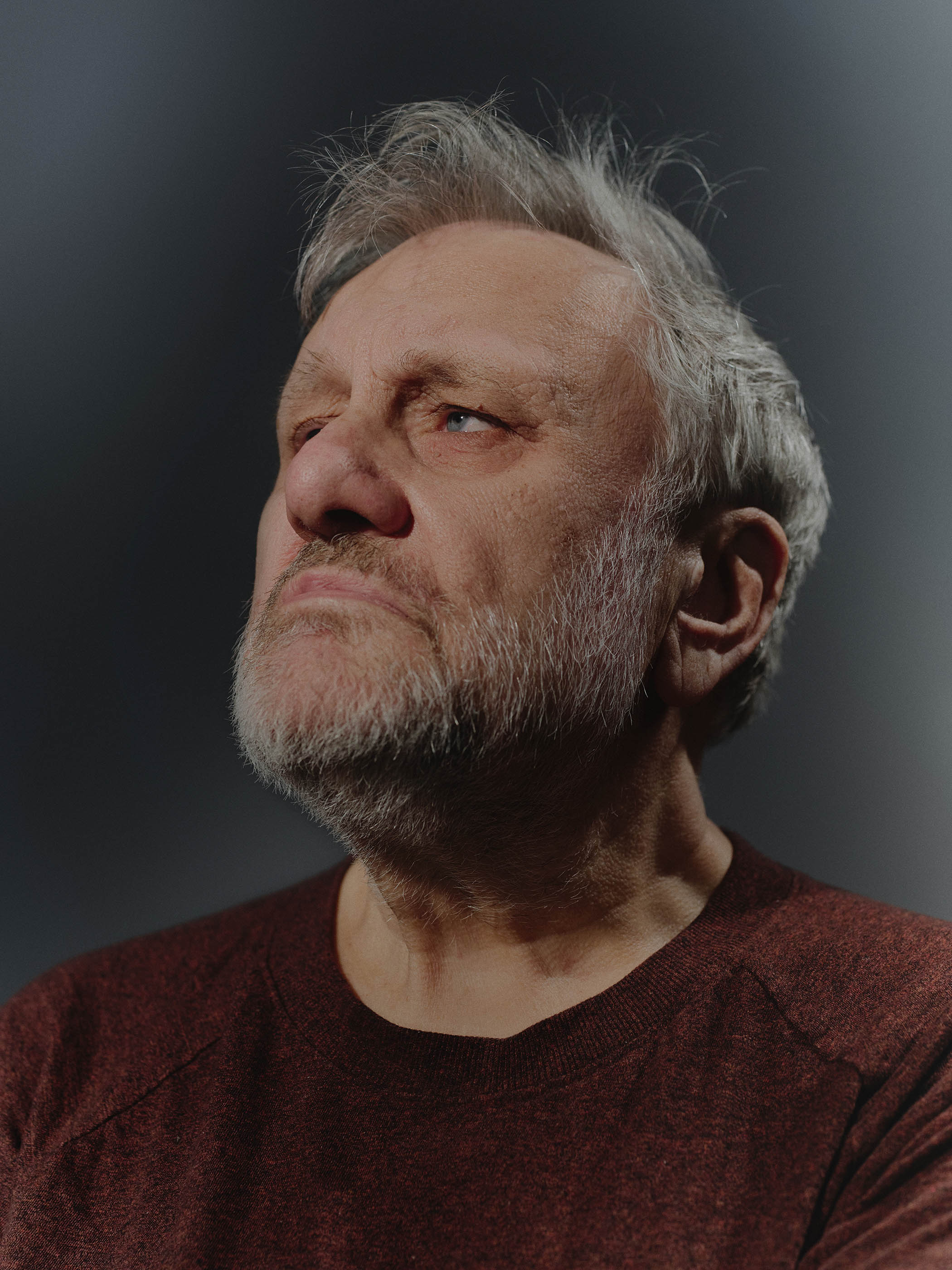
Slavoj Žižek photographed in Ljubljana, Slovenia, February
“Trump is not the only option. Trump is one variation,” he says. “Trump is literally a fascist liberal. That’s, for me, what’s so interesting about Trump… look at Steve Bannon: he said ‘destroy the state’, ‘diminish the role of the state’... was the state ever stronger than it is now in the US economy?” After that Žižek goes off on a tangent about Belgian laws prohibiting flatulence.
In Liberal Fascisms, Žižek writes that “Trump today is not fascism with a liberal mask, but liberalism brought to its (fascist) conclusion”. Is he saying that liberalism inevitably leads to fascism? “I wouldn’t go so far… but I think we underestimate this. Mussolini is a clear case here. His fascism saved capitalism in Italy… today more and more we have a tension between capitalism and bourgeois multi-party democracy.”
Žižek is a communist but, like most communists, his ideology is contextually situated within the opaque boundaries of consumer capitalism and can therefore be hard to express in definitive terms (it’s like he says, quoting Fredric Jameson, it’s easier to imagine the end of the world than the end of capitalism). Nevertheless, Žižek defines himself as a “moderately conservative communist”, although he’s deeply pessimistic about the future of the left, and doesn’t see a viable alternative to the encroachment of far-right authoritarianism, particularly not in the UK.
“What do [the left] do if they take power? Return to old social democracy? That’s basically Corbyn... That Zarah Sultana, she’s crazy. As a Stalinist I would say, ‘Here, one-way ticket to gulag’.” The MP for Coventry South is the second person (including myself) Žižek has sent to the gulag since we sat down, and probably won’t be the last.
Žižek has been criticised for contradicting himself. But contradictions are his style. He thinks, as Hegel (his hero) implores, dialectically. Trump is a liberal fascist paradox. Saudi Arabia is the only country in the world without corruption because it embodies corruption. Žižek still likes the EU because it “guarantees certain minimal rights”, but also writes that the EU has reached an “ethico-political low” in the wake of Gaza.
Eventually, Žižek’s wife comes home and we have to move to a local cafe. On the way downstairs, Žižek turns to me and says, quite matter-of-factly, “I don’t think liberal democracy will survive”.
Zižek is probably the second most famous Slovene outside of Slovenia. About an hour’s drive from Ljubljana, in the village of Sevnica, there have been two attempts to build statues of Melania Trump (formerly Melanija Knavs). The initial statue was made of wood, but was set on fire. Žižek was asked to speak at the unveiling but declined. Its bronze replacement was subsequently stolen. The first lady rarely mentions her Slovenian roots and has made no official visit since her husband was re-elected president. Before the interview, I had asked my host to watch Melania’s new documentary but he wasn’t keen.
Unlike the first lady, Žižek is deeply enmeshed with Slovenian society. He was part of the underground intellectual counterculture in the 1970s and 80s and wrote a widely read column in weekly magazine Mladina. In 1990, he stood for the country’s presidency and gained almost 10% of the vote. Which wasn’t bad given that, two weeks before the election, he tanked his chances (on purpose, apparently) by telling an interviewer that his hero was Pol Pot.
The year before his presidential bid, Žižek had published his first book, The Sublime Object of Ideology, widely acknowledged to be his masterwork: a melding of Hegel, Marx and Lecanian psychoanalysis. The book was precipitated by six years studying under Jacques-Alain Miller in Paris. At one point Miller, who married Lacan’s daughter Judith, introduced Žižek to his famous father-in-law, but Lacan was senile by then and barely even registered his existence.
I ask if he found this disappointing.
“In a way it wasn’t,” he says. “Because I am afraid of knowing too many well-known people, because then you have obligations.” Later, during our chat, he receives a call from a man he describes as the “former Mandelson of Slovenia”. “Interview!” he half-shouts down the phone along with some more rushed Slovene, “OK fuck you, fuck him,” he continues, hanging up. No obligations there.
From the late 1990s onward, Žižek went global. By the following decade he was packing out auditoriums, speaking to a generation of curious millennials, then still fresh-faced and full of lovely hope. In Argentina, they set up a Žižek club night. “It was somewhat of an inside joke,” one of its founders told Billboard, “Slavoj Žižek was kind of a rock star in Argentina.” In 2005, he married the 26-year-old Argentine model and Lacanian scholar Analia Hounie. He was 56 at the time. A few days before tying the knot, Žižek fled to Uruguay, but he was convinced to return and walk up the aisle to Shostakovich’s 10th Symphony (supposedly a musical portrait of Stalin). The marriage didn’t last.
Then, a few years later, the financial crisis hit, and disenfranchised young people in the west turned to Žižek for answers.
“We are not dreamers,” Žižek told an assembled crowd at Zuccotti Park in New York, during the height of Occupy Wall Street. “We are awakening from a dream that is turning into a nightmare.” The speech concluded with a warning: “The only thing I’m afraid of is that we will someday just go home and then we will meet once a year, drinking beer, nostalgically remembering ‘What a nice time we had here’. Promise yourselves that this will not be the case.”
That largely was the case. Almost all leftist movements to have sprung from the post-2008 wellspring failed in the 2010s. Meanwhile, Žižek became YouTube’s philosopher, just as the platform started to be dominated by rightwing content. This process reached its zenith at the 2019 “Debate of the Century”, where Žižek faced off with Jordan Peterson in front of 3,000 people at the Meridian Hall in Toronto. Current Affairs magazine called it “one of the most pathetic displays in the history of intellectuals arguing with each other in public”.
And now here we are. Žižek’s still famous, but he says the New Left Review and the LRB and the Guardian don’t want to publish him any more. He’s also had his share of criticism from his contemporaries. John Gray wrote a scathing response to Žižek in the New York Review of Books. However, when I contacted the British philosopher Simon Critchley, he was quite measured. “Philosophers are awful narcissists,” he wrote via email, “and they hate it when other philosophers get more attention than they do. Every academic philosopher dreams of the popularity enjoyed by Žižek and they resent him because he has it. I think ‘academic seriousness’ is a fraud meant to disguise thinkers who are usually pretty boring. And to be clear, I say this as a public enemy of Žižek.”
One thing you cannot criticise Žižek for is being boring. Moreover, his work is often, by design, approachable. He loves movies and often uses them to underline his ideas. His own films, The Pervert’s Guide to Cinema (2006) and The Pervert’s Guide to Ideology (2012), both directed by Sophie Fiennes, are genuinely entertaining in their analysis of blockbusters and Hollywood classics. One of his favourite films is Chaplin’s City Lights, a movie in which a wretched outcast is finally recognised and (perhaps) loved for who he is. Žižek recently returned from shooting a third instalment with Fiennes, The Pervert’s Guide to Utopia, in Scandinavia.
Žižek begins pontificating about film. He likes Ryan Coogler’s Sinners. “Vampires versus zombies is class struggle,” he explains. “Vampires are these rich aristocrats among us. But [in Sinners], vampires are egalitarian. You sing blues, vampires come, who tell you, join us, any race, sex, it doesn’t matter. This is what fascinated me.” The other day he went with his wife to see Emerald Fennell’s adaptation of Wuthering Heights in the cinema – he enjoyed that too.
I ask if he’s a romantic.
“Totally romantic,” Žižek says emphatically. “I believe in full commitment… sex without love is basically like masturbating with a real partner… I never have one night stands.” In Paris in the early 1980s, a failed love affair left Žižek depressed and suicidal. That was the only time he tried psychoanalysis. “What saved me was the pure power of ritual,” he says, citing how he decided not to kill himself in order to keep his appointment with the analyst.
Pretty quickly he also realised that, if he never stopped talking, the analyst couldn’t ask him any difficult questions, an approach he appears to have carried with him into later life. Žižek has never taken drugs. He doesn’t really drink either. He once experimented with a glass of Baileys but was too traumatised to continue drinking it after finding out it was a drink for English spinsters.
Lost loves stagger Žižek. But he tells me that he barely reacted when his parents died, especially his father, who he didn’t like and found controlling. When he got the call that Jož e Žižek had died, he answered, “Is everything arranged?” Then he put the phone down and carried on working as if nothing had happened. Likewise, he has never visited his mother’s grave. “My mother was too intrusive…” he recalls. “I also disliked [her].”
Žižek prefers not to think about his own legacy. “The moment you get into this you are lost.” Then, quite suddenly and, as far as I can tell, sincerely, he asks me why people think he’s crazy.
I reply that he’s sort of billed himself as crazy. Fourteen years ago he proudly told the Guardian, “I live as a madman!” People have compared him to Diogenes of Sinope, the ancient Greek thinker who, along with assisting the foundation of cynicism, slept in a barrel and shat in the street. When students used to ask Žižek for advice, he’d cite his madness to make them leave him alone.
“What do we mean by mad!” he shoots back. “Mad is, for me, in today’s world, non-cynically naive… I try to be mad in the sense that I really mean what I say.”
According to Žižek, the most subversive thing you can do is take something literally. “Fuck deeper meaning,” he continues, after another tangent. “Hegel knew this, he said ‘remain on the surface’. Truth is always at the surface… That’s why I like that series with Gillian Anderson; she was very fuckable when she was young… what was that series, my God?... Two guys… David Duchovny…”
He draws a blank. But he’s thinking of The X-Files – the truth is out there.
Liberal Fascisms is published by Bloomsbury Academic (£9.99). Order a copy from observershop.co.uk for £8.99. Delivery charges may apply